
Novelties · Watches
Bremont Supernova: A Perpetual Calendar in Black Orbit
The Supernova Perpetual Calendar GMT Monopusher brings Geneva-developed complications, British assembly and sharply geometric design together in an Ultra Black edition limited to just 20 pieces worldwide.
At a Glance
- Clearly assigned controls: The perpetual calendar accounts for varying month lengths and leap years, while the crown-integrated pusher advances the GMT display in one-hour increments.
- Architecture over classical calendar styling: A 41mm DLC-treated 904L steel case, a ten-sided ceramic bezel and orbit-inspired displays define this 20-piece edition.
- Developed in Geneva, assembled in Britain: Agenhor created the calendar-GMT module exclusively for Bremont and trained the watchmakers at The Wing to assemble the complete movement in the UK.
A perpetual calendar need not look like an exercise in classical watchmaking. Bremont places the venerable complication in a different visual world: black surfaces, angular contours and displays that draw on the globe and the Moon. The new Supernova Perpetual Calendar GMT Monopusher pairs a perpetual calendar with a second time zone, housing this mechanical complexity in an emphatically architectural case.

Following its appearance in the Altitude Perpetual Calendar GMT Monopusher, the combination now joins the Supernova collection. Introduced in April 2026, the line sits at the top of Bremont’s range and takes inspiration from the forms, structures and technical challenges of modern space exploration. In this 20-piece edition, that design vocabulary provides a distinctive setting for sophisticated calendar mechanics.
An architecture in black
The 41mm case is made from 904L stainless steel with an Ultra Black DLC treatment. Its sandwich construction draws on Bremont’s signature Trip-Tick architecture, topped by a faceted, ten-sided black ceramic bezel. Brushed and polished surfaces catch the light differently. The watch is offered with an integrated 904L steel bracelet or a black rubber strap with an adjustable double folding clasp.

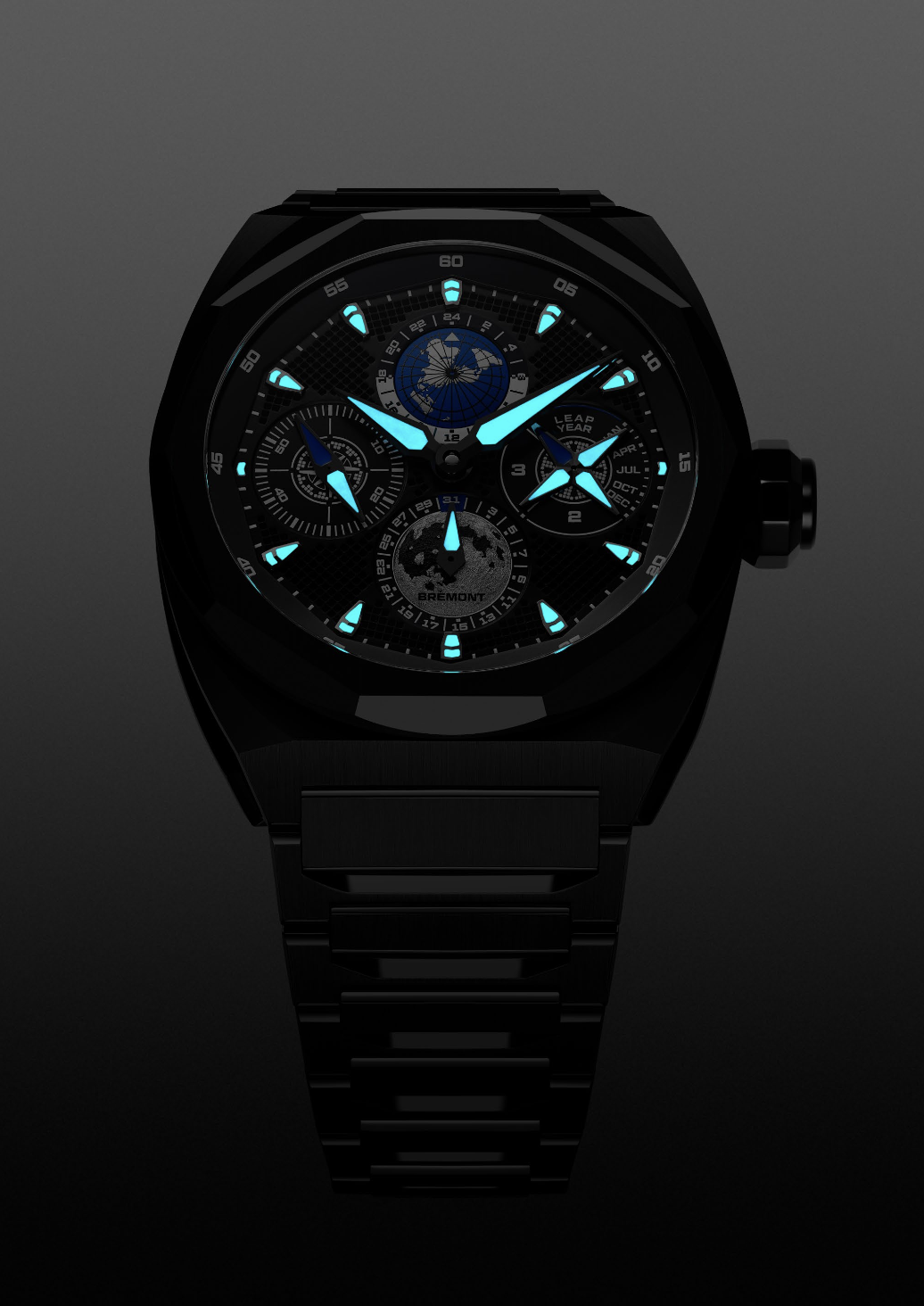
The dial follows the same geometric logic. An interlocking galvanic black grid evokes spacecraft solar arrays, intersected by angular triangular pathways. Applied triangular indexes filled with white Super-LumiNova and faceted rhomboidal hands extend the design language. Rather than appearing as instruments added to an existing dial, the complications read as integral parts of a single composition.
The Agenhor connection
Bremont partnered with Agenhor for the calendar-GMT module. Founded in 1996 by Jean-Marc Wiederrecht and now led by his sons Laurent and Nicolas, the Geneva atelier has created mechanisms for watches by MB&F, H. Moser & Cie. and Hermès, among others. For Bremont, it developed an exclusive, slim module combining perpetual calendar and GMT functions.
The calendar automatically accounts for different month lengths and leap years. The controls also explain the “Monopusher” designation: a pusher integrated into the crown advances the GMT indication in one-hour increments. A corrector at two o’clock adjusts the date, while another at four o’clock sets the month and leap-year indications. Each function therefore has a clearly assigned control.
A globe for home time, a Moon for the date
At 12 o’clock, a domed disc decorated with a globe motif provides the second time-zone display. As the globe turns, an arrow indicates home time against a 24-hour scale divided into day and night sectors. The motif echoes those used on the Terra Nova Dual-Time Tourbillon and the Altitude Perpetual Calendar GMT Monopusher.

Running seconds at nine o’clock use a sector-style subdial and a two-blade hand with blue-lacquered and white luminous accents. At six o’clock, a domed disc carries a detailed Moon decoration. Its role, however, is to display the date: a single lume-tipped hand points to the surrounding scale, with an applied Bremont logo at the centre.
The month and leap-year display at three o’clock is particularly distinctive. A four-blade hand, with three white lume-tipped blades and one blue-lacquered blade, moves across four sectors, each corresponding to a year in the leap-year cycle. The first sector also contains the twelve month indications; the blue blade identifies the position within the four-year cycle. Beneath this unconventional display lies a hand movement divided into 172 micro-jumps over the complete cycle.

Bringing expertise to Henley-on-Thames
The collaboration extends beyond development in Geneva. Agenhor’s team trained Bremont’s watchmakers at The Wing, the manufacturing and technology centre in Henley-on-Thames, to assemble the complete movement in Britain. That gives the Supernova an industrial significance alongside its horological interest: specialist expertise in complex mechanisms is being embedded within Bremont’s British operations.

This Supernova’s appeal is therefore not simply a matter of scarcity. It gives one of watchmaking’s most demanding calendar complications a technical, deliberately unconventional setting, complemented by an easily adjusted second time zone. Its dark, space-inspired aesthetic and elaborate mechanics are not competing ideas. Together, they are the point.
Editor’s Picks