
Haute Joaillerie
Piaget Colours of Extraleganza: 65 creations in two chapters
Piaget’s Colours of Extraleganza in full: 65 high jewellery creations spanning coloured gemstones, sculptural gold and transformable jewellery watches.
At a Glance
- An overview of chapters 1 and 2, comprising 65 creations
- Blue Illusions combines sapphires, Paraíba tourmaline and black opal
- Transformable jewellery watches unite goldwork and ornamental stones
Across chapters 1 and 2, Piaget’s Colours of Extraleganza high jewellery collection comprises a total of 65 creations. Following INSIGHT LUXURY’s introduction to the collection in June, attention now turns to its full spectrum: from the blue-green gemstone compositions of Blue Illusions and the pink geometries of Blush Symphony to the transformable jewellery watches of Flamboyant Links. They share a design approach that treats gemstones, ornamental materials and worked gold as equal elements of colour and form.
Colour as a unifying design element
Colours of Extraleganza concludes a high jewellery trilogy that Piaget dedicates to the concept of Extraleganza. Viewed as a whole, it reveals a range of design references: the flowing forms of the 1970s, optical effects recalling Pop Art and Verner Panton, and the high-contrast combinations of the Memphis movement. The result is not a series of uniform suites, but ensembles, each with its own design language.
Stéphanie Sivrière describes the collection’s starting point as an interest in the colour effects of gemstones and their interplay. A black opal with green reflections meets ultramarine-blue sapphires; pink sapphires and mother-of-pearl accentuate one another’s hues. Gold, too, plays a chromatic role. Its surfaces, engravings and fluting also define the structure of the jewels.
Blue Illusions: three principal gemstones and a geometric framework
The Blue Illusions necklace offers a particularly clear expression of this approach. A cushion-cut sapphire from Madagascar weighing 8.52 Karat, a Paraíba tourmaline weighing 3.30 Karat and a black opal weighing 13.98 Karat form its centrepiece. The sapphire’s blue and the tourmaline’s lagoon green are echoed in the opal’s blue-green play of colour.
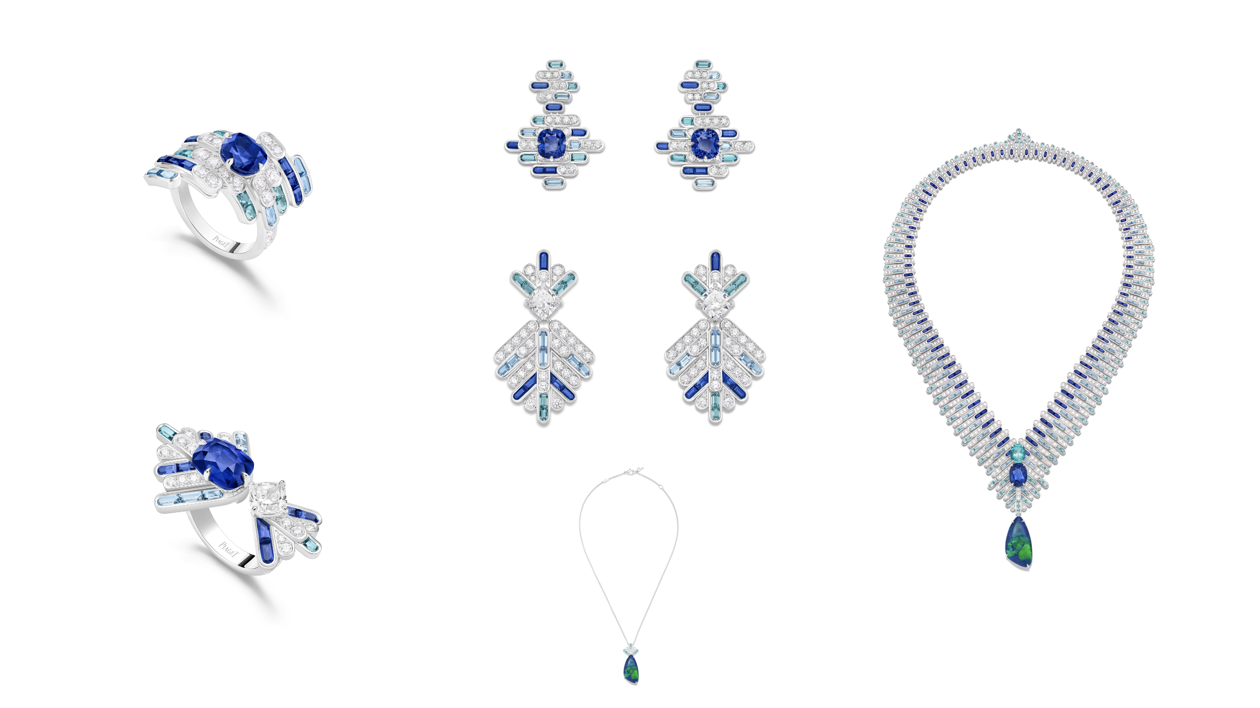
A geometric arrangement of sapphires, baguette-cut tourmalines and diamonds surrounds them. The coloured gemstones were cut specifically for their positions within the jewel. Repeated lines and flowing contours create the optical rhythm evoked by the name Blue Illusions. Piaget’s ateliers devoted almost 900 hours to crafting the necklace.

The ensemble also includes two rings and two pairs of earrings. One of the rings features a sapphire from Sri Lanka weighing almost 5 Karat, whose appearance is described in the source material as silky.
Blush Symphony: pink sapphires, mother-of-pearl and clean lines
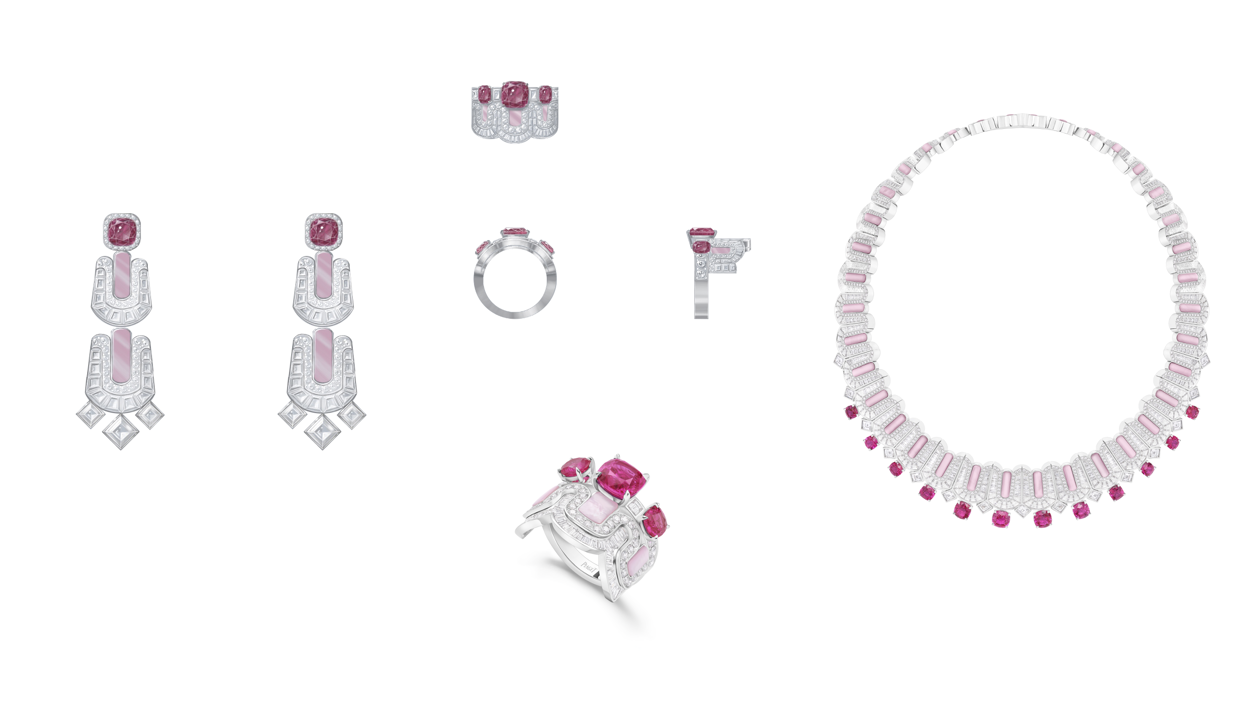
Blush Symphony explores the alternation of diamonds, pink sapphires and mother-of-pearl. Clean lines and pronounced volumes give the different materials a geometric framework. While the faceted stones reflect light in individual flashes, the mother-of-pearl brings a broader sheen to the composition. References to the art and design of the 1970s emerge here chiefly through the rhythmic arrangement of forms.
Flamboyant Links: a sautoir with multiple ways to wear it
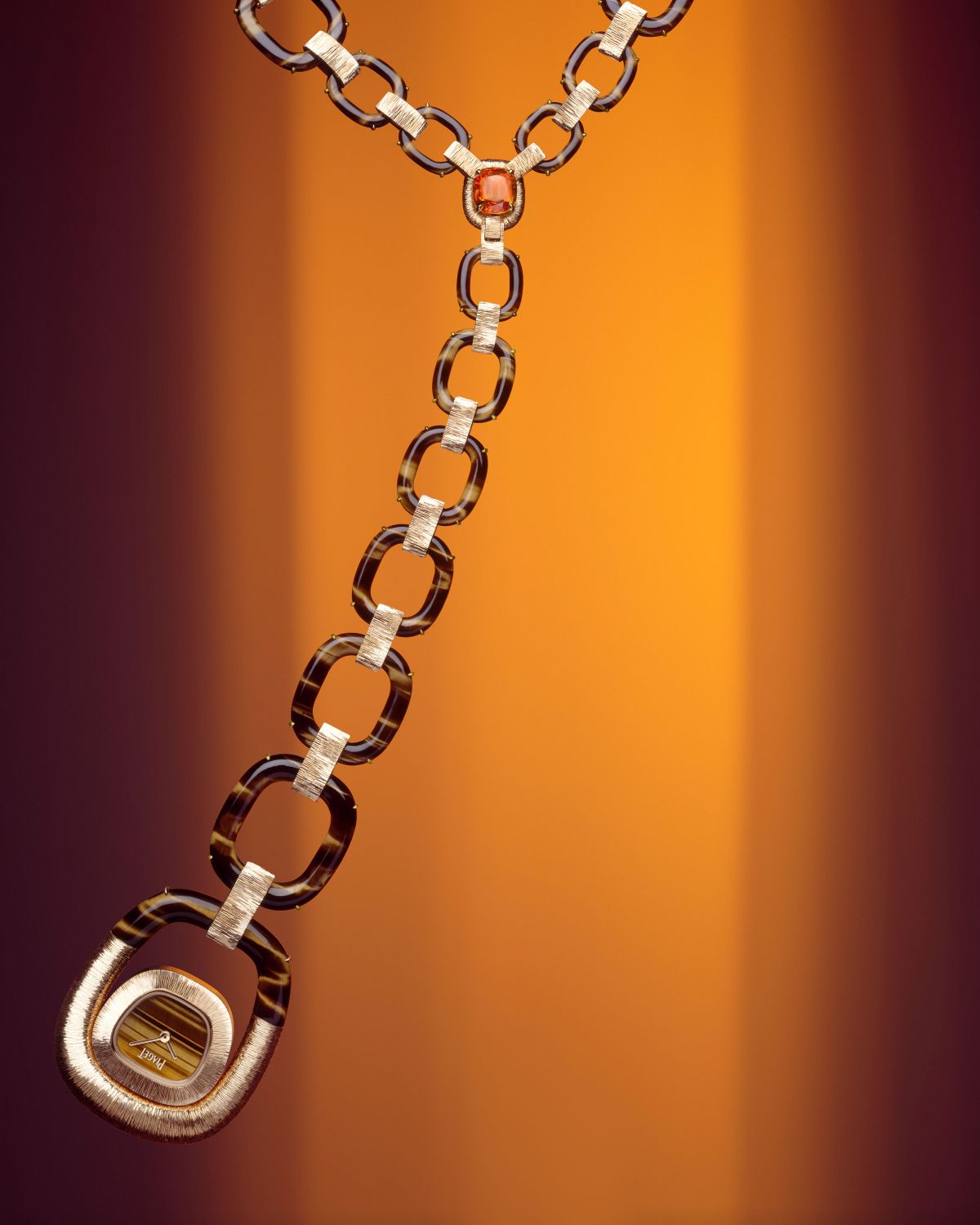
In Flamboyant Links, the union of jewellery and watchmaking becomes a structural theme. Piaget introduced the sautoir watch in 1969 as part of the 21st Century Collection. The current interpretation combines engraved rose gold with tiger’s eye, whose banded pattern was decisive in selecting the stones. Piaget thus revisits the pairing of gold links and ornamental stone for the first time since the 1970s.
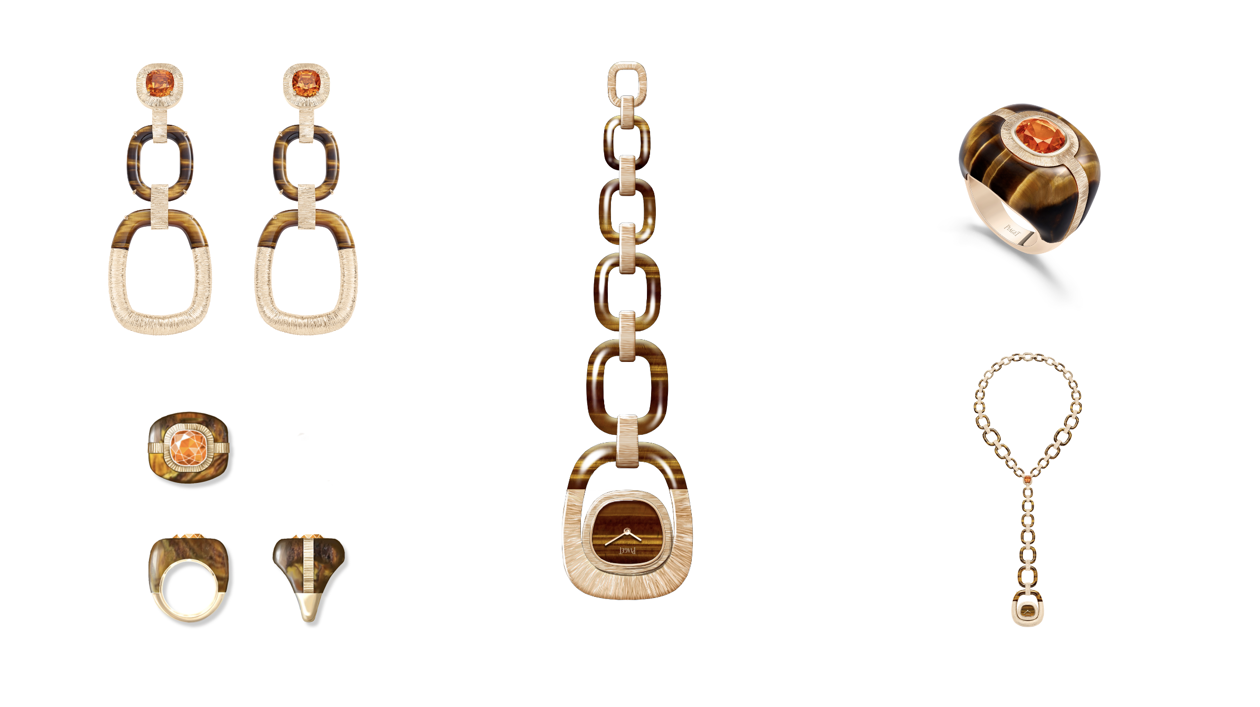
Set with a mandarin garnet weighing 4.13 Karat, the sautoir can also be worn as a choker or wristwatch. Its transformability is therefore integral to its construction, rather than simply a matter of styling. The ensemble is completed by a ring with a cushion-cut mandarin garnet weighing 6.42 Karat and drop earrings featuring two garnets, each weighing 3.04 Karat. Gold, tiger’s eye and the orange gemstones define a palette for which Piaget also cites the aesthetic of Emilio Pucci.
Gold Swirl: fluted gold and a concealed dial
The four-piece Gold Swirl ensemble develops the flowing forms of the 1970s. Rose gold and blue-green baguette-cut tourmalines intertwine on a cuff bracelet. The metal forms a sculptural framework into which the stones are integrated.
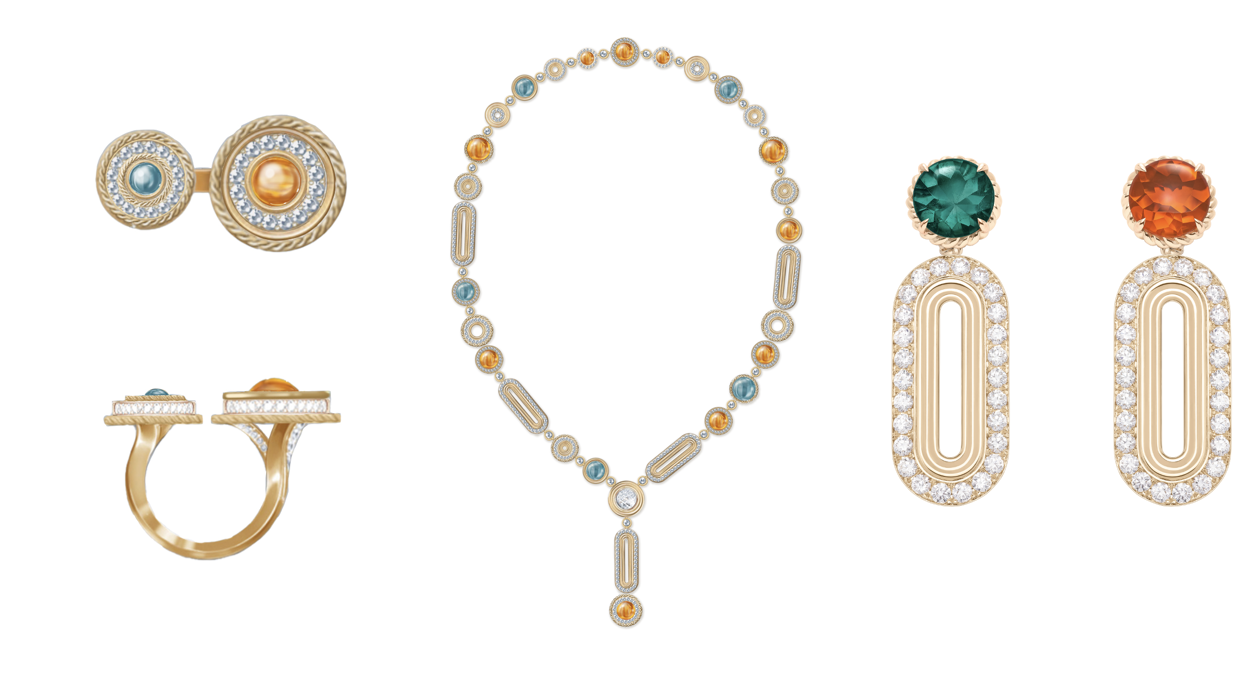
Here, for the first time, Piaget uses rose-gold fluting borrowed from watch design in a high jewellery ensemble. It also extends across a necklace featuring orange fire opal cabochons and indicolite tourmalines. At its centre lies a concealed dial fully pavé-set with diamonds.
Gems Pop: Memphis colours and asymmetrical forms
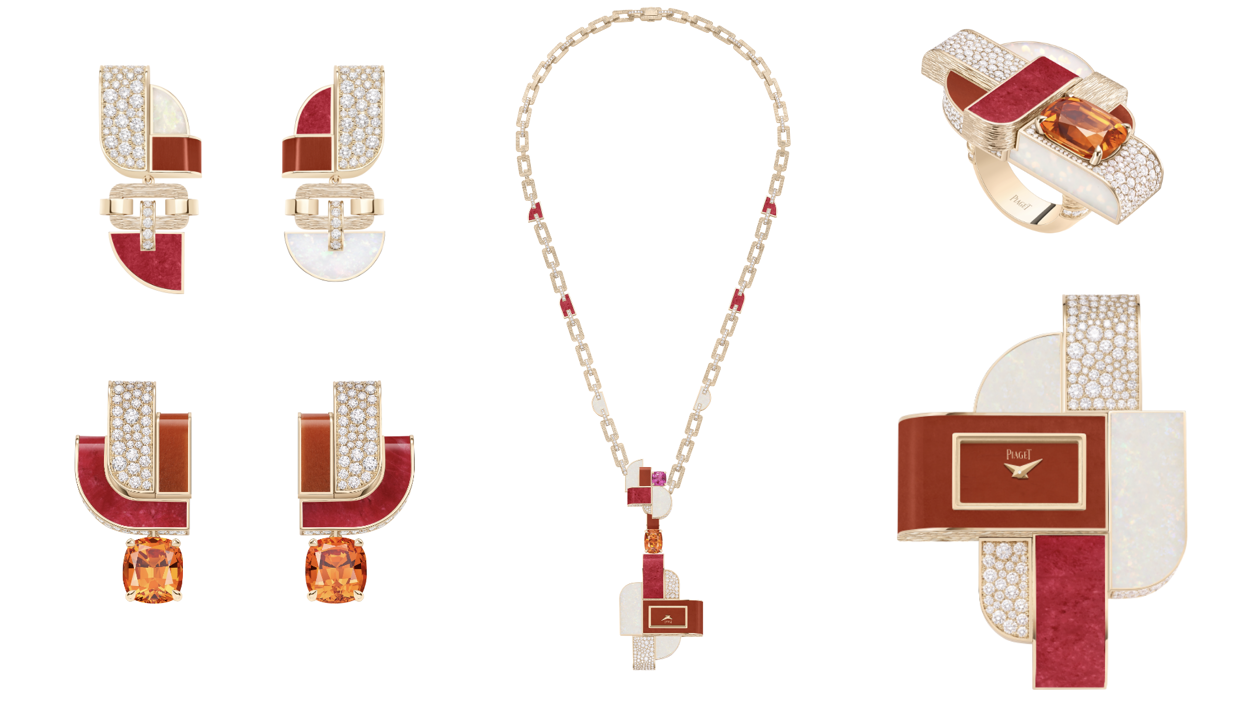
Gems Pop shifts the design reference to the 1980s. The five-piece ensemble draws on the Memphis movement, combining the orange of mandarin garnets and aventurine with the pink hues of sapphires, thulite and gold. White opal introduces pale expanses between the vivid colours.
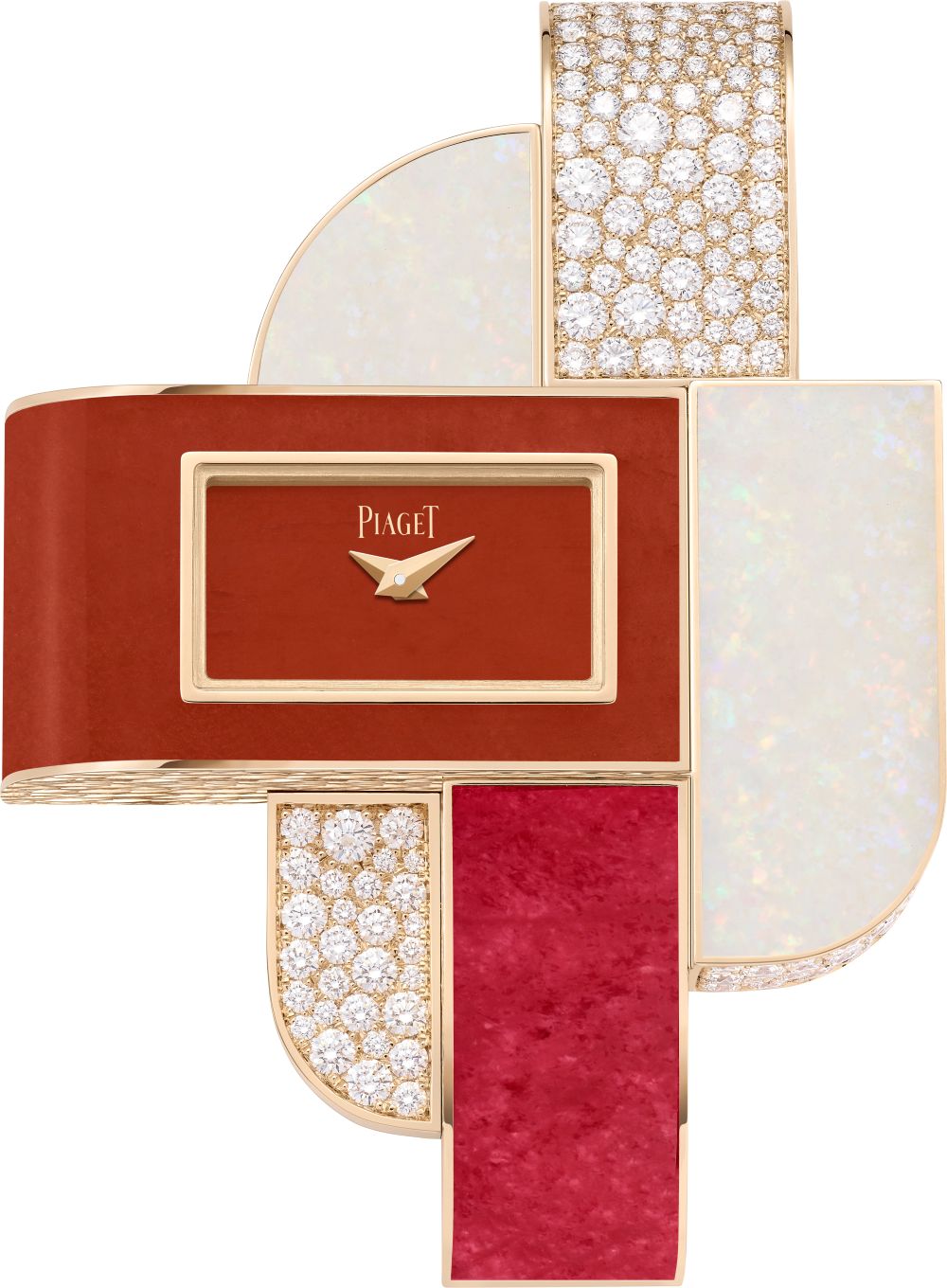
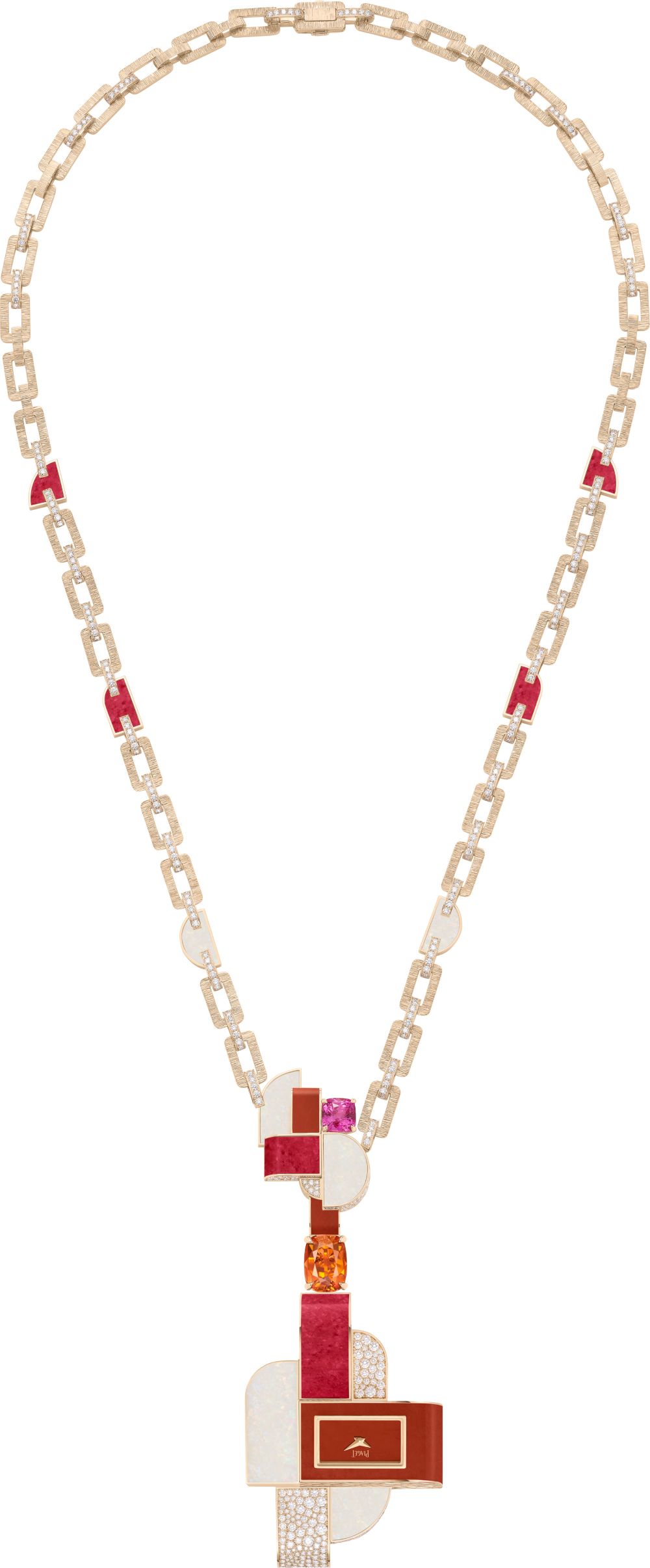
The sautoir is composed of gold links bearing the Decor Palace motif. Suspended from them is a detachable, asymmetrically shaped pendant watch with an orange aventurine dial. A mandarin garnet weighing 8.30 Karat and a pink sapphire weighing 3.54 Karat provide its gemstone accents. In the accompanying sculptural ring, discs of white opal, pink thulite and orange aventurine frame a garnet weighing 8.53 Karat.
All images: Piaget, cover image: BRIGITTE NIEDERMAIR
Editor’s Picks