LVMH Quarterly Results: The Luxury Market Is Growing at Two Different Paces
LVMH’s latest financial results paint a mixed picture: While fashion and leather goods are suffering from weaker demand in China, the watch and jewelry business continues to grow. Tiffany & Co. and Bulgari, in particular, are performing well. Nevertheless, the results have caused disappointment in the financial markets—and are raising questions about the continued recovery of the international luxury market.
On October 12, the French luxury goods group LVMH released its financial results for the third quarter of 2026. The world’s largest luxury goods group generated revenue of 57.1 billion euros in the first nine months, down from 58.1 billion euros in the same period a year earlier. While reported revenue declined by 2 percent, the company posted organic growth—that is, adjusted for currency effects and changes in the scope of consolidation—of 2 percent as well.
In the third quarter, organic growth stood at one percent. LVMH thus continued its modest recovery, but fell short of analysts’ expectations.
The differences between the business segments are particularly evident. While watches and jewelry, as well as selective retail, continued to grow, the fashion and leather goods business—which is particularly important to the Group—saw a decline.
Fashion Disappoints – Jewelry Shows Positive Growth
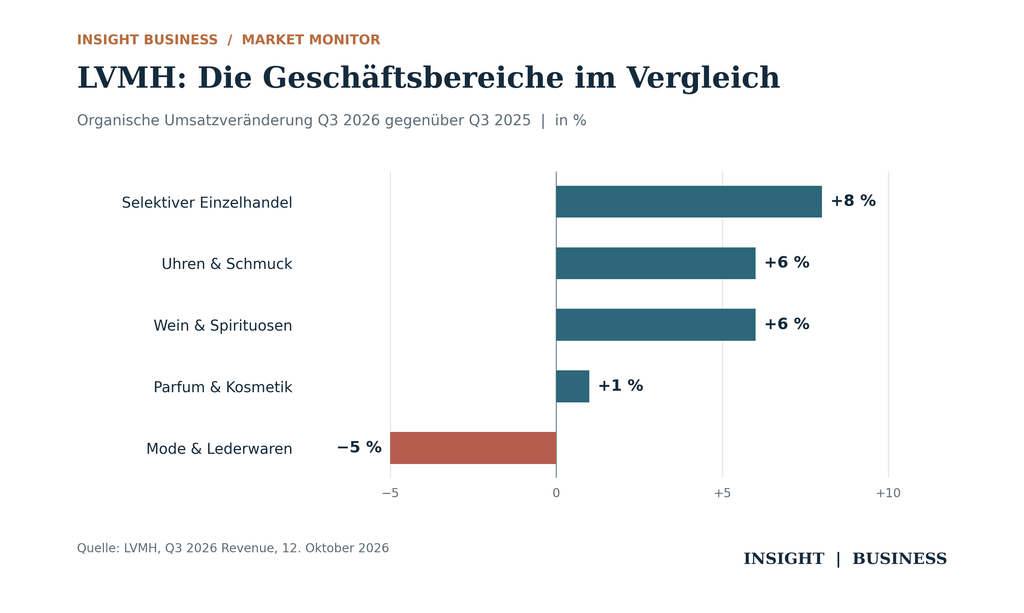
The Fashion & Leather Goods segment, which includes Louis Vuitton, Dior, Celine, Fendi, and Loewe, among others, reported a 5 percent organic decline in revenue in the third quarter. In the second quarter, the segment had posted a slight increase of 1 percent.
This development came as a disappointment to the financial markets. According to Reuters, analysts had expected, on average, a decline of only 1.8 percent. Since fashion and leather goods account for nearly half of the group’s revenue, the performance of this business segment carries particular weight.
By contrast, the results for Watches & Jewelry are significantly more positive. The division generated revenue of 7.725 billion euros in the first nine months, a reported increase of 4 percent. Adjusted for currency effects, growth amounted to 8 percent.
In the third quarter, the division grew organically by 6 percent. This marked a slowdown in growth compared with the first two quarters, during which LVMH had reported growth of 7 percent and 11 percent, respectively. Nevertheless, Watches & Jewelry remains one of the Group’s fastest-growing business segments.
Wines & Spirits also performed well, posting 6 percent organic growth in the third quarter. Selective Retailing, which includes Sephora in particular, grew by as much as 8 percent. Perfumes & Cosmetics rose by 1 percent.
The figures therefore do not indicate a uniform weakness in the luxury goods sector. Rather, trends vary considerably across the individual categories.
Tiffany and Bulgari are driving growth
LVMH attributes the positive performance of Watches & Jewelry primarily to the jewelry business.
At Tiffany & Co., the company points to the continued success of established collections such as HardWear, Knot, and Sixteen Stone. According to the company, the Blue Book 2026: Hidden Garden high-jewelry collection was also well received by customers. At the same time, Tiffany is continuing to modernize its international boutique network.
Bulgari also reports strong performance for its iconic collections. Particular emphasis is placed on the new high-jewelry collection, Eclettica, which, according to the company, generated record sales. The new Vimini line, as well as exhibitions showcasing the brand and its design history, are also contributing to its international presence.
Meanwhile, Chaumet continues to develop its Bee de Chaumet collection and has unveiled a new high-jewelry collection titled “A Journey Through Nature.”
The importance of established designs is striking. According to the company, both Tiffany and Bulgari benefit from their well-known collections, while new creations and high jewelry provide additional momentum.
However, it is not possible to determine from the published figures how the growth is distributed across the various price segments.
LVMH Remains Cautious About Watch Brands
While the jewelry brands are discussed in detail in the press release, the information about the watch brands is largely limited to product launches and marketing activities.
According to the company, TAG Heuer benefited from its presence in Formula 1, including at the Madrid Grand Prix. Hublot continued its collaboration with artist Jeff Koons, while Zenith unveiled new models in its G.F.J. and Chronomaster lines.
LVMH does not disclose specific sales figures for individual brands. Nor does it provide a separate breakdown of watches and jewelry within the business segment.
The reported 8 percent growth for the first nine months cannot, therefore, be attributed equally to both product categories. The only certainty is that LVMH itself highlights the particularly positive performance of the jewelry business as a key growth driver.
China is holding back development
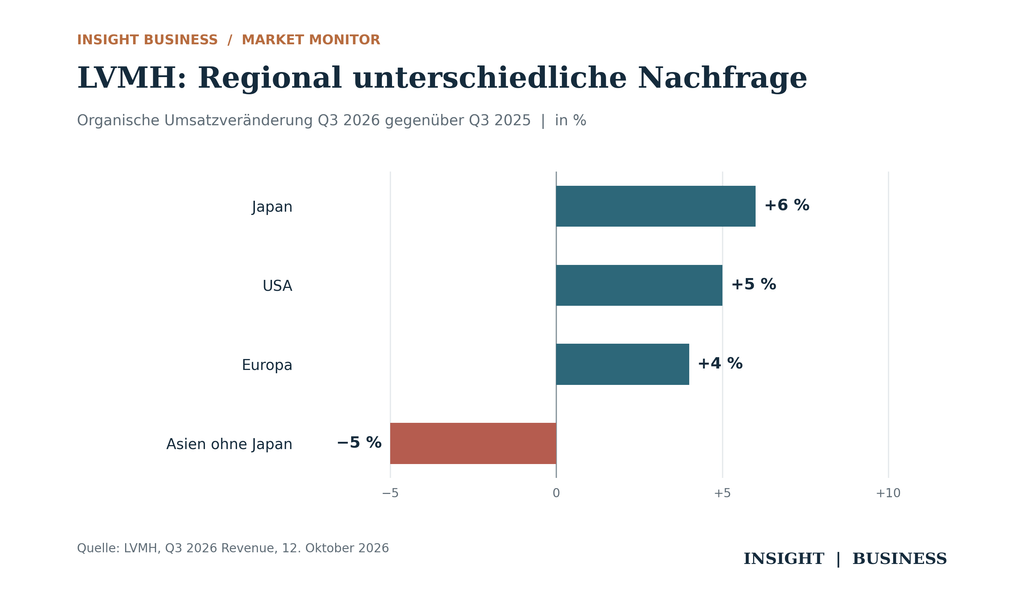
In addition to the differences between the business segments, regional shifts are shaping the business. This is particularly evident in Asia, excluding Japan: Following organic growth of 7 percent in the first quarter and 4 percent in the second quarter, revenue declined by 5 percent in the third quarter.
LVMH attributes this in particular to weaker demand in China, which weighed most heavily on its fashion and leather goods businesses. International financial analysts see this as a sign that the recovery of the Chinese luxury market remains fragile.
In other regions, business performed significantly better. The U.S. posted organic growth of 5 percent in the third quarter, Japan grew by 6 percent, and Europe by 4 percent. However, these figures refer to the entire Group, not specifically to Watches & Jewelry.
Why the Stock Market Is Still Disappointed
The financial markets are viewing the results more critically than the revenue trend would initially suggest. Analysts had expected organic group growth of 1.3 percent for the third quarter. In fact, LVMH achieved 1 percent. Particularly disappointing, however, was the 5 percent decline in the fashion and leather goods segment, while forecasts had called for a decline of only 1.8 percent.
This puts a damper on hopes for a sustained recovery in the luxury market. As one of the first major luxury conglomerates to release its quarterly results, LVMH is seen by investors as a key indicator of the industry’s future performance.
No Uniform Trend in the Luxury Market
LVMH’s financial results show significant differences among the various luxury segments. While fashion and leather goods are under pressure, watches and jewelry, wine and spirits, and selective retail continue to grow.
The positive performance of the jewelry business is particularly noteworthy. It is not yet possible to determine from the available figures whether this reflects a broader shift in demand or is primarily due to the strength of individual brands and collections.
Further clues will come from competitors’ financial results. Kering and Hermès will release their results on October 22, followed by Richemont on November 13.
There is currently no sign of a uniform recovery in the international luxury market. While some business segments continue to struggle with declining demand, others are faring significantly better. The jewelry business is one of LVMH’s key growth drivers.
Sources: LVMH, “Continued Growth in the Third Quarter of 2026,” press release dated October 12, 2026, and “Q3 2026 Revenue,” investor presentation dated October 12, 2026. Additional context provided by financial and business coverage from Reuters, the Financial Times, and The Wall Street Journal on October 12 and 13, 2026, regarding the quarterly results, analyst expectations, and trends in the international luxury market. As of October 13, 2026.