


Zenith anniversary model - the founder would have loved more than just the name
Zenith anniversary model - the founder would have loved more than just the name
When Georges Favre-Jacot founded his manufactory in 1865, he envisioned "the perfect watch." This vision is also reflected in the brand's name.
Zenith is derived from the term "zenith" for the highest imaginary point in the sky above the observer's position. This is also where the star in the brand's logo comes from.
To celebrate its 160th anniversary, Zenith is dedicating a very special timepiece and an exceptional movement to this high standard, which the founder has set for his brand from the very beginning.
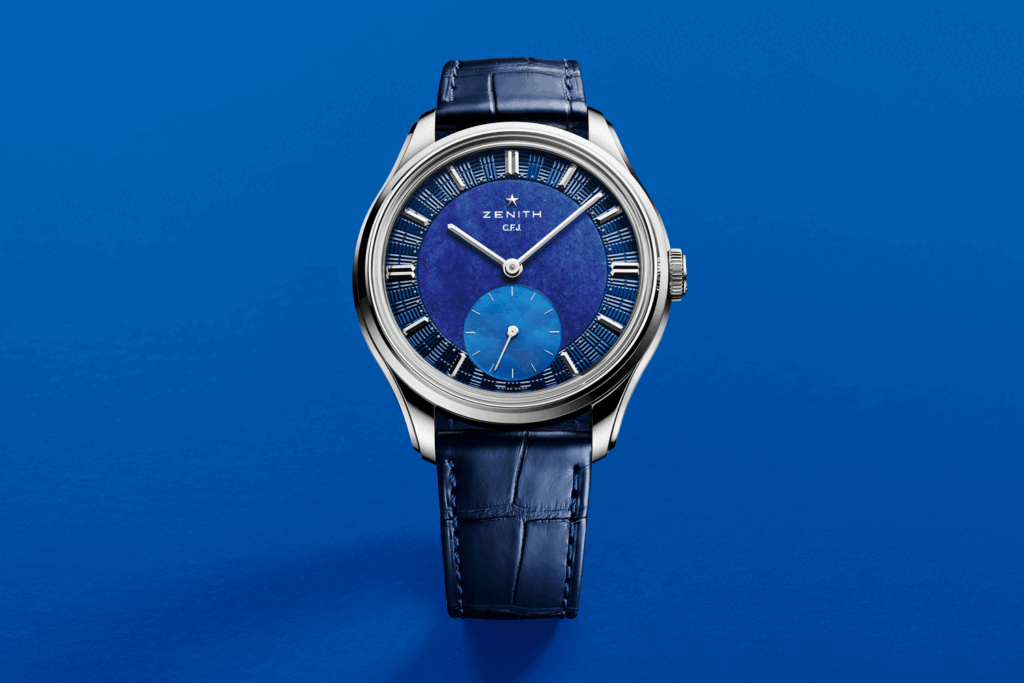
Together, this creates the new "GFJ" – named after the initials of Georges Favre-Jacot. Inside, the reissued hand-wound Caliber 135 works, the most award-winning movement in the so-called observatory competitions.
Return of an excellent caliber
Until the 1960s, observatory competitions were important for watchmaking. Watchmakers submitted their most precise creations to renowned institutions such as the Neuchâtel Observatory. The latter held chronometry competitions until 1968—until the quartz crisis.
These awards were highly coveted, as they served as proof of the high level of precision of a watch or a brand. For this reason, manufacturers submitted movements that had been adjusted, prepared, or even developed specifically for these competitions.
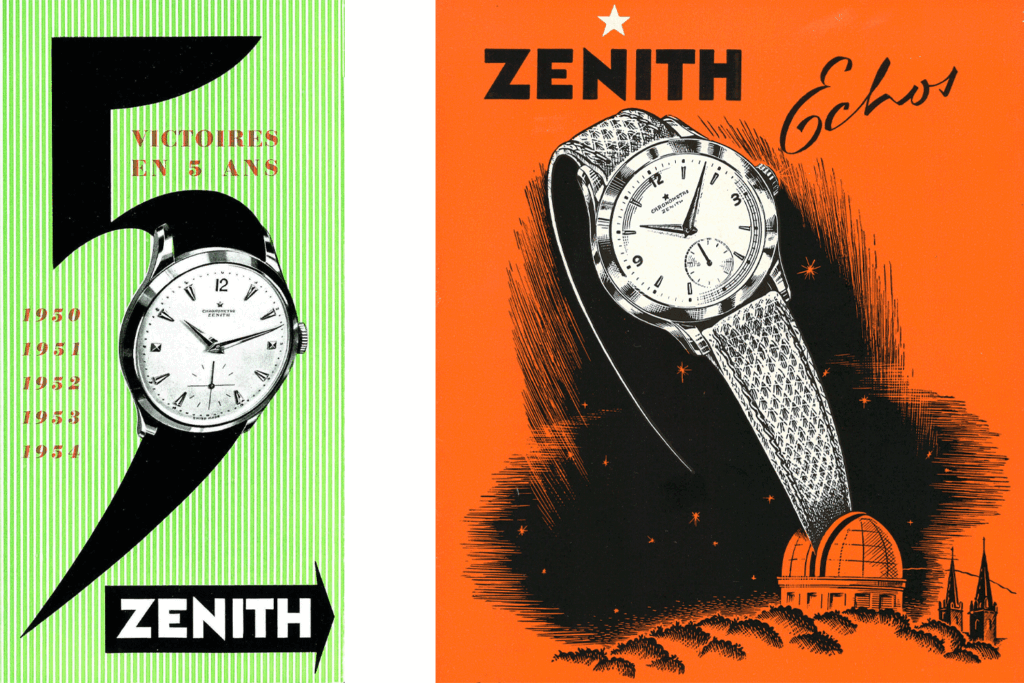
Zenith was extremely successful with this, winning a total of 2,333 chronometry prizes—more than any other brand. But that's not all. A single movement from the manufacture set its own record, receiving over 235 chronometry prizes. This is the Caliber 135. The chronometer movement, commissioned by Charles Ziegler, Zenith's technical director, and designed by Ephrem Jobin, was developed specifically for the chronometry competitions held at the observatories in Neuchâtel, Geneva, Kew Teddington, and Besançon.
The name was derived from its dimensions: 13 lignes (or 30 mm, the maximum size allowed in wristwatch competitions at the Neuchâtel Observatory) and a height of five millimeters.
It was produced in two different versions from 1949 to 1962: a commercial version and a version with the suffix “O” (135-O), which was produced exclusively for observatory chronometry competitions and won over 235 awards.
Regulated by the famous Zenith chronometers Charles Fleck and René Gygax, the movement also won a record five consecutive first prizes in the wristwatch category at the Neuchâtel Observatory from 1950 to 1954.
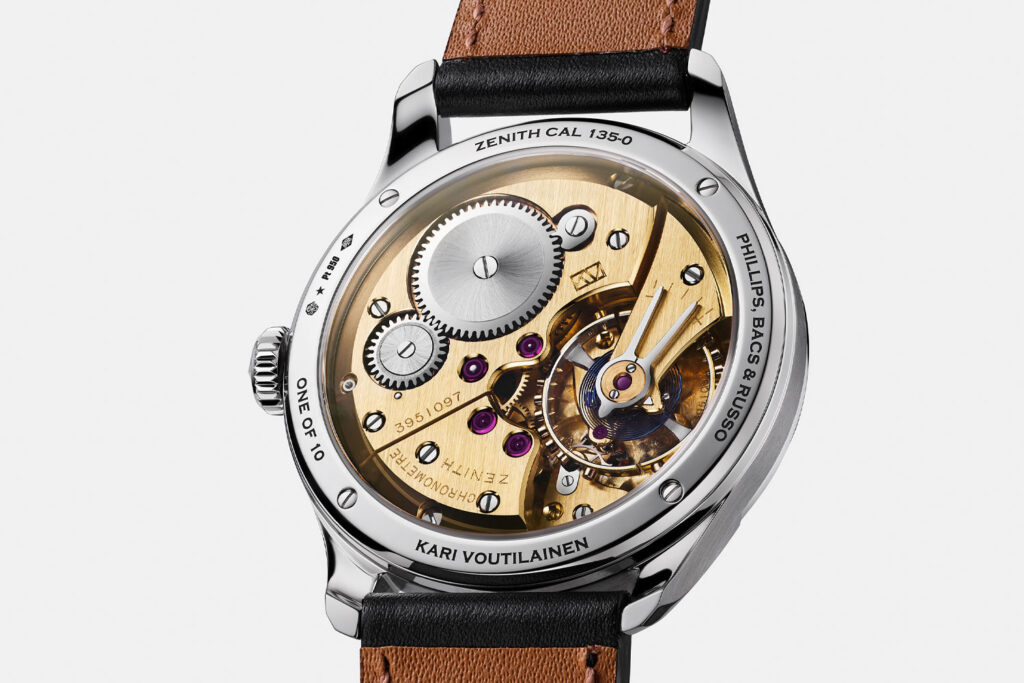
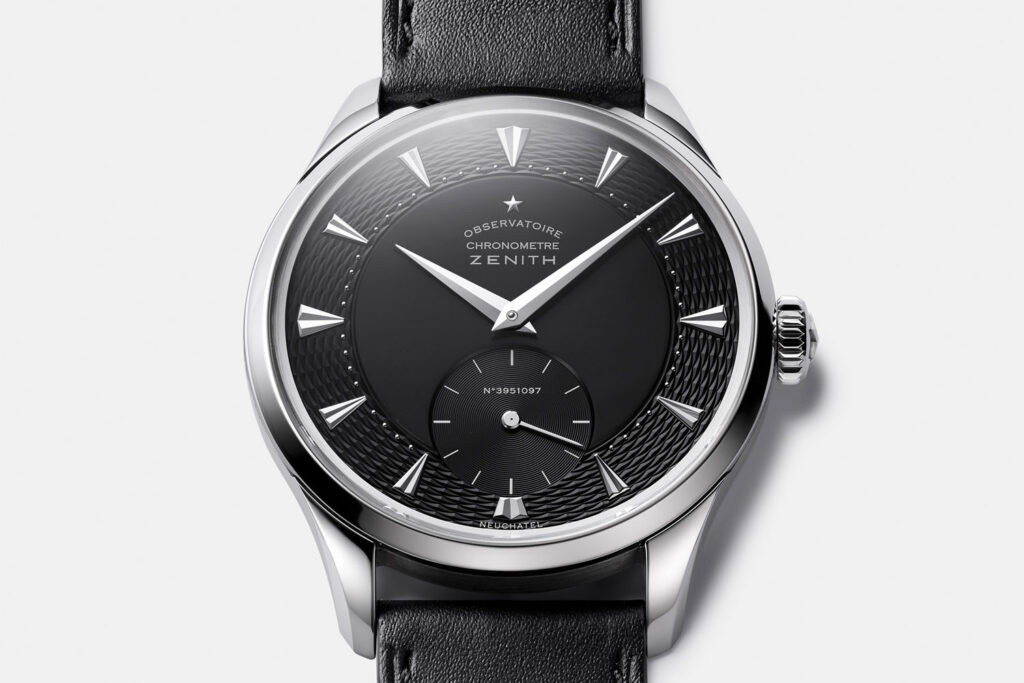
In 2022, the Caliber 135-O was revived for the first time through a partnership with Kari Voutilainen and the Phillips auction house in collaboration with Bacs & Russo. Ten vintage movements from the series-winning years 1950 to 1954 were restored and decorated by the master watchmaker and then incorporated into a limited edition.
The modernized 135 celebrates comeback in a new collection
Now, Zenith has developed a new version of its Caliber 135 with the same dimensions, look, and architecture as the original. It features an off-center third wheel, making room for an oversized balance wheel, which in turn improves both precision and rate stability.

This is not a simple reproduction, but a modernized version. For example, the barrel now provides a power reserve of 72 hours, whereas the 1950s version only offered 40 hours.
The gear train driven by this mechanism features optimized tooth geometry for greater efficiency. The balance, beating at a frequency of 2.5 Hz, is equipped with regulating screws and a Breguet hairspring.
A distinctive feature of the 135-O, the double arrow-shaped regulator, allows for precise setting, and a hacking mechanism has been added to enable accurate timekeeping to the second. The balance staff is now protected by spring-loaded jewel bezels. All movements have been set to an accuracy of +/-2 seconds per day. This precision is COSC-certified.
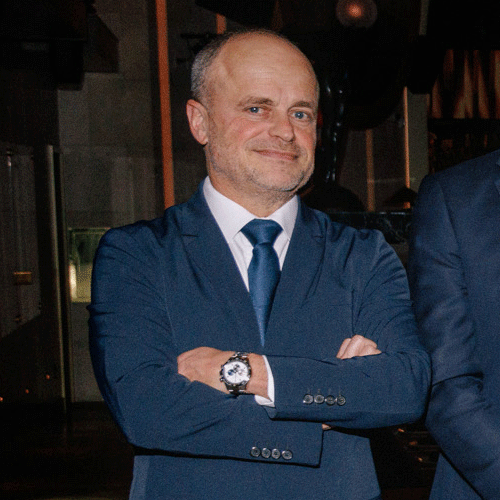
Benoît de Clerck, CEO of Zenith, explains:
"Few movements in the history of watchmaking have achieved such a level of chronometric performance and acclaim as the Caliber 135. Thus, it remained not just a technical achievement, but became a true icon of precision."
"Its comeback for our 160th anniversary is a tribute to this legacy and, at the same time, allows us to share this caliber with a new generation of collectors. With the 'GFJ,' we have reworked the legendary movement, not only as a reminder of the past, but as a way to make a crucial chapter of this history accessible while offering a modern interpretation that reflects today's zeitgeist. We are very proud of this."
A timepiece in the spirit of the brand founder
As a fitting housing for the new Caliber 135, Zenith has created the "GFJ" with a 39-millimeter platinum case featuring a stepped bezel and lugs. The notched crown bears the initials of the manufacturer's founder. Beneath the box-shaped sapphire crystal, the "GFJ" features a blue dial divided into three sections.
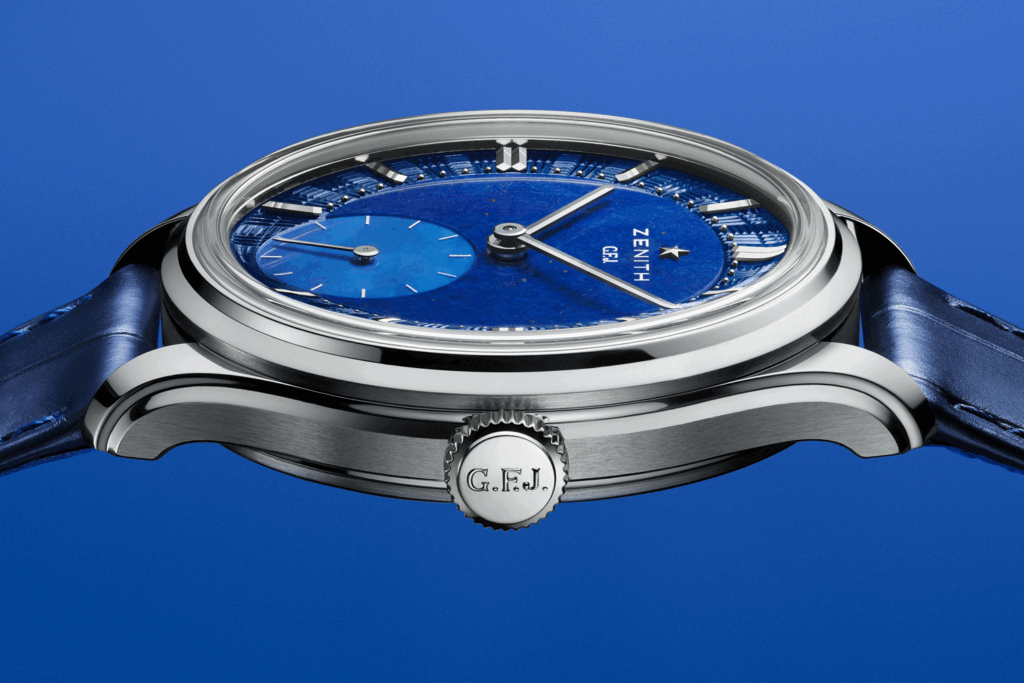
The outer ring features a "brick" guilloché pattern and is adorned with faceted white gold hour markers and a minute track composed of 40 hand-applied white gold beads. The center is crafted from dark blue lapis lazuli, reminiscent of a starry sky with its gold-colored pyrite inclusions.
The large subdial at 6 o'clock is crafted from mother-of-pearl and displays the seconds. The hours, minutes, and seconds are indicated by thin white gold baton hands.
The anniversary timepiece comes with three different straps: a dark blue alligator leather strap, a black calf leather strap, and a blue Saffiano calf leather strap.

The "GFJ" is released in a limited edition of 160 pieces and is available for pre-order exclusively at Zenith boutiques and online shops, as well as from authorized retailers worldwide. (RRP €52,900)

 Deutsch
  English (UK)