




Geneva Watch Days 2025: Czapek and the good robot of the „Antarctique Rattrapante RUR“
Robots are a popular topic in the science fiction genre and among cultural pessimists - usually with negative connotations. Not so with Czapek. The watch brand takes a playful approach to the robot theme and simply reverses the balance of power.
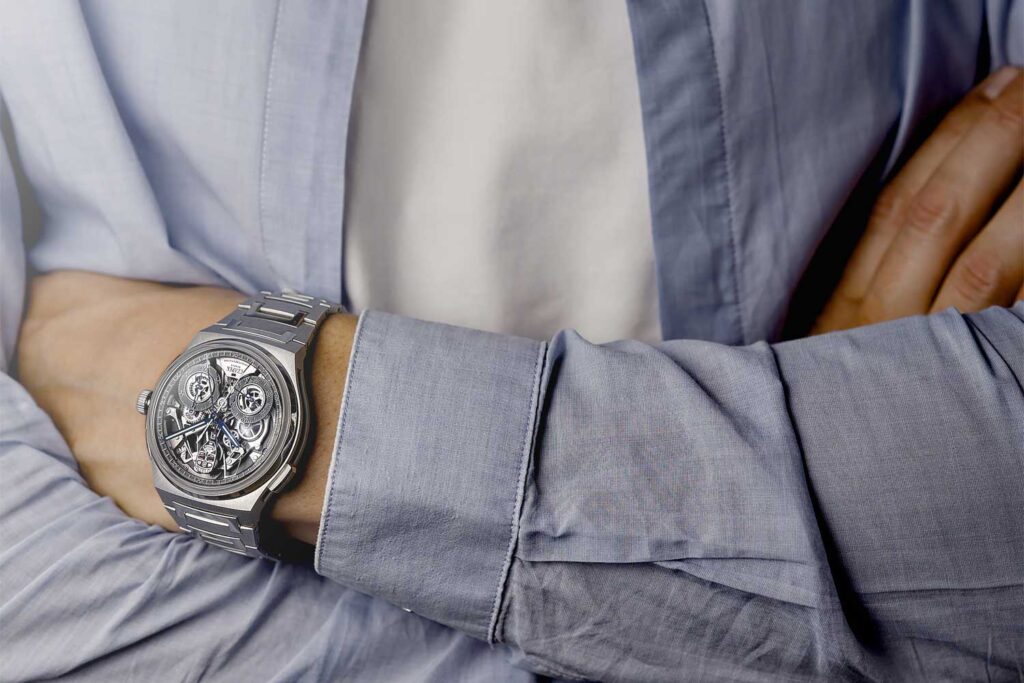
This is realised with the new "Antarctique Rattrapante "R.U.R.", which is limited to 77 pieces: Beneath the grey-metallised sapphire crystal dial, a robot animates the visible mechanism.
As soon as the chronograph function is activated, its eyes change colour: when starting, they glow yellow - a homage to the shrikes from the film Mortal Engines - when stopping, they turn red, and when resetting to zero, they glow blue.
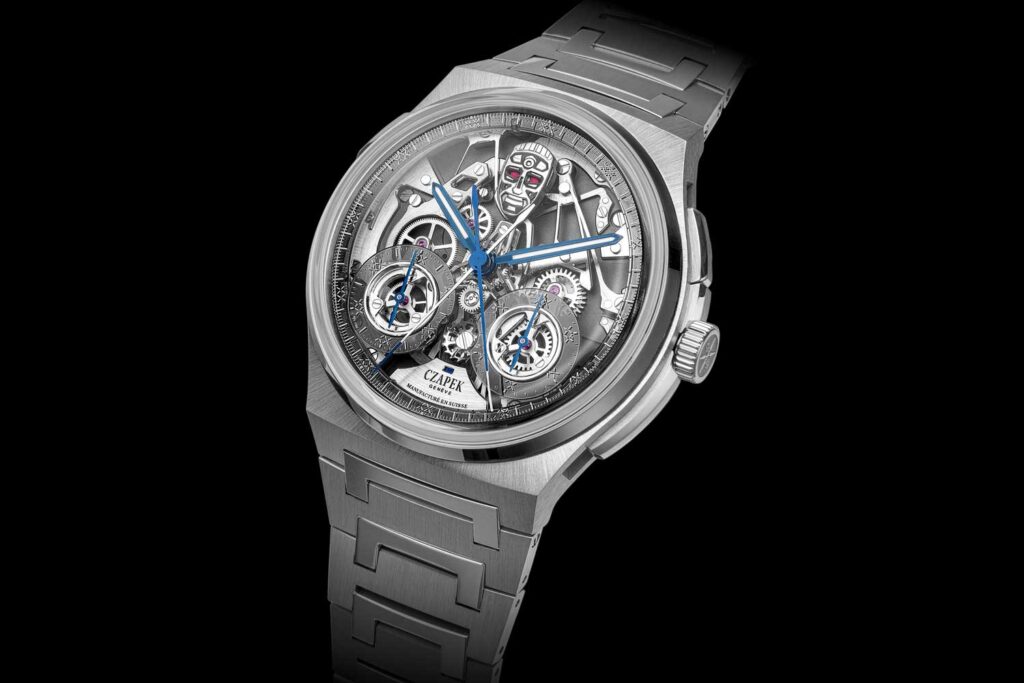
The robot head, created by Czapek partner MD'Art, is made of titanium, milled, polished by hand and laser engraved. Its eyes are each micro-painted by hand in three neon colours.
Czapek lets his robot speak
A closer look reveals further details that distinguish the "R.U.R." dial from the earlier "Antarctique Rattrapante" models. These include the white chronograph hand and the blue anodised rattrapante hand with a white tip. On the outer chronograph scale and the two sub-dials, "XX" symbols also represent the language of the robot - a language invented especially for "R.U.R.", which is based on the Yautja alphabet from the Predator films and plays with the "X" of Xavier de Roquemaurel.

"When we launched the 'Antarctique Rattrapante' in 2021, one of our shareholders immediately suggested integrating a robot into the movement - as a tribute to the beauty of mechanics," says Xavier de Roquemaurel, CEO of Czapek & Cie.
"As the constant search for mechanical and aesthetic beauty is central to our philosophy of watchmaking at Czapek and we are always looking to break new ground, the idea of a robot - a playful mix of aesthetics and mechanics - was immediately fascinating. But the actual impetus for this idea lies further back."
Karel Čapek once gave the term robot its current meaning
The Czapek team's discovery that the word "robot" had been introduced to the world exactly a century earlier by a Mr Čapek (in the Czech spelling) made the idea of a "rattrapante" with a robot irresistible.
Karel Čapek, an important Czech intellectual, was deeply concerned about the scientific materialism of the early 20th century. His play "R.U.R. - Rossum's Universal Robots", about artificial humans who are built for factory work but rebel against their human masters, was a critical examination of the dehumanisation caused by industrialisation, science and technology.
The play premiered in Prague in 1921 and within two years it had been translated into 30 languages. The original edition is now in the Museum of Science Fiction in Yverdon, Switzerland.

In the early versions of his play, Čapek initially called his artificial beings "labori", derived from the Latin labor for labour. It was only at the suggestion of his brother Josef that he decided on "roboti" - "robots" in English. Interestingly, the word appears in the Oxford English Dictionary as early as 1839, but in the context of a Central European system of indentured labour in which contributions were made in the form of forced labour.
Čapek gave the term a completely new meaning: it became synonymous with humanoid machines in science fiction literature and film. His drama paved the way for dystopian stories such as Terminator and Blade Runner.
A century after "R.U.R.", Čapek's questions seem more relevant than ever - in the face of automation, artificial intelligence, cloud-based power structures, transhumanist debates and the increasingly complex relationship between humans and technology.
Czapek has his robot under control
The calibre SHX6, which Czapek developed together with Jean-François Mojon from the independent watchmaking company Chronode, based in Le Locle, is a split-seconds chronograph (rattrapante) whose mechanism is not concealed but presented on the dial side.
Instead of on the back as usual, the rattrapante mechanism takes centre stage here: a three-axis central bridge carries the patented minute wheel and the split-seconds mechanism. Two column wheels structure the movement - the upper one at 12 o'clock controls the chronograph, the lower one at 6 o'clock the rattrapante function. This makes the engagement of the clutch, the engagement of the clamps and the precise interplay of pushers and wheels visible.
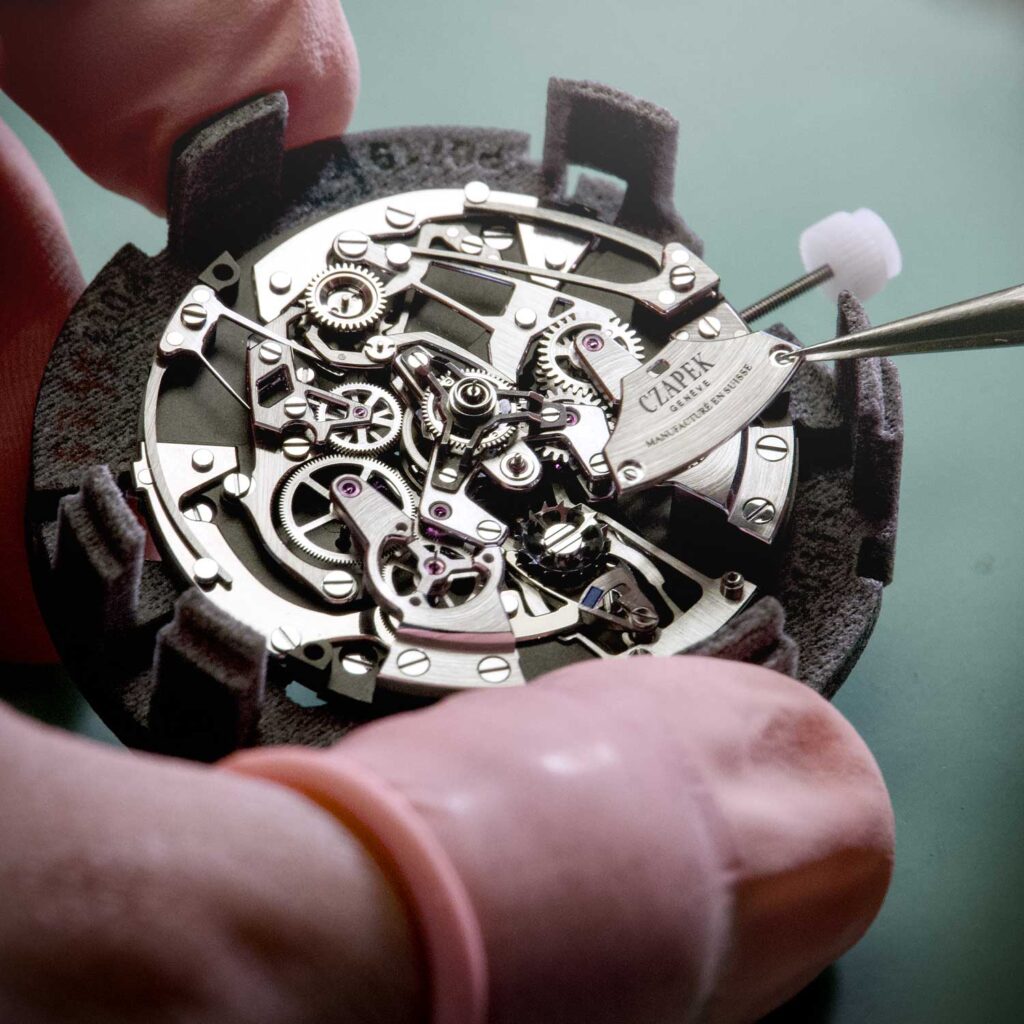
Special attention is paid to the robot head, which sits directly above the chronograph column wheel in accordance with the principle of form follows function. Every time the start, stop or reset button is pressed, its eyes change colour - a playful reference to the mechanism.
The realisation proved to be challenging. The right finish for the robot head required numerous tests with textures and surfaces in order to optimise depth and contrasts. The choice of colour for the eyes was also tested intensively in order to maximise luminosity and differentiation.
As every tiny change affects the balance of the whole, Chronode developed a special bracket that enables precise alignment of all gears and components when installing the head.
A hidden mechanism within the mechanism: the insulator
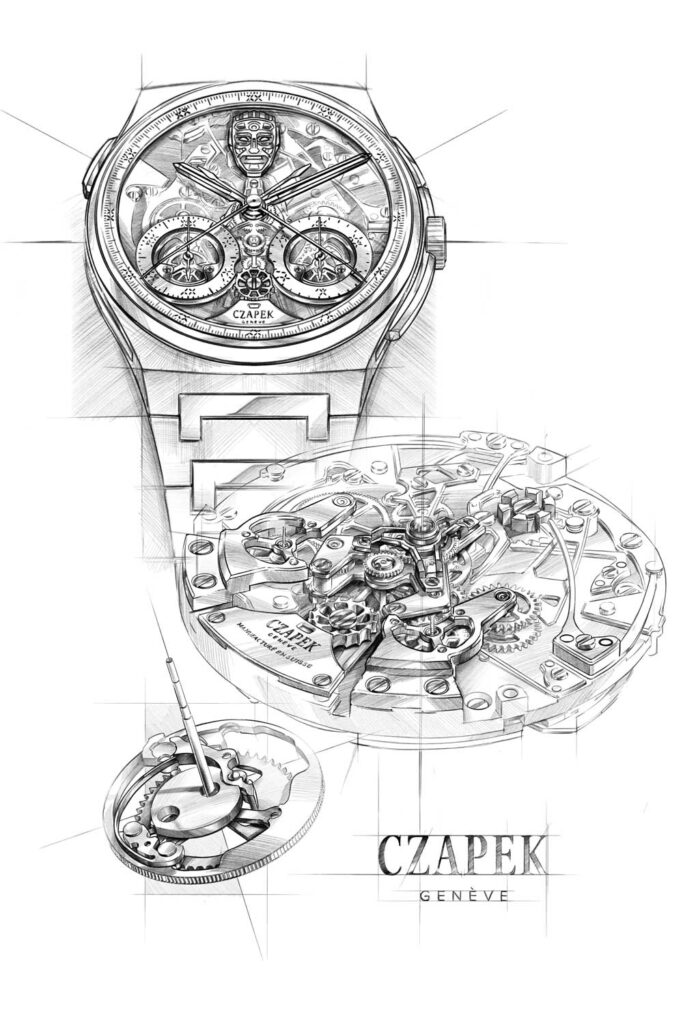
A split-seconds chronograph is one of the most sophisticated complications in the art of watchmaking. It differs from a normal chronograph in that it has clamps that immediately block one of the chronograph wheels when the rattrapante pusher is activated. The other wheel continues to run or count in the meantime. If the clamps are unlocked again, the blocked hand catches up with its "twin" (French "rattraper" = to catch up).
Inside the split-seconds mechanism, the "Antarctique Rattrapante R.U.R." conceals another mechanism: the isolator. With the help of a lever, it enables the two chronograph second wheels to be completely decoupled without generating friction in the rest of the movement. This significantly reduces any rate deviations when using the rattrapante function.
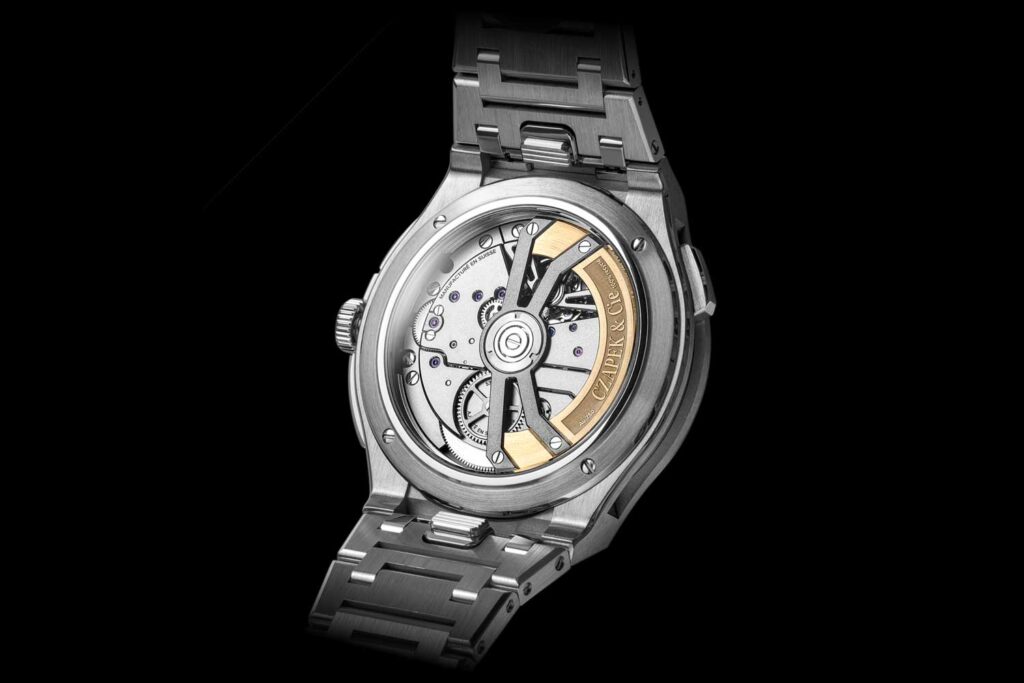
The finely finished SHX6 calibre offers a 60-hour power reserve and is encased in a 42.5-millimetre stainless steel case, which is water-resistant to 12 bar and reveals its inner workings through the sapphire crystal case back.

(RRP 58,000 CHF)

 Deutsch
  English (UK)