

Sustainability in the Watch and Jewelry Industry
Sustainability is one of the major issues of our time. There is a great deal of discussion, writing, and even speculation about it. For many people, the concept is becoming increasingly important and is influencing purchasing decisions. Consumers are increasingly asking: Where does a product come from? Under what conditions was it manufactured? What raw materials were used, and what is their origin and how were they sourced? What are the working conditions throughout the supply chain? And what routes do materials and products travel?
Added to this are questions regarding reusability, recyclability, and the responsible use of resources overall.
At the same time, it becomes clear that for any given product, these questions can often be answered only partially or only with considerable effort. Furthermore, the discussion is shaped by simplified narratives or “modern myths.” Terms such as “blood diamonds” have a real-world basis, but they do not reflect the full range of today’s supply chain challenges and have since lost much of their significance.
To gain a clearer understanding, it’s worth taking a closer look.
What does sustainability mean in the watch and jewelry industry?
Sustainability describes the principle of using and shaping resources, the environment, and social structures in such a way that they remain viable in the long term. It is based on the principle of not consuming more than can be regenerated or made available in the future—combined with environmental responsibility, social equity, and economic stability.
In the watch and jewelry industry, this means, in particular: responsible sourcing of raw materials, transparent supply chains, respect for human rights, reduction of environmental impacts, and the mindful use of materials throughout their entire life cycle—including reuse and recycling.
Supply Chains: Gold and Diamonds
These principles can be clearly illustrated using the supply chains of two key materials: gold and diamonds.
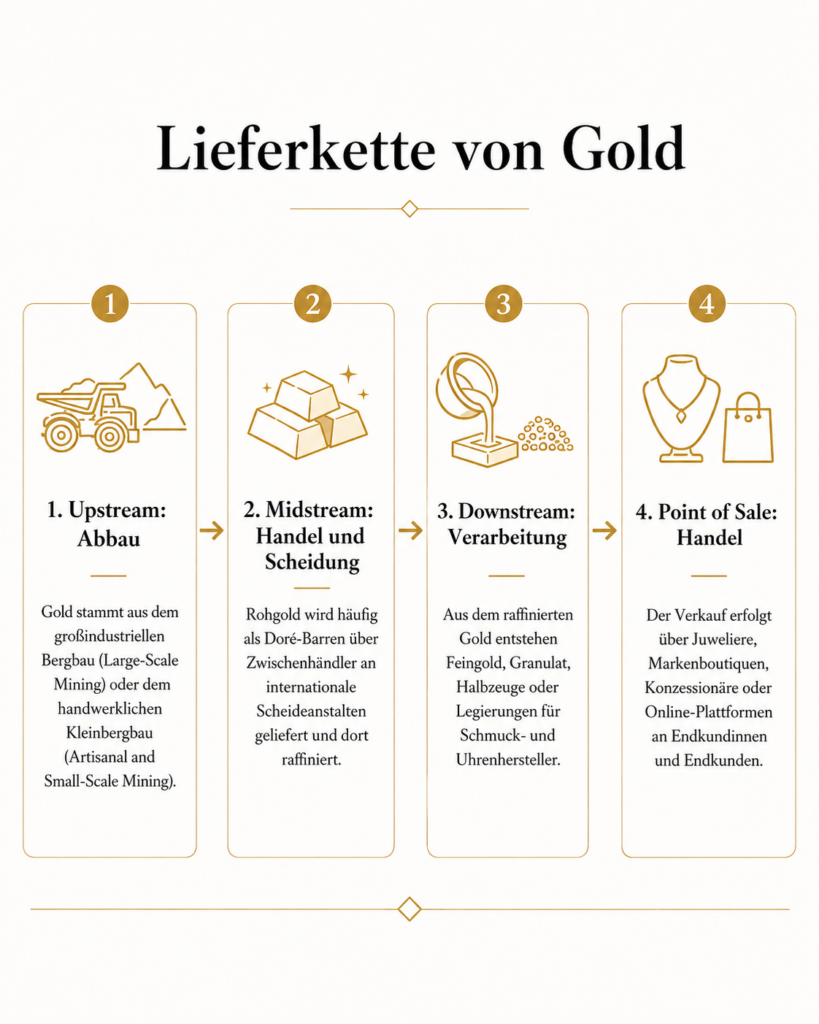
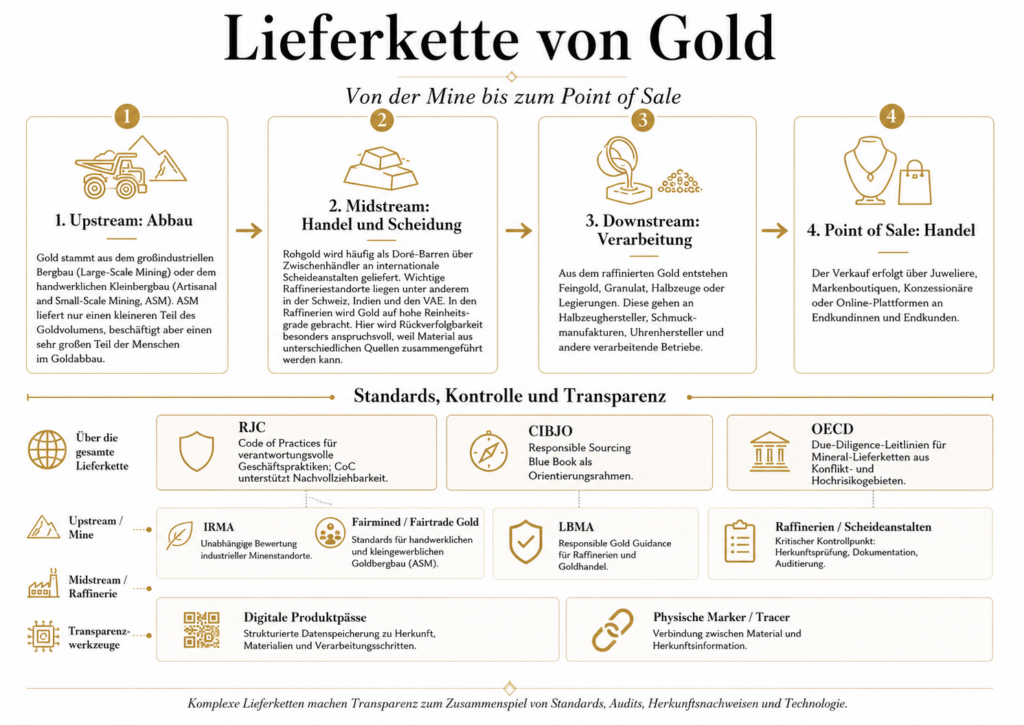
The Gold Supply Chain
1. Upstream: Gold is sourced
either from large-scale mining or from artisanal and small-scale mining (ASM). While ASM accounts for only a small portion of the world’s gold production, it provides a livelihood for millions of people and is therefore particularly important from a social perspective.
2. Midstream: Trading and Refining
After mining, gold is often delivered to refineries via intermediaries in the form of so-called doré bars. Key locations include Switzerland, India, and the United Arab Emirates, among others. There, the gold is refined to high levels of purity. At this stage, traceability becomes particularly challenging, as material from different sources is combined.
3. Downstream: Processing
. Refined gold is used to produce semi-finished products, alloys, or components that are further processed by jewelry and watch manufacturers. In addition to the source of the gold, energy use, emissions, and the handling of chemicals also play a role here.
4. Point of Sale: Retail
. Sales take place through jewelers, brand boutiques, or online platforms. It is only at this stage that a raw material traded globally is transformed into a tangible product with a brand, design, and guarantee of origin.
The Diamond Supply Chain
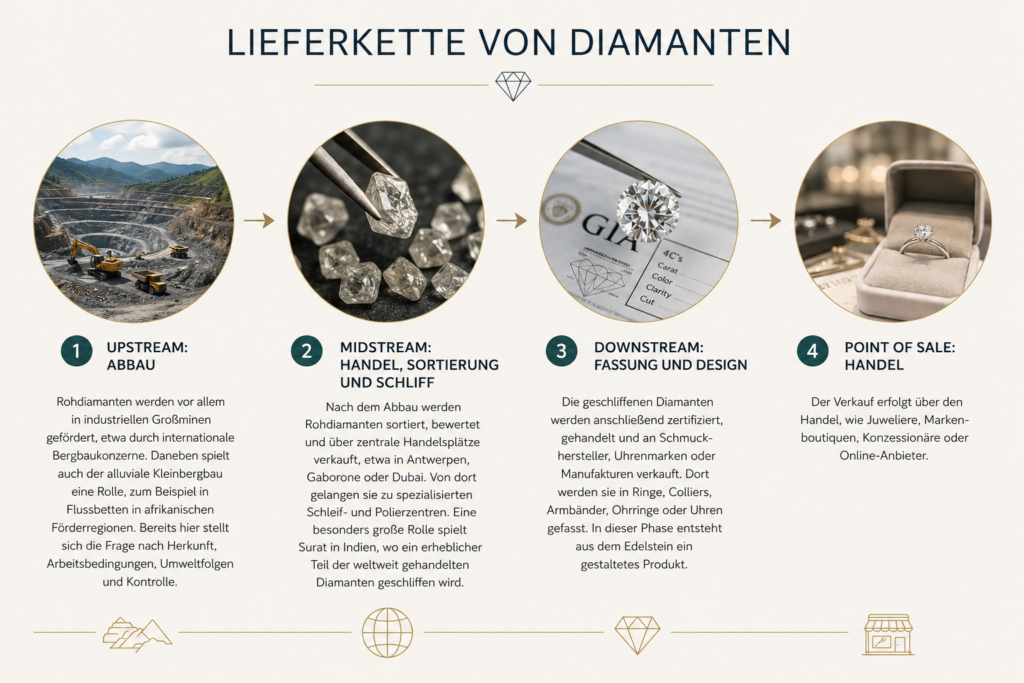
1. Upstream: Rough
diamonds are primarily mined in industrial mines, though they are also extracted in small-scale alluvial mining operations. Even at this stage, questions arise regarding their origin, environmental impacts, and working conditions.
2. Midstream: Trading, Grading, and Cutting
After mining, diamonds are graded and sold through trading centers such as Antwerp, Gaborone, or Dubai. Cutting is often carried out in specialized centers, particularly in India.
3. Downstream: Processing
The cut diamonds are certified and sold to manufacturers, who use them in jewelry or watches. The finished product is created during this phase.
4. Point of Sale: Retail
Sales are made to end customers through retail stores or digital channels.
Transparency and Its Limits
Even this simplified illustration shows just how complex supply chains are and how difficult it is to achieve complete traceability across national and system boundaries.
Transparency therefore usually results from the interplay of standards, certifications, audits, and digital systems. At the same time, traceability is an important tool, but it is not synonymous with sustainability. A product can be well documented without necessarily having been produced under better environmental or social conditions.
Who ensures transparency?
Over time, various initiatives, standards, and systems have been established that address different stages of the supply chain—from mining through trade and processing to certification and documentation.
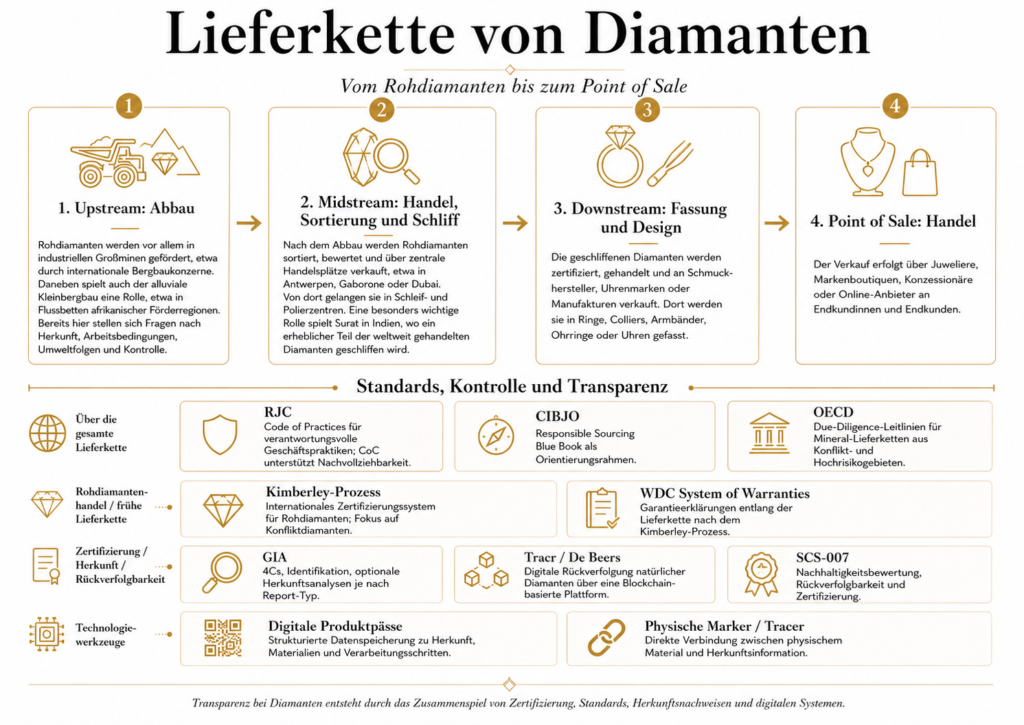
Cross-Cutting Standards
Organizations such as the Responsible Jewellery Council (RJC), CIBJO, and the OECD, with its Due Diligence Guidance, define fundamental frameworks for responsible business practices.
The RJC is aimed directly at companies in the jewelry and watch industry, and its Code of Practices covers topics such as human rights, environmental management, and business ethics. The complementary Chain of Custody certification is intended to make material flows more traceable.
With its Responsible Sourcing Blue Book, CIBJO provides guidance on terminology and processes. The OECD Guidelines serve as an internationally recognized foundation for risk-based due diligence obligations and shape many industry-specific standards.
Gold: Standards for Mining, Refining, and Trading
IRMA evaluates industrial mines based on social, environmental, and governance criteria.
Fairmined and Fairtrade focus on small-scale mining and promote better working and environmental conditions as well as more stable incomes.
The LBMA plays a central role in the international gold trade. Its Responsible Gold Guidance is aimed specifically at refiners and includes requirements for provenance verification, risk management, and the prevention of money laundering.
Refineries play a crucial role in this process, as they are where materials from various sources are brought together.
Diamonds: Conflict Monitoring and Traceability
The Kimberley Process regulates the international trade in rough diamonds and aims to eliminate conflict diamonds, but it is not a comprehensive sustainability standard.
The System of Warranties extends this approach throughout the supply chain. In addition, certificates of origin and digital traceability systems are becoming increasingly important.
Technological Approaches
Digital systems such as blockchain or product passports make it possible to store and make information accessible throughout the supply chain.
Physical markers, such as DNA-based tracers, can help strengthen the link between the material and the dataset. Nevertheless, the reliability of the underlying data remains crucial.
Additional Perspectives
In addition to the sourcing of primary raw materials, the use of recycled precious metals is becoming increasingly important. Recycling can significantly reduce the need for new mining and is a key component of sustainable materials strategies.
At the same time, recycled material is not automatically “sustainable” in the broadest sense. Here, too, the question of transparency arises: Where does the raw material come from? Is it post-consumer or industrial waste? How are material streams tracked and separated?
Furthermore, recycling itself requires energy and processes that must be evaluated. In practice, it is clear that a combination of responsibly sourced primary raw materials and high-quality recycled materials currently represents the most realistic approach.
In addition, greater attention is being paid to the lifespan, repairability, and reusability of jewelry and watches—aspects that are often less visible than the origin of the materials but make a significant contribution to sustainability.
Note: The processes and relationships have been simplified for clarity. Due to their complexity, there may be inaccuracies in the presentation.