
German Jewelry and Watch Industry: May Figures Still Require Explanation
Foreign Trade Figures with a Question Mark
The latest foreign trade figures for the German jewelry and watch industry continue to paint a mixed picture in May 2026. Following the exceptionally high figures in the first quarter—which INSIGHT-LUXURY had already characterized as “record figures with a question mark”—the trend still requires further explanation: import and export figures cannot be interpreted without considering precious metal prices, inventory movements, and international demand. In the first quarter, INSIGHT-LUXURY had already pointed out that sharply rising precious metal prices can drive up foreign trade figures without a corresponding increase in actual unit volumes or real demand. (insight-luxury.com)
The Federal Association of Jewelry, Watches, Silverware, and Related Industries expressly notes that the published figures refer to import and export values—not to consumer prices or the results of individual companies. In addition, the data may be subsequently corrected or adjusted by the Federal Statistical Office.
Jewelry: Significant Month-Over-Month Fluctuations
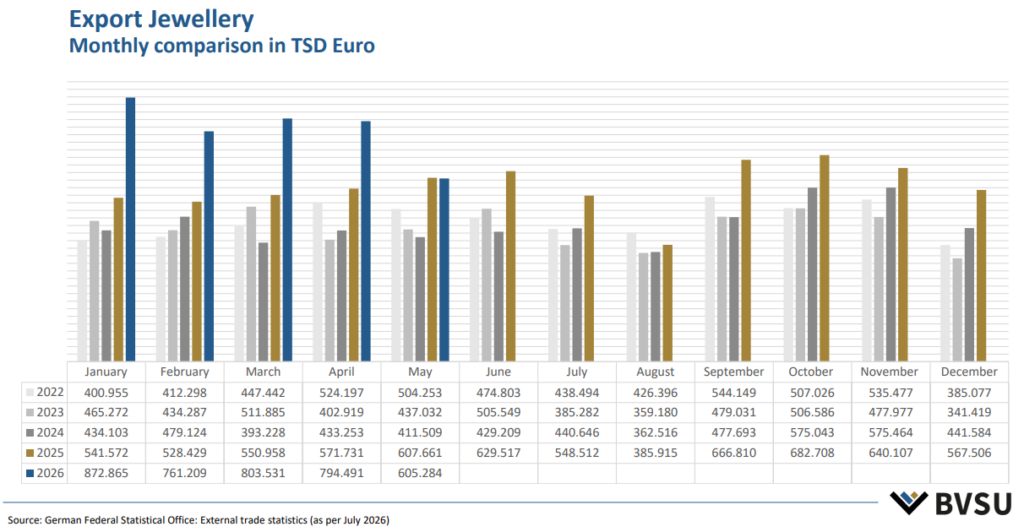
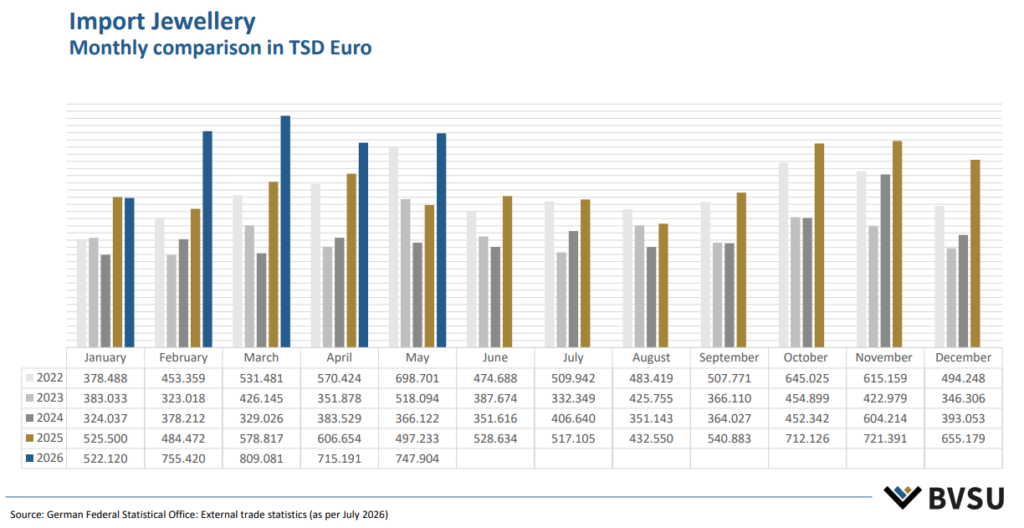
In May 2026, jewelry exports totaled 605.3 million euros. Compared to the previous month, this represents a significant decline of 31.6 percent; compared to May 2025, however, there was only a slight decrease of 0.4 percent. Jewelry imports, on the other hand, reached 747.9 million euros, up 4.4 percent from the previous month and 33.5 percent from the same month a year earlier.
Watches: Steady, but without clear momentum
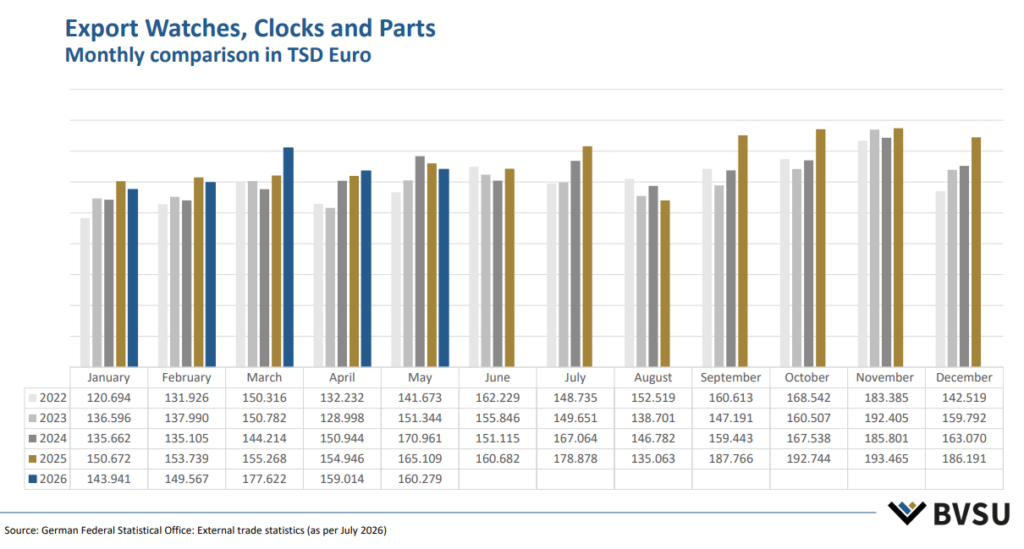
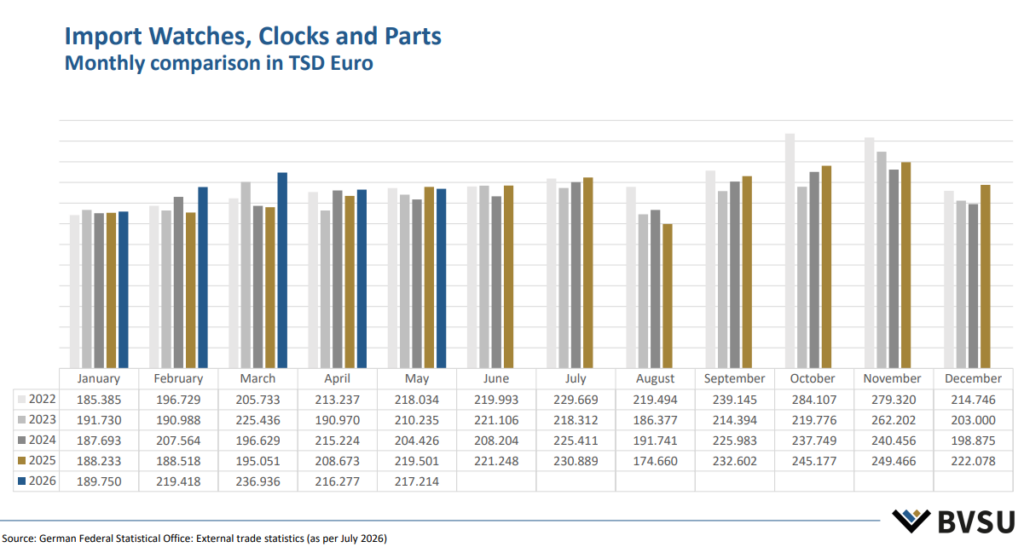
The trend for watches and watch parts was more subdued. Exports in May totaled 160.3 million euros, up 0.8 percent from the previous month but down 3.0 percent from May 2025. Imports totaled 217.2 million euros, an increase of 0.4 percent compared with April and a decrease of 1.1 percent compared with the same month a year earlier.
This confirms an observation from the first quarter: jewelry and watch figures must be interpreted differently. According to INSIGHT-LUXURY, the German watch industry performed significantly more steadily than the jewelry segment in Q1 and was less directly affected by precious metal prices. At the same time, however, it also lacked major growth drivers. (insight-luxury.com)
Precious metals have a delayed effect
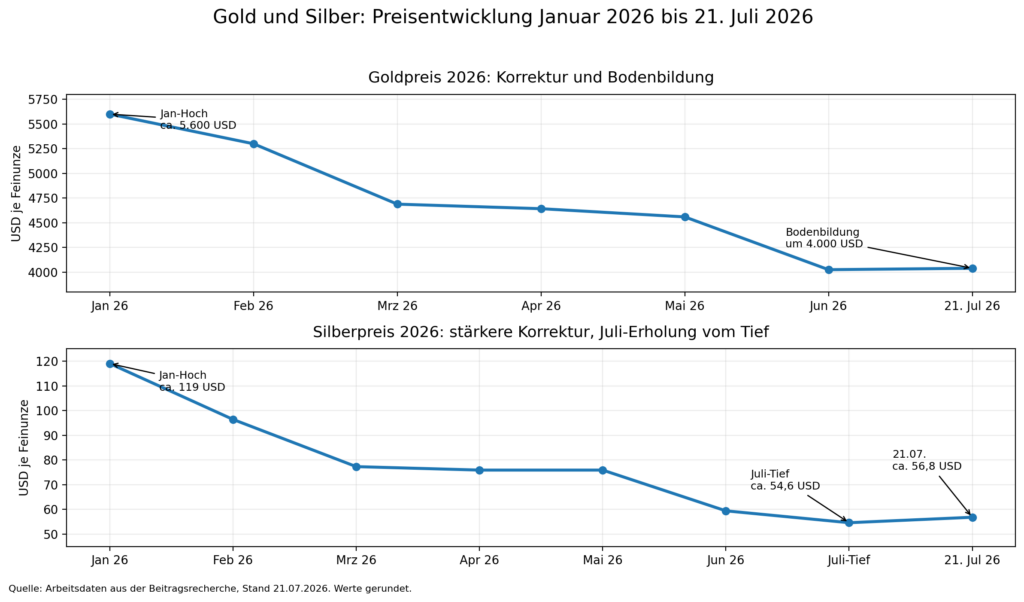
In May, the correlation between precious metal prices and foreign trade figures was less direct than in the first quarter, but remained relevant. While gold prices fell only moderately in May, silver remained virtually stable. However, the significant corrections from March and April may continue to affect the May statistics through inventory levels, timing of purchases, ongoing orders, invoicing, and delayed shipments.
In the jewelry sector, this connection is particularly obvious. Gold, silver, and platinum account for a significant portion of the value of goods. The 31.6 percent decline in jewelry exports compared to April cannot therefore be explained solely by price trends in May. It is more likely the result of a combination of the lingering effects of the previous price rally and correction, export timing, inventory movements, and fluctuating international demand. At the same time, jewelry exports were only 0.4 percent lower than in the same month of the previous year, which puts the sharp monthly decline into perspective.
Similarly, the 4.4 percent increase in jewelry imports compared with April should not be viewed in isolation. Following the strong precious metal prices at the start of the year and the subsequent pullbacks, imports may have been influenced by lag effects, perceived more favorable buying opportunities, inventory buildup, or shifts in trade flows. In a year-over-year comparison, the price effect remains particularly relevant: Jewelry imports were 33.5 percent higher than in May 2025, while the general price level for gold and silver remained significantly higher than in the previous year.
Clocks follow a different logic
When it comes to watches, the correlation with precious metals is less direct. Many watches and watch components are not primarily made of precious metals; for steel, titanium, ceramic, or component-based products, other factors play a greater role. Nevertheless, precious metal prices do have an indirect impact on the segment: through gold and two-tone models, case and band materials, inventory levels, price positioning, and demand for higher-end models.
The May figures paint a more stable, though still subdued, picture. Exports of watches and watch parts totaled 160.3 million euros, slightly higher than the previous month but 3.0 percent lower than in May 2025. Imports reached 217.2 million euros, virtually unchanged from April and 1.1 percent below the same month last year. This suggests less of a strong impact from raw material prices and more of a sideways trend with limited momentum.
What the May Figures Show
The May figures thus do not show a simple decoupling from precious metal prices, but rather a varying impact depending on the product category. Jewelry continues to be strongly influenced by the value of the materials and by lagging price effects. Watches react less directly to gold and silver but reflect international demand, inventory movements, price segments, and product mix. Precisely for this reason, foreign trade data based on value still require further explanation.
Hard Facts May 2026
605.3 million euros
in jewelry exports in May 2026; down 31.6 percent from the previous month, down 0.4 percent from May 2025.
Jewelry imports totaled 747.9 million euros
in May 2026; up 4.4 percent from the previous month and up 33.5 percent from May 2025.
160.3 million euros
in exports of watches and watch parts; up 0.8 percent from the previous month, down 3.0 percent from May 2025.
217.2 million euros
in imports of watches and watch parts; up 0.4 percent from the previous month, down 1.1 percent from May 2025.
Outlook for the remainder of 2026: Stabilization with upside risk
Following the sharp correction from the record highs at the start of the year, gold and silver are more likely to stabilize than to quickly resume their rally for the remainder of 2026. Gold bottomed out in July at around $4,000 per troy ounce; many forecasts predict prices will rise again by year-end, to a range of approximately $4,500 to $4,900. The market is being supported by geopolitical uncertainty and ongoing demand from central banks. According to the World Gold Council, 89 percent of the central banks surveyed expect global gold reserves to continue rising over the next twelve months.
At the same time, headwinds from high interest rates, the U.S. dollar, and real yields persist. The World Gold Council accordingly describes the second half of the year as a period in which gold will continue to be strongly influenced by geopolitics, interest rate expectations, and investor positioning. For the jewelry industry, this means that gold is unlikely to become significantly cheaper. Price and cost pressures remain, even though the extreme volatility of the first half of the year has subsided for the time being.
The picture for silver is more volatile. The price has corrected more sharply than gold’s, but has greater upside potential due to structural scarcity. The LBMA cites an analyst consensus of $79.57 per troy ounce for 2026; at the same time, the range of forecasts remains wide. The key difference from gold is that silver is in high demand not only as an investment but also for industrial purposes. If the expected supply deficit persists, the price could recover more quickly than gold in the second half of the year.
For the industry, this paints a clear picture: Precious metals will remain a factor affecting both value and risk through the end of the year. Jewelry manufacturers and retailers must continue to expect fluctuating purchase prices, challenging cost calculations, and retail prices that require explanation. At the same time, the high price level reinforces the perception of gold, silver, and platinum as tangible assets. Products with a clearly identifiable precious metal content thus gain a stronger case based on intrinsic value—but are also subject to closer scrutiny regarding their pricing.
Sources and Data Sources for Precious Metal Prices:
Federal Association of Jewelry, Watches, Silverware, and Related Industries (BVSU)
The price and forecast data for gold, silver, and platinum are based on the following sources:
Heraeus Precious Metals – Precious Metals Forecast 2026
: Forecast ranges for gold, silver, and platinum, as well as assessments of supply and demand trends.
World Gold Council (WGC)
Analysis of Gold Price Trends, Central Bank Purchases, Geopolitical Risks, and Market Conditions in the Second Half of 2026.
London Bullion Market Association (LBMA)
reference prices for gold, as well as analyst estimates and forecasts for precious metals, particularly gold and silver.
Reuters / HSBC
: Current market reports and forecasts on gold price trends, including the expected price trend through the end of 2026.
The Silver Institute / World Silver Survey 2026
: Data on silver demand, the expected supply deficit, and industrial demand.
J.P. Morgan, Goldman Sachs, UBS, Société Générale
: Additional analyst forecasts for gold and silver for the second half of the year and year-end 2026.
Data from the contribution research, as of July 21, 2026
. Exchange rates and rounded monthly figures were used for the graphical representation of gold and silver price trends.