

Watch-News Briefing: Venezianico, MB&F, and Lederer
This edition of “Watch News in Brief” brings together three different visions of contemporary watchmaking. Venezianico focuses on light weight, Italian mechanics, and a hand-guilloché dial for the Redentore Levius. MB&F reinterprets its unusually understated SP One with white gold and 255 diamonds. Lederer, on the other hand, transforms a mathematical concept into the three-dimensional structure of a dial.
In this issue: Venezianico, MB&F, Lederer
Venezianico Redentore Levius: Lightness as a Concept
With the Redentore Levius, Venezianico brings the collection’s classic design to an exceptionally lightweight model. The 38-millimeter case is made of Grade 5 titanium, is 8.9 millimeters thick, and weighs 40 grams without the strap. Together with the Italian leather strap, the watch weighs 48 grams.

In elegant watches, titanium is usually given a subtle satin or sandblasted finish. Venezianico, on the other hand, combines brushed and polished surfaces. This preserves the Redentore’s clean, neoclassical form, while its light weight alters the way it feels on the wrist.
Zefiro: Wind as a Guilloché Pattern
The focal point is the dial, featuring the specially developed “Zefiro” pattern. It is named after Zephyros, the gentle west wind of Greek mythology. The wavy lines are intended to represent not so much the wind itself as its movement across the surface.

Each dial is hand-guilloché by Linda Renzetti on a mid-19th-century rosette machine. Pressure, rhythm, and feed are controlled entirely by hand. Since lines that have already been drawn cannot be corrected, small differences arise between individual dials despite their precise geometry.
The Levius is powered by the hand-wound V5000 caliber. Manufactured by OISA, the movement was developed by Fausto Berizzi and Venezianico’s technical director, Andrea Menegazzo, and is entirely made in Italy. By omitting an automatic rotor, the design remains slim, and the movement is clearly visible through the sapphire crystal case back.
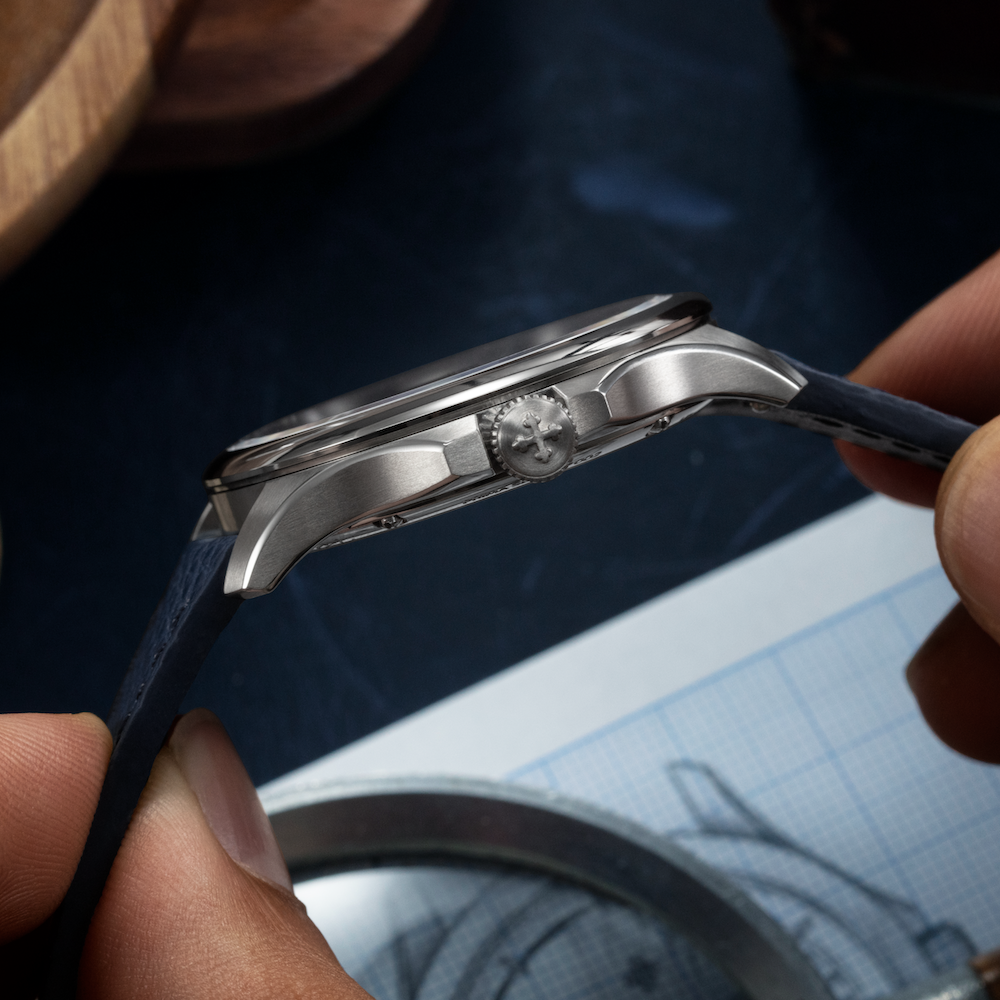
The first 100 pieces are individually numbered and, according to the manufacturer, are available immediately. Another 100 watches are expected to follow within a month; for later orders, Venezianico estimates a delivery time of up to five months. The price is 4,750 euros.
MB&F SP One Pavée: Diamonds Frame the Movement
MB&F reinterprets the understated architecture of the SP One in a more luxurious version. The new SP One Pavée features a 38-millimeter-wide, 12-millimeter-high case crafted from 18-karat white gold. A total of 255 diamonds, weighing a combined 1.608 carats, are set on the case, bezel, crown, and clasp.

The bezel follows the curves of the watch rather than covering its architecture with a flat surface. This leaves the three characteristic circles of the design fully visible: the mainspring barrel, the balance wheel, and the time display—tilted at the six o’clock position—appear to float in the center. In the pavé version, the previously black finish changes to a dark blue.
Inside, the watch is powered by the SP One’s well-known hand-wound movement. It consists of 189 components, operates at 2.5 hertz, and offers a 72-hour power reserve. Hand-angled wheels, polished bevels, and hand-engraved details remain integral to the finishing concept. In the pavé version, the bridges are rhodium-plated, echoing the cool tones of white gold and diamonds.
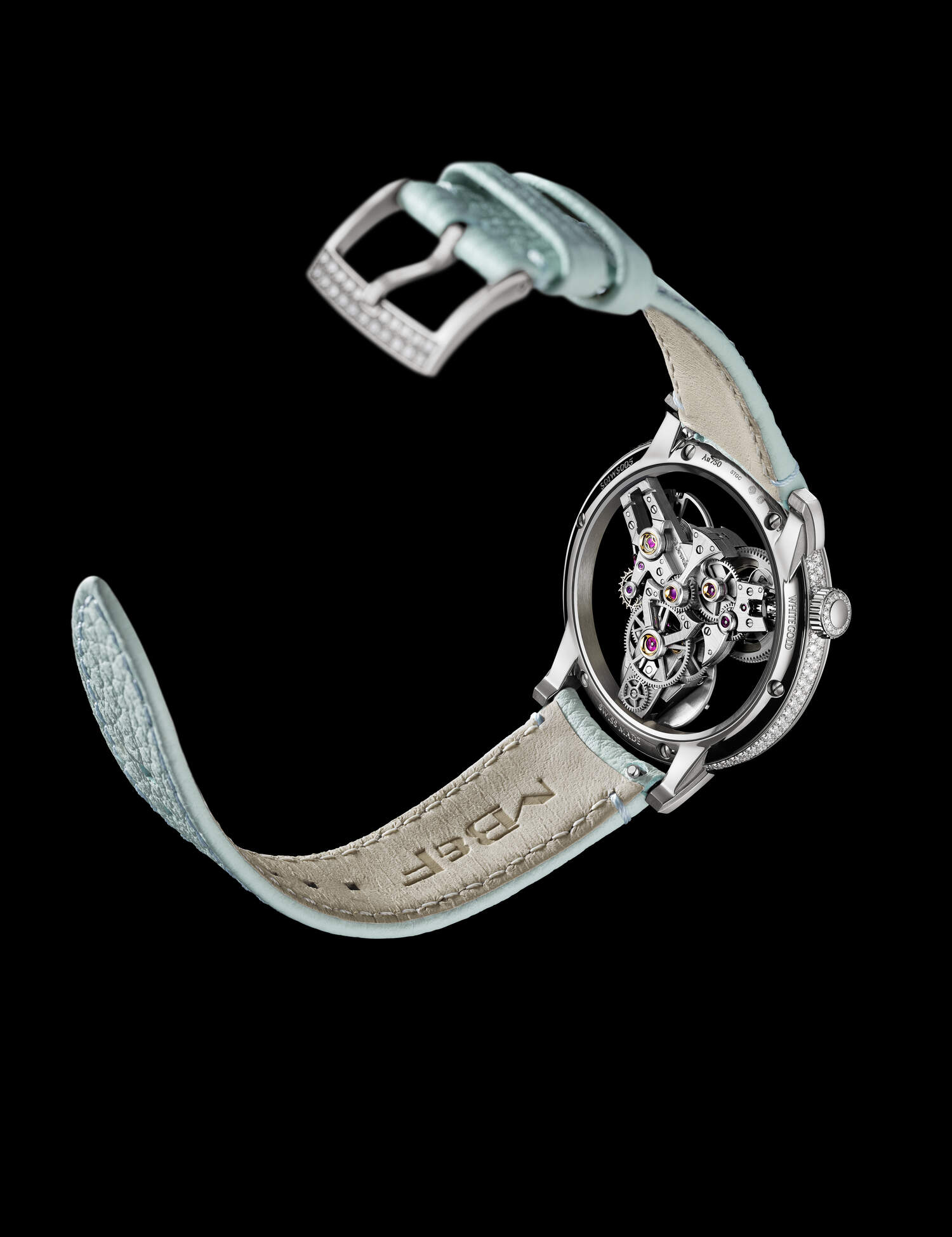
With the SP One, MB&F revealed an unusually classic side of itself in 2025. The model is the Geneva-based brand’s smallest and thinnest wristwatch to date and bridges the gap between the experimental Horological Machines and the more tradition-oriented Legacy Machines. The new version retains these proportions but significantly alters its appearance with its diamond-set bezel. The price is 85,000 euros plus taxes.
Lederer CIC EinStein 44: Mathematics Comes to Life on the Dial
With the CIC EinStein 44, Lederer translates a mathematical concept into watchmaking. The starting point is the long-standing open question of whether a surface can be completely filled with just one basic geometric shape without the resulting pattern repeating regularly. In Lederer’s design, this principle is not merely superimposed: the geometry forms the spatial structure of the dial.

Delicate ridges separate the individual shapes from one another. Three distinct levels of relief lend depth to the surface and ensure that the pattern changes depending on the viewing angle and the angle of the light. The result is not a flat graphic decoration, but a three-dimensional composition.

Each dial is based on a different section of the same continuous geometric sequence. As a result, the arrangement remains part of a shared mathematical system without repeating exactly from one watch to the next. The CIC EinStein 44 thus combines abstract mathematics, artisanal craftsmanship, and mechanical watchmaking into a unique design.