



My jewelry month of October: The Louvre drama and solutions for the future
No topic dominated the jewelry world in October as much as the robbery at the Louvre, in which valuable Napoleonic jewelry was stolen. Why are emotions running so high, and what measures exist to better protect jewelry in the future?
A loss in the millions
On October 19, nine historically valuable pieces of jewelry from the Napoleonic era were stolen from the Louvre Museum in Paris. Their value is estimated at approximately 88 million euros. The world is in an uproar – shocked by the immense historical value of the jewelry and simultaneously almost morbidly fascinated by the fact that the theft occurred in broad daylight while visitors were in the museum, forcing its evacuation.
There is great concern about the fate of the valuable jewelry. A necklace and earrings each with sapphires and diamonds, as well as the same pair with emeralds and diamonds, a crown with sapphires and diamonds, a tiara with pearls, and two diamond brooches were stolen. Another crown was dropped by the perpetrators during their escape.

What usually awaits such loot is destruction. Stones are pried from their settings and sold individually, and the precious metals in the jewelry are melted down. Thus, the treasures are irretrievably lost. It is very rare for the jewelry to be recovered, as in the comparable case of the burglary at the Dresden Green Vault.
Here you can follow the developments in the Louvre robbery:
- Jewelry robbery at the Louvre: What is missing and what history teaches us
- Breakthrough after Louvre break-in: Two men arrested
- Developments in the Louvre jewelry heist: further arrests and first confessions
Against loss: A solution from science
There is a solution that could at least offer some relief should another valuable piece of jewelry be stolen from a museum. Because: not only do the perpetrators have fingerprints and leave them at the scene of the crime – the gemstones also possess their own unique fingerprint.
One expert who has examined the composition and origin of gemstones in a famous piece of jewelry—the so-called Imperial Crown—is Professor Hans Albert Gilg of the Technical University of Munich. The engineering geologist knows how to examine gemstones and can characterize them based on their inclusions and chemical composition. This results in such a precise description of the stones that it can be described as their fingerprint. If the stones were lost, they could be re-identified based on their chemical profile. This theoretically makes it more difficult to simply "disappear" gemstones as stolen goods after a jewelry robbery.
More gemstone characterization for art treasures, please!
Professor Gilg explains that characterizing artifacts can be valuable for protecting art treasures such as the famous Imperial Crown or even those stolen from the Louvre. "Actually, determining the material value would be the responsibility of the insurers," says the engineering geologist.
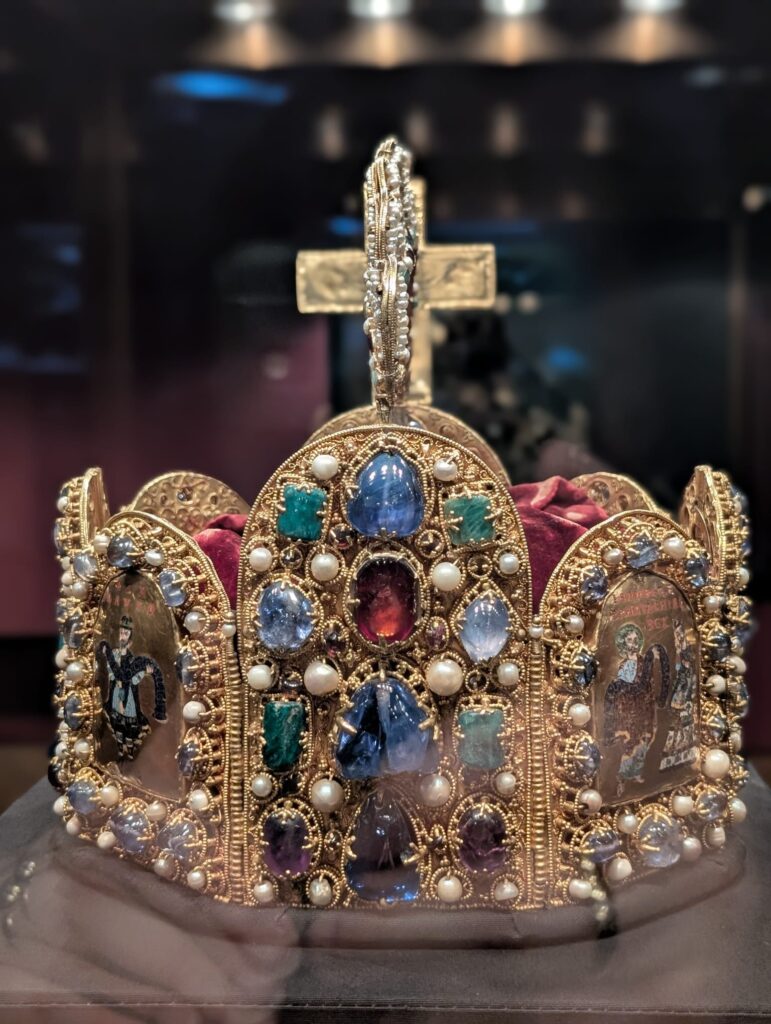
While museums, such as the Treasury in Munich, now possess their own equipment for examining gemstones, they often still require expert assistance for the analysis. Earlier examinations using less precise methods frequently yield inaccurate results, and a large proportion of the gemstones in famous exhibits are not even properly categorized. Of course, examining the gemstones in Europe's jewelry treasures costs money, and this is often not readily available.
Research projects like the examination of the Imperial Crown, in which Professor Gilg participated, make it possible to characterize valuable, historical gemstones, because in conjunction with scientific research, the identification of these gemstones can then be financed. Further cooperation with universities in this area would also be conceivable in order to protect this precious cultural heritage.
Real treasures belong in the safe?
Indeed, in many European museums we have the privilege of admiring original treasures worn by queens and kings, princes and military leaders – a true privilege. But the fact that these treasures are not slumbering in a vault, but are presented to us in all their splendor, also puts them at risk – as is the case with the Louvre.
Gemstone imitations, and especially synthetic diamonds, which are becoming increasingly affordable, would be perfect for creating imitations of the famous diadems and crowns, but the work involved in making the replicas is itself a costly and time-consuming undertaking.
One can only hope that the Louvre jewelry heist opens the world's eyes to what we actually have to lose and that these treasures are worth protecting in ways that go beyond alarm systems and bulletproof glass cases. Who knows, perhaps industry can also help? De Beers has just unveiled its ORIGIN range., which uses blockchain technology to track diamonds from the mine to the market.

 Deutsch
  English (UK)