



Rado makes the Centrix sparkle
And that's twice over. Rado has equipped both new versions of the "Centrix Diamonds" with 71 brilliant-cut diamonds (Top Wesselton, VS-SI), distributed between the bezel and the dial.
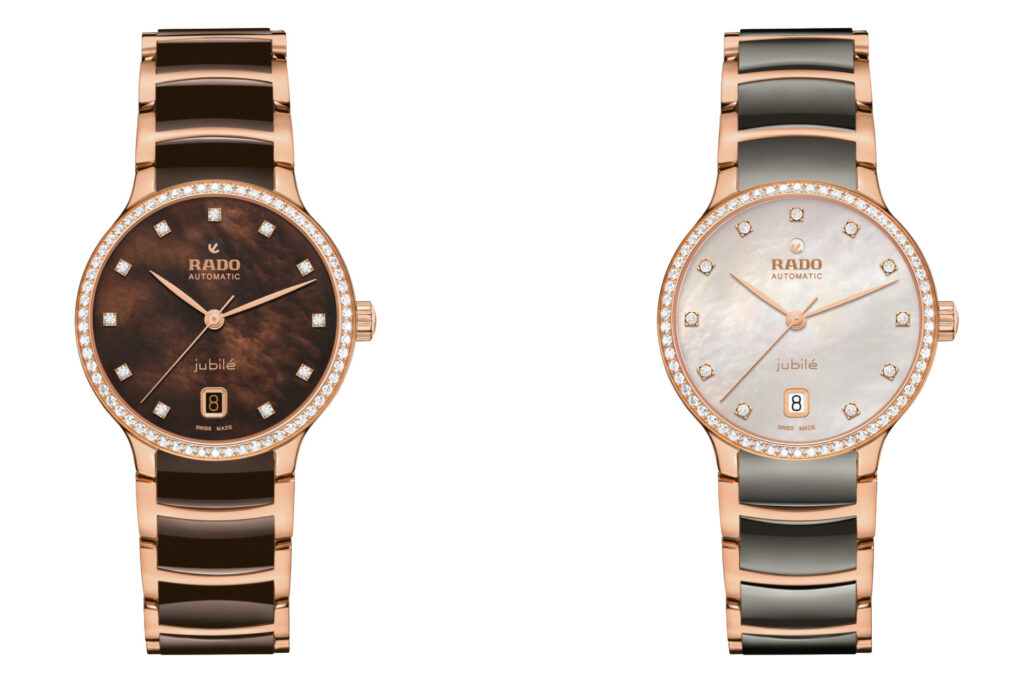
These „Centrix“ timepieces combine the brilliance of diamonds with the shimmer of mother-of-pearl for the dial – optionally in a dark brown or a bright silver sheen.
In both cases, a 35-millimeter rose gold-colored case serves as a protective frame. The crown, hands, and bracelet also feature this material. The latter combines the precious metal with center links made of polished, durable high-tech ceramic in warm brown (matching the brown mother-of-pearl) or in Rado's Plasma finish (for the silver version).
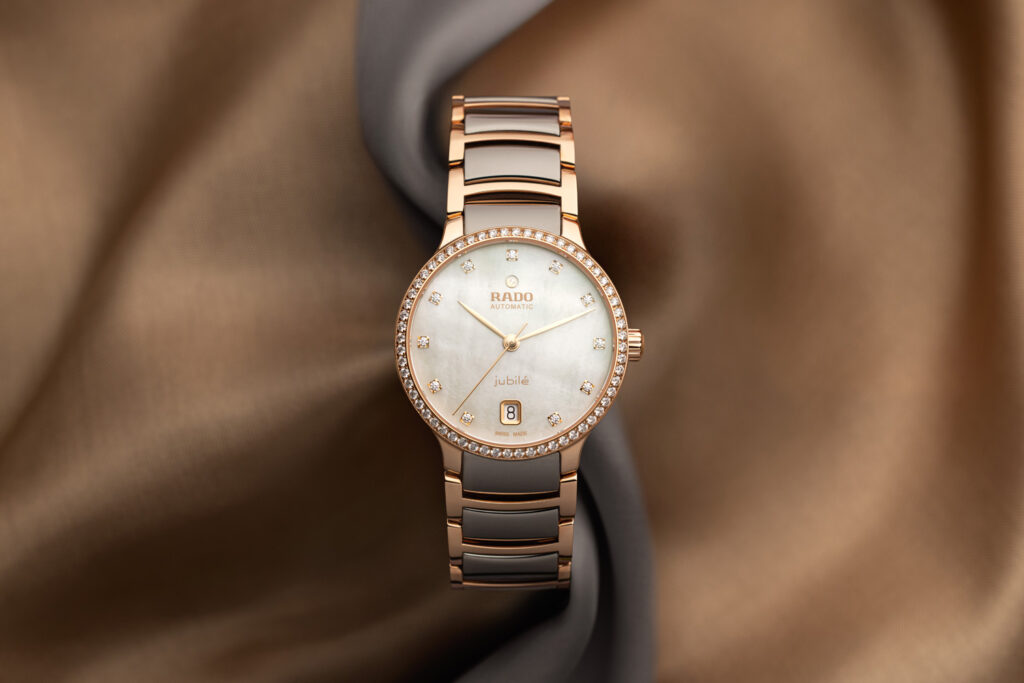
The dial with date window at 6 o'clock, the movable Rado anchor at 12 o'clock and the 11 diamond indices is covered by a domed sapphire crystal that extends to the edge and seamlessly transitions into the case, which is water-resistant to 5 bar.

Inside, the Rado caliber R763 ensures precision. It is equipped with an antimagnetic Nivachron balance spring, has been tested in five positions, and offers an 80-hour power reserve. It can be viewed through the sapphire crystal case back.
(RRP: €5,000)
High-tech ceramics from Rado
Following intensive research and development, Rado presented a material in 1986 that can only be produced under strictly controlled conditions. The manufacturing process begins with extremely pure, precisely calibrated zirconium oxide mineral powders, which are mixed with a specially developed polymer carrier medium and injected into precision molds under a pressure of approximately 1,000 bar.
These molds are fired, then slowly cooled, and the plastic substrate is subsequently chemically removed. In the next step, the ceramic molds are reheated – this time to 1,450 °C. Through this precisely controlled sintering process, the powder particles fuse to a density and hardness that significantly surpasses that of conventional ceramics. The result is a material with a hardness of 1,250 on the Vickers scale, which can only be machined and finished using diamond tools.


 Deutsch
  English (UK)