

Omega: The first two-hand watch with Master Chronometer certification
A new acoustic testing method makes it possible, for the first time, to certify a two-hand watch as a Master Chronometer. This method was developed at the Laboratoire de Précision, which was founded in 2023 and opened by Omega last year.
The movements and watches in Omega’s “Constellation Observatory” collection undergo both chronometer and Master Chronometer testing without requiring a seconds hand. For the first time in the history of watchmaking, a two-hand watch with hour and minute hands has received Master Chronometer certification.

Acoustic testing method enables the Constellation Observatory
Since 1952, the “Constellation” collection has embodied Omega’s commitment to certified precision. With two new movements across a total of nine models, the “Constellation Observatory” collection continues this tradition. The 39.4-millimeter watches combine the line’s decades-long design tradition with modern precision testing and exclusive materials throughout the collection.
“Until now, a seconds hand was required for precision certification. With the development of a new acoustic testing method, this requirement is no longer necessary. This breakthrough has enabled us to introduce the ‘Constellation Observatory,’ the first two-hand watch with Master Chronometer certification,” explained Raynald Aeschlimann, President and CEO of Omega.
The Precision Laboratory
The Laboratoire de Précision serves as an official, independent certification body responsible for its own measurement technology and management. It is certified by METAS for the Master Chronometer and officially accredited by SAS as a testing laboratory for chronometers. The Laboratoire’s structure ensures impartial and confidential results that the entire watch industry can rely on with confidence.
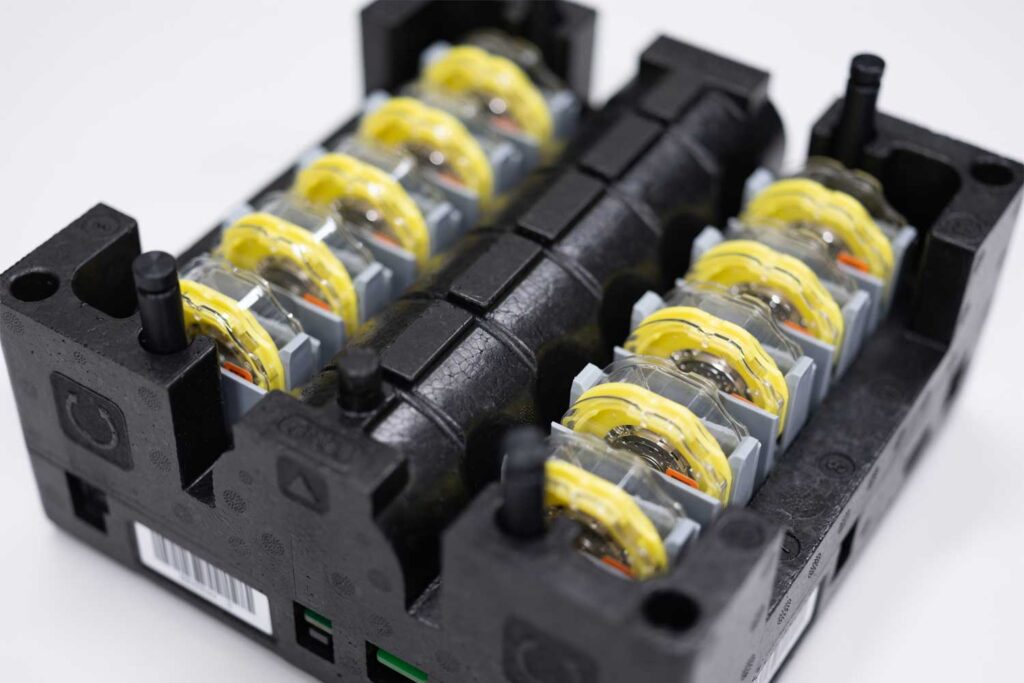

Dual Metric Technology
The laboratory has developed a wireless, standalone testing unit that combines all certification processes for Chronometers and Master Chronometers into a single device. Thanks to Dual Metric Technology, the device continuously monitors the timekeeping performance while simultaneously recording environmental parameters such as temperature, position, and air pressure throughout the entire 25-day testing period.
In traditional tests, the position of the second hand was previously recorded photographically, resulting in two data points per day. Dual Metric Technology generates continuous data from the very first second.
The acoustic signature can identify frequency irregularities, temperature and pressure sensitivities, positional deviations, and amplitude fluctuations. This allows watchmakers not only to determine whether a deviation exists, but also where and when it occurs.
Traditional design elements
The “Constellation Observatory” collection reinterprets Omega’s signature aesthetic features.
These include:
- The sleek design of the “1948 Centenary,” created to mark Omega’s 100th anniversary, which laid the foundation for the “Constellation.”
- The twelve-sided dial introduced in 1952, featuring the “Constellation” star at 6 o’clock and the “Constellation” observatory medallion on the case back.
- The guilloché finish on the facets of the “Pie-Pan” dial, introduced in 1953.
- The hour markers, each reinterpreted in a new style (originally faceted dragon-shaped indices), and traditional Dauphine hands.
- The dog-leg lugs that characterized the Omega models of that era.
- The nine-row brick pattern on an 18K Moonshine gold bracelet, inspired by brick-pattern bracelets from the same era.
Two new Master Chronometer calibers
The collection features two new calibers, mounted on a skeletonized rotor base with polished or glossy bevels, and featuring a rounded outer zone on the rotor as well as an applied “Constellation” observatory medallion. The Caliber 8915 is available in the Grand Luxe and Luxe categories, along with the Caliber 8914 Standard. All offer a 60-hour power reserve.
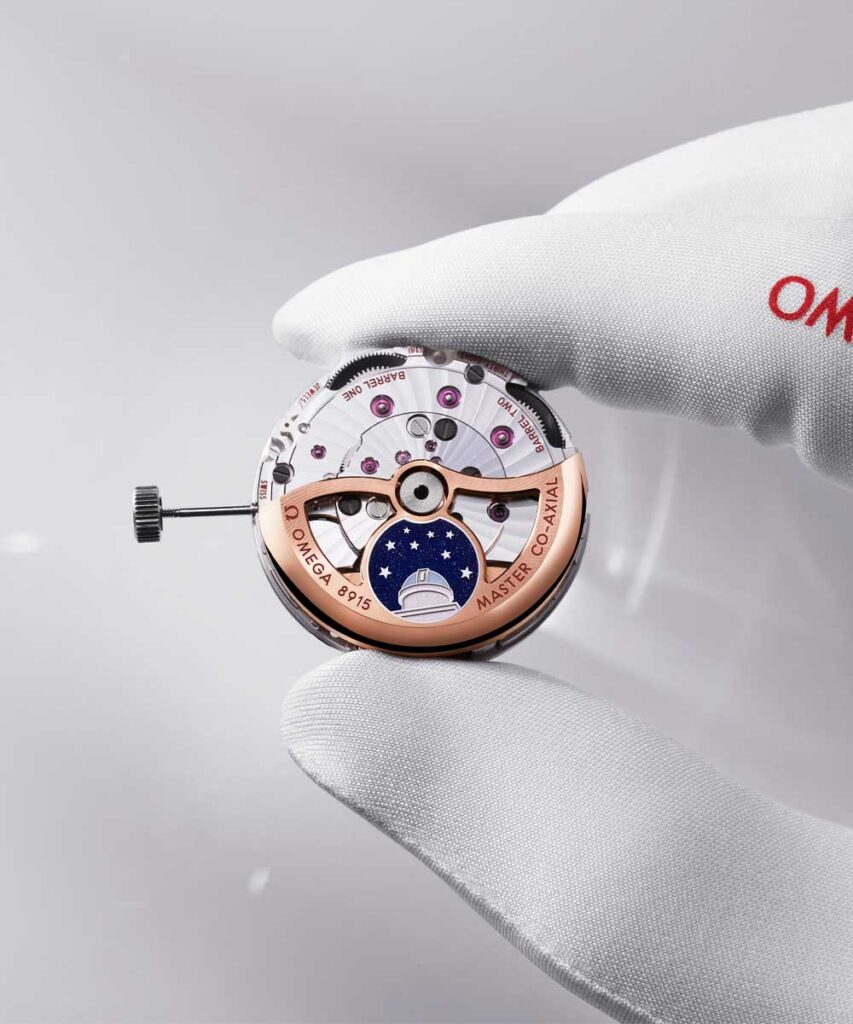
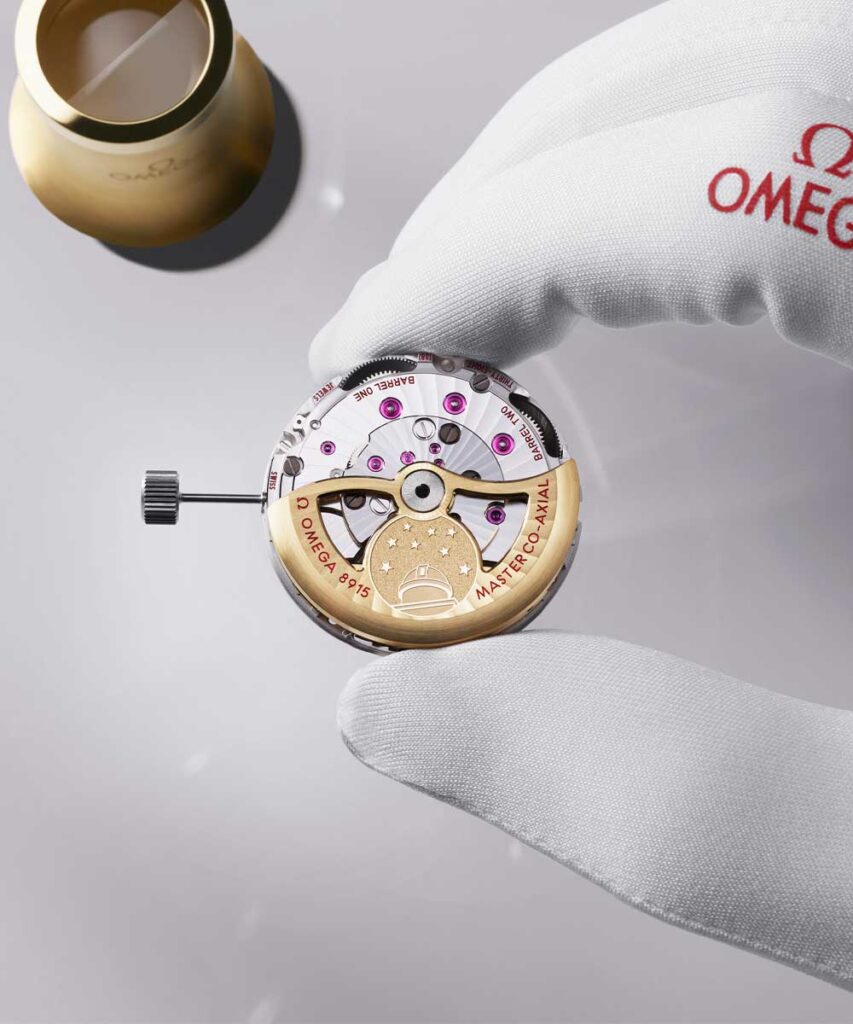

The Caliber 8915 Grand Luxe is paired with the 950 platinum-gold edition. It features an 18K Sedna gold rotor base with a delicate spiral pattern and a polished outer zone. The observatory medallion, crafted from 18K white gold, is laser-engraved and adorned with a dark blue sky made of aventurine glass and eight stars. The dome of the observatory is filled with translucent white opal enamel.
The Calibre 8915 Luxe movements were developed for the collection in 18-karat gold and, in addition to the standard 18K Sedna gold, feature a rotor and balance bridge made of 18K Moonshine gold for the first time in Omega’s history. The rotor base features Geneva stripes in an arabesque pattern and a horizontally brushed outer zone. The 18-karat gold medallion is enhanced by laser-engraved elements and contrasting matte and polished surfaces.
The Caliber 8914 Standard is a rhodium-plated version of the Caliber 8915 Luxe and powers the O-Megasteel watches. (MSRP: €10,600–€11,800)
Caliber 8915

Four versions in 18-karat gold have been created to achieve a seamless precious metal look. Crafted from 18K Sedna or Moonshine gold, these models harmoniously combine a 39.4-millimeter case, a hand-guilloché dial, and the movement, and are available with a leather or metal strap. The model crafted from 18K Canopus gold combines a clean-cut watch design with an 18K Sedna gold movement visible through the case back.


The Platinum-Gold Edition rounds out Omega’s precious metal lineup and, for the first time, brings together all four of the brand’s proprietary precious metal alloys in a single collection. (€36,700–57,200)
Caliber 8914
Four 39.4-millimeter models are available in Omega’s exclusive steel alloy, which was selected for its hardness and mechanical properties.


The collection features a black ceramic dial in a pie-pan shape—a significant technical achievement in dial manufacturing that required extensive development work to achieve the precision of the twelve-sided shape in ceramic. Three additional models feature colored dials with embossed grooved facets.

Omega Milestones in Precision
- 1948: Omega unveils the “Centenary,” its first chronometer-certified automatic watch.
- 1952: The “Constellation” becomes Omega’s first mass-produced chronometer collection. From the very beginning, every mechanical “Constellation” is a chronometer.
- 1999–2013: Omega introduces the Co-Axial escapement, the first practical new escapement in 250 years. It reduces friction, thereby ensuring greater long-term accuracy. This is followed by fully anti-magnetic movements featuring silicon, Nivagauss, and non-magnetic components.
- 2015: The “Globemaster” receives the first Master Chronometer certification from METAS. The watches are evaluated as complete timepieces, and are tested not only for precision and magnetic resistance, but also for power reserve and water resistance.
- 2023: Omega establishes the Laboratoire de Précision, which is officially accredited as a measurement laboratory in accordance with the ISO/IEC 17025:2017 standard.
- 2026: The “Constellation Observatory” collection will be the first two-hand watch collection to be tested by the Laboratoire de Précision. The testing process uses an acoustic method that eliminates the need for a seconds hand during precision testing.
omegawatches.com