

German Jewelry and Watch Industry 1st Quarter 2026: Record Figures with a Question Mark
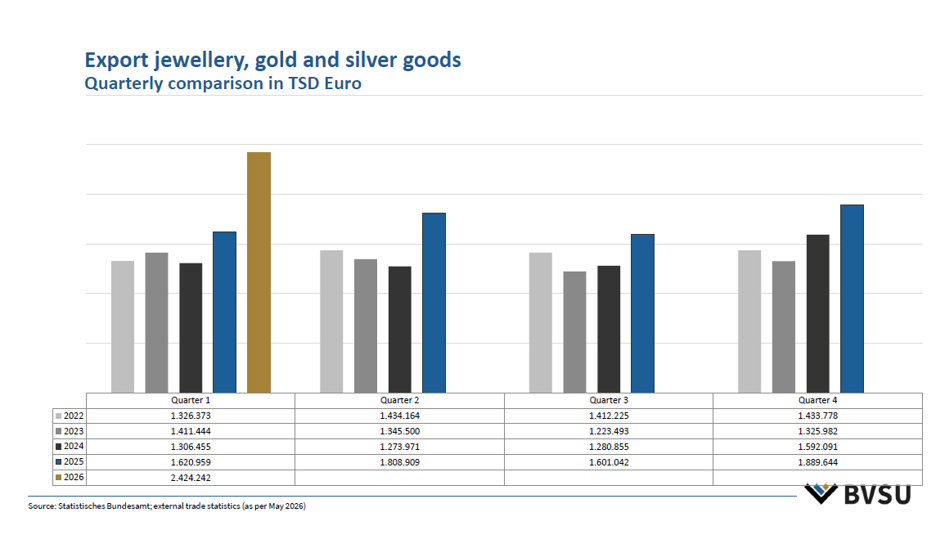
The German jewelry and watch industry is starting 2026 with exceptionally high foreign trade figures. According to current figures from the Federal Association of Jewelry, Watches, Silverware, and Related Industries (BVSU), exports of jewelry, gold, and silverware reached approximately 2.42 billion euros in the first quarter of 2026—a new quarterly record and an increase of nearly 50 percent compared to the same period last year.
However, as was already evident in earlier reports by the BSVU (as reported by INSIGHT-LUXURY here) on the state of the industry, the same is true this time around: the impressive statistics only partially reflect the actual economic reality facing many companies.
Precious metal prices skew the statistics
The BVSU expressly points out that these extraordinary figures are primarily driven by the sharp rise in precious metal prices. Gold, silver, and platinum have been on a historic upward trend for several years, which has accelerated dramatically since the end of 2025.
By the end of 2025, gold had reached prices of over $4,400 per ounce for the first time. According to the BVSU, silver rose by about 150 percent within a year, and platinum by more than 110 percent.
As a result, the industry’s foreign trade figures reported in euros automatically rise—even when actual unit sales or real demand are significantly less robust.
The association puts it in unusually clear terms:
“Anyone who reads the figures without this context will get a fundamentally distorted picture of the industry’s actual economic situation.”
Jewelry exports are rising significantly
Exports of precious metals and semi-finished products saw particularly strong growth. At around 1.34 billion euros, this sector was up more than 60 percent from the same quarter of the previous year.
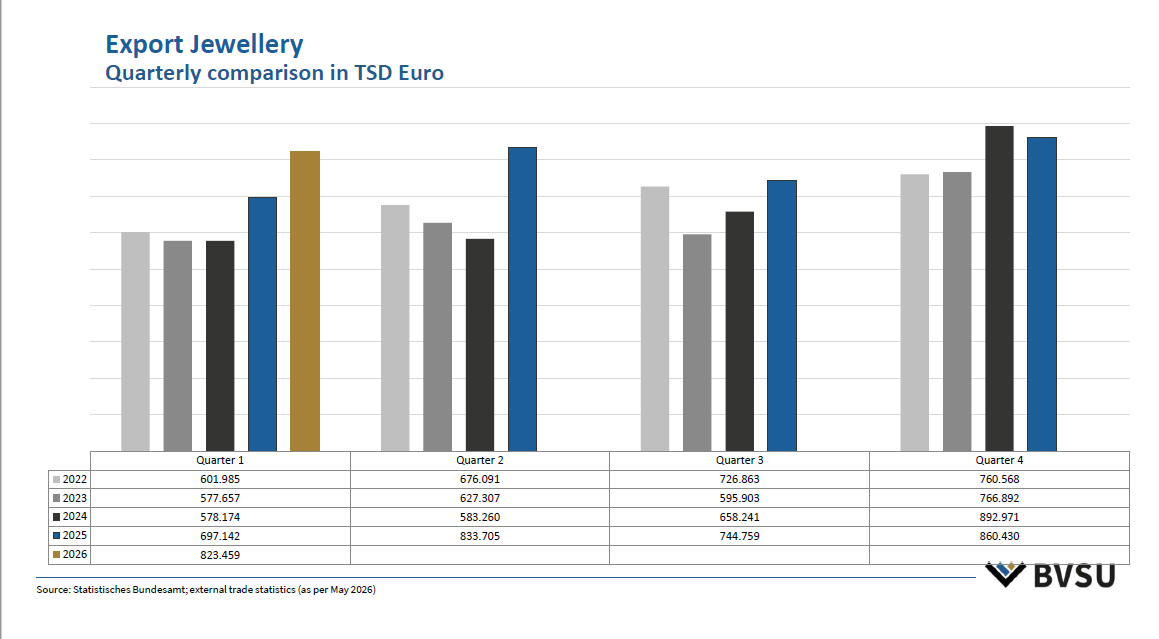
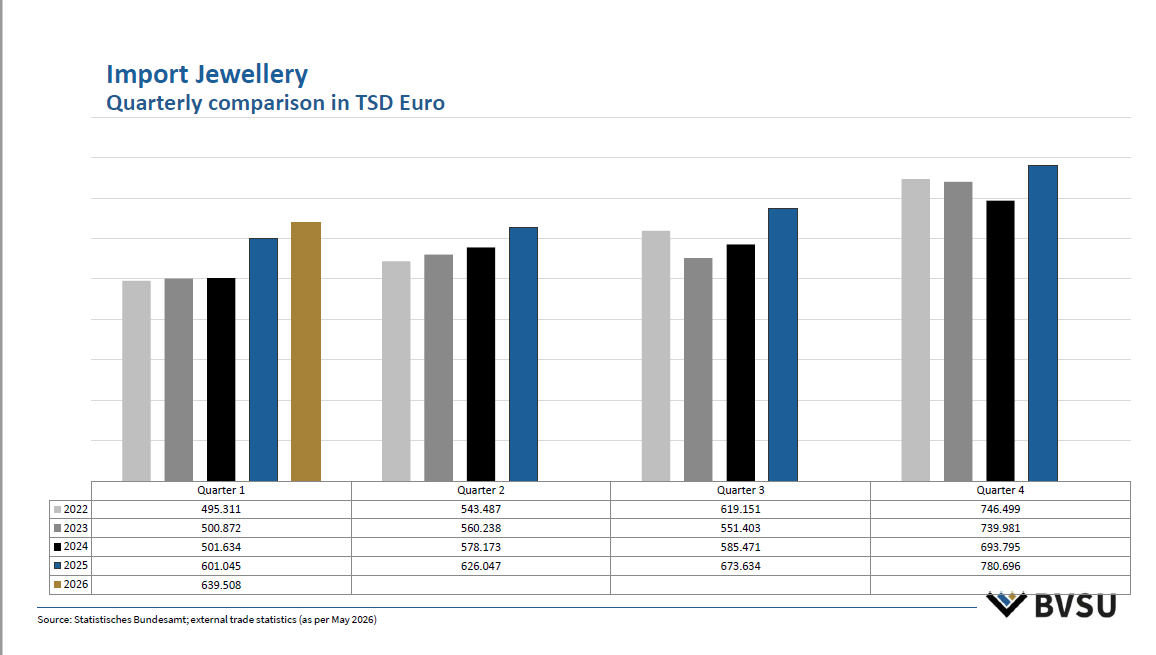
Exports of finished jewelry also rose to 823.5 million euros. This represents an increase of approximately 18 percent compared to Q1 2025. At the same time, imports of finished jewelry also rose to 639.5 million euros.
It is interesting to note that the BVSU anticipates, at least in part, a slight recovery in international demand—even though it remains difficult to make reliable statements about actual sales figures.
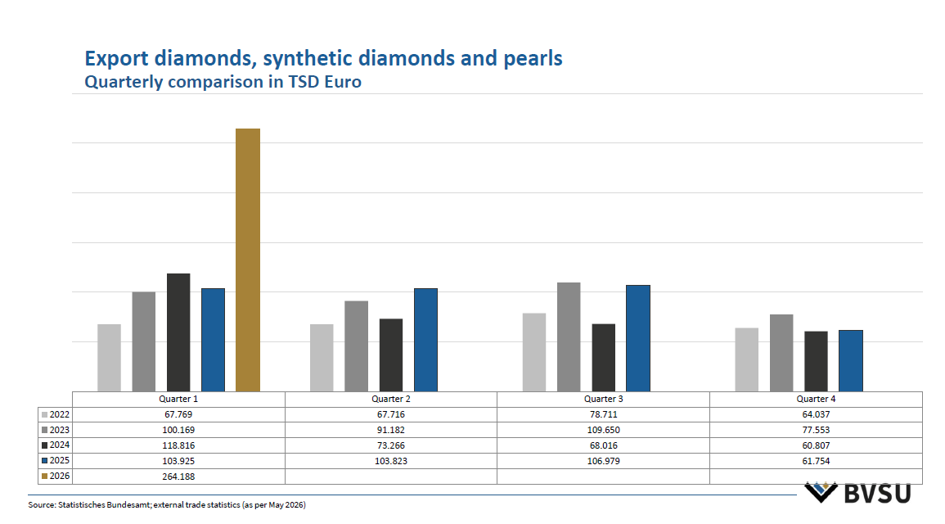
The trend in precious stones, diamonds, synthetic diamonds, and pearls is particularly striking. In this sector, export values rose to 264.2 million euros, more than double the figures for the same quarters of the previous year. This extraordinary development suggests that additional market forces are currently at play in this segment, which cannot be explained solely by the general rise in precious metal prices.
Watch industry shows more stable performance
By contrast, the German watch industry is experiencing much more subdued growth. Total exports of watches, clocks, and parts rose moderately to 470.1 million euros in the first quarter of 2026, representing an increase of about 2.3 percent over the previous year.
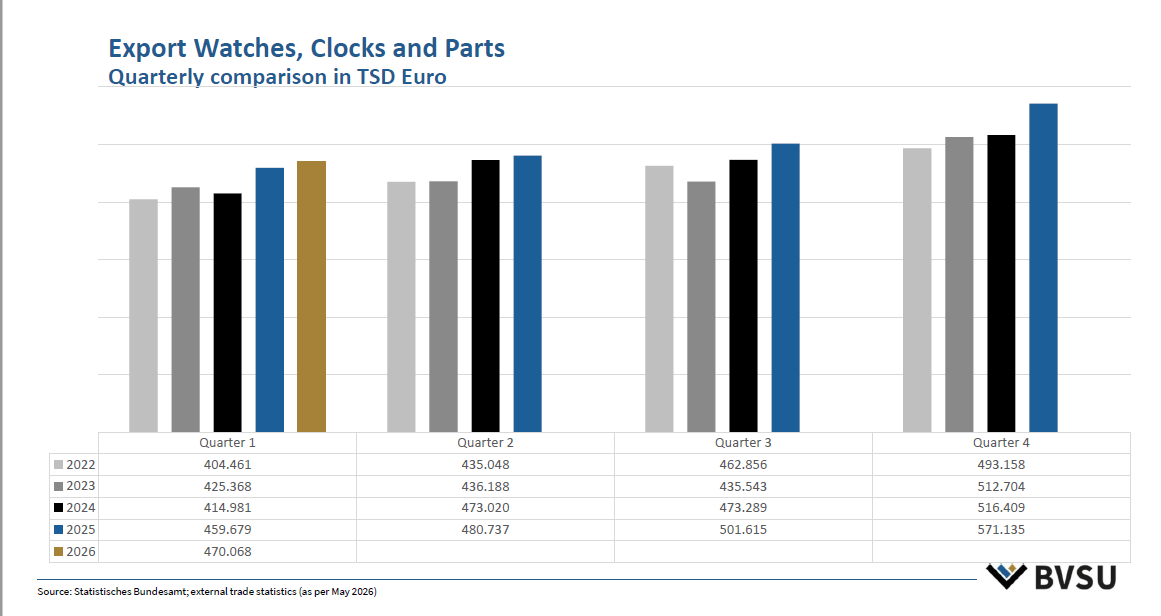
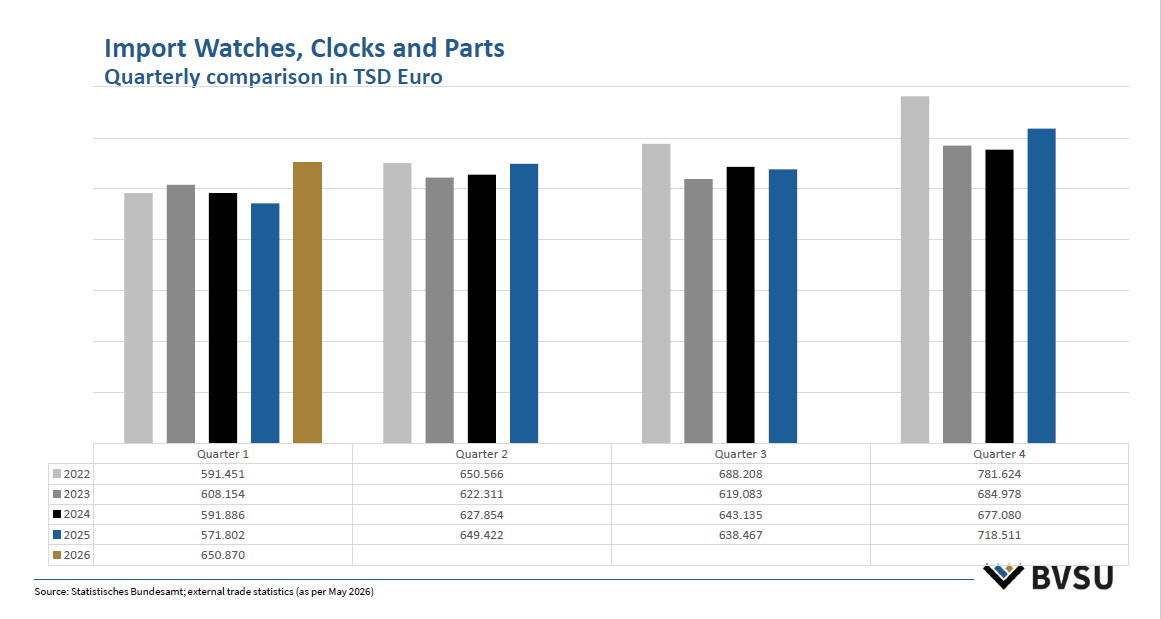
Exports of wristwatches remained virtually unchanged from the previous year at 428.4 million euros. At the same time, imports of watches and watch parts rose significantly to 650.9 million euros.
The association interprets this, among other things, as a possible normalization of inventory levels following periods of weaker imports in previous years. Compared to the jewelry segment, the watch industry is thus currently much less affected by precious metal prices and is generally more stable, though it is also lacking significant growth momentum.
Geopolitics is becoming an economic factor
The BVSU clearly frames this development in geopolitical terms. In addition to the war in Ukraine, trade conflicts between the U.S. and China, and global debt and currency issues, the association specifically points to the escalation of the Iran conflict in early 2026.
These uncertainties are increasingly pushing precious metals into the role of global safe-haven assets. At the same time, this is creating greater operational challenges for the industry:
Higher capital requirements, reduced predictability, and more difficult cost calculations, coupled with greater price volatility and increasing pressure to pass on price increases to end customers
According to the BVSU, small and medium-sized enterprises in particular are increasingly facing the challenge of passing on sharply rising material costs to customers without losing demand.
Between the luxury boom and the pressure to conform
This also confirms the assessment presented in the earlier INSIGHT LUXURY article on the state of the German jewelry and watch industry: The sector continues to navigate between impressive statistics and real pressure to adapt.
While some international luxury groups and high-end jewelry houses continue to benefit from global demand, the situation for many mid-sized manufacturers remains more complex. High precious metal prices, cautious consumers, geopolitical uncertainties, and rising financing costs are noticeably altering market dynamics.
At the same time, however, new opportunities are also emerging. Especially in the high-end segment, topics such as:
- Value
- Precious metals as a safe haven
- durable products
- Repairability
- Heritage
- artisanal credibility
continues to grow in importance.
This trend is also becoming increasingly evident in the retail sector. Despite a sharp rise in precious metal prices, demand for high-quality gold jewelry remains stable in many premium segments.
Dr. Gunnar Binder, CEO of CHRIST, commented on this back in March 2026 in an interview with INSIGHT-LUXURY:
“The price of gold has risen significantly, and with it, the prices of gold jewelry. Nevertheless, we are selling more gold products than before. These materials symbolize quality, durability, and sustainability. This shows that customers are willing to invest in quality.”
This statement underscores a trend that is currently shaping large parts of the industry: high-quality jewelry is once again increasingly being viewed as a long-term store of value.
(You can find the full interview here: https://insight-luxury.com/2026/03/03/dr-gunnar-binder-ceo-christ-die-schmuckbranche-ist-stabiler-als-viele-denken/)
The outlook remains cautious
The outlook for the coming quarters remains difficult to predict. The key factors will be how precious metal prices, geopolitical tensions, and global consumer demand evolve.
Following the historic highs in the price of gold in early 2026, the market is currently in a phase of slight consolidation. However, many international analysts and investment banks continue to anticipate structurally high price levels for gold and other precious metals in 2026 and 2027. Key factors include ongoing geopolitical uncertainties, strong gold purchases by central banks, and the growing importance of precious metals as global safe-haven and reserve assets.
At the same time, risks remain. A persistently strong U.S. dollar or delays in interest rate cuts by the Federal Reserve could slow price growth in the short term and lead to increased volatility.
For the jewelry and watch industry, this means one thing above all else: the extraordinary price trend for precious metals is unlikely to subside anytime soon—and with it, the pressure to adjust pricing, purchasing, inventory management, and retail prices will persist.
The BVSU expects the second-quarter figures, in particular, to provide key insights into whether the record figures actually reflect a sustainable trend in demand—or whether the current surge in the statistics is primarily a reflection of exceptional commodity prices.
Note: Figures, illustrations, and facts from the “BV Aktuell – Newsletter of May 27, 2026” and (C) Federal Association of Jewelry, Watches, Silverware, and Related Industries (BVSU)
Learn more about the BSVU: https://bv-schmuck-uhren.de/