
The Watch and Jewelry Industry Caught Between New Channels of Information
Just being there isn’t enough anymore
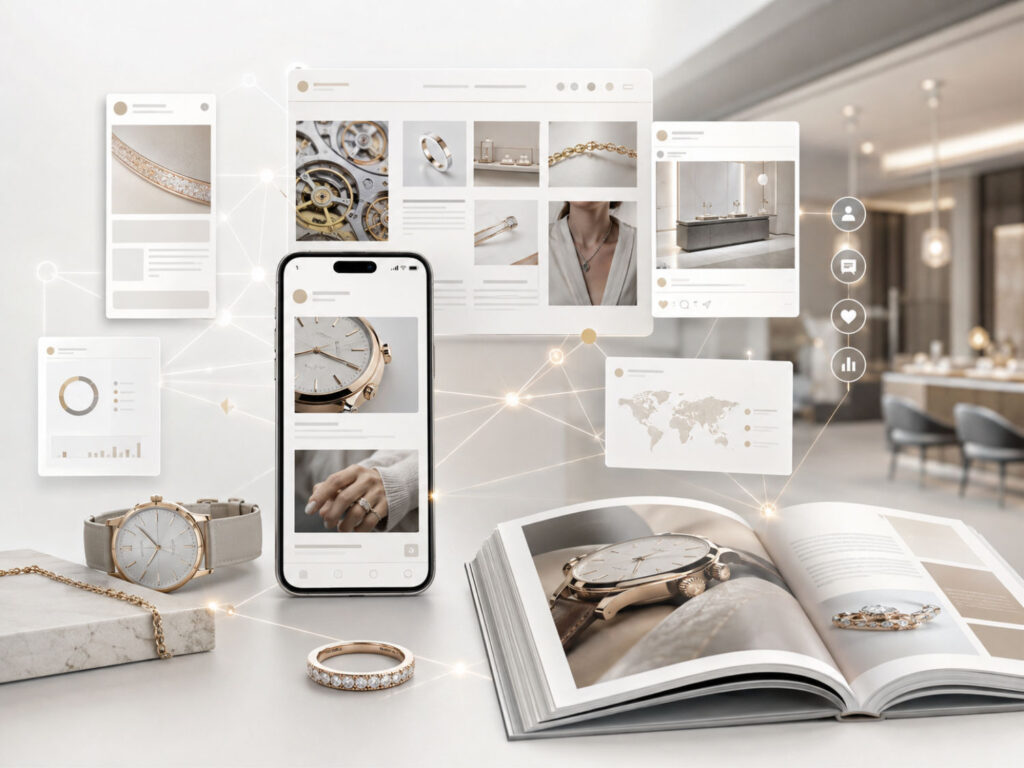
The communication landscape for brands, manufacturers, retailers, and service providers is undergoing a fundamental shift. Never before have so many channels been available: websites, newsletters, social media, digital offerings, podcasts, videos, creator-driven formats, lifestyle magazines, traditional trade media, trade shows, and, increasingly, events. Nevertheless, it has become more difficult to truly get noticed.
The reason lies not in a lack of opportunities, but in their fragmentation. Today, information is spread across an ever-increasing number of channels, some of which are highly specialized. Target audiences move back and forth between touchpoints, and attention is rarely captured by a single stimulus. Awareness must therefore be built up in a targeted manner, reinforced repeatedly, and placed within a credible context.
1. Information Behavior: More Channels, Less Focused Attention
More channels do not mean greater impact—on the contrary
This trend isn’t limited to the luxury industry. The Reuters Institute’s “Digital News Report 2025” describes a significant shift in information consumption patterns: Traditional news outlets are facing stiffer competition from social media, video platforms, content creators, podcasts, and other digital formats. At the same time, it is becoming more difficult for established news providers to reach younger audiences on a regular basis.
For companies, this means that simply having channels available does not in itself constitute a communication advantage. Anyone communicating today faces an environment where attention is scattered, selective, and often short-lived. A message can be visible without truly taking root. It can generate reach without building trust. And it can be noticed without becoming relevant.
Creator formats also reflect this fragmentation. While they often foster closeness and trust within specific communities, they are no substitute for comprehensive communication. For brands, they can be an important component, but they remain part of a broader communication mix—especially when the goal is to reach more than one very specific target audience.
This distinction is particularly relevant for the watch and jewelry industry. The industry thrives on trust, perceived value, expert advice, context, and long-term relationships. A product image, a social media post, or a single ad can generate attention. However, they cannot replace the context that is necessary for high-quality products, offerings that require explanation, and differentiated brand positioning.
2. Luxury Market: Value Needs to Be Explained More Clearly
Luxury is under pressure to justify itself
The market environment has also changed. Analyses by Bain & Company and Fondazione Altagamma have shown for some time now that, after years of strong growth, the luxury market has come under pressure. Price increases, shifting consumer priorities, and more selective demand have led brands to have to explain more clearly what they stand for and what value they create.
Reuters reported, based on the Bain analysis, that the market for personal luxury goods was in decline in 2025 and is expected to recover only modestly in 2026. At the same time, Bain points out that the industry has lost a portion of its active customer base worldwide since 2022. Reuters reported, based on current Bain data, that there are approximately 70 million consumers. The main reasons cited are price increases and the fact that many brands are increasingly targeting high-spending consumer groups.
The concept of luxury is changing
One reason for this may be that the concept of luxury is increasingly changing. Luxury is less commonly defined in terms of possessions, status, or brand names. Origin, craftsmanship, authenticity, service, sustainability, durability, cultural relevance, and personal significance are becoming more important.
This shift is not solely the result of changing values. It is also driven by increased access to information. Today, consumers can more quickly compare products, research background information, check prices, discover alternatives, and scrutinize brand promises.
This trend is further amplified by the emerging generational shift in wealth and purchasing power. As part of the “Great Wealth Transfer,” the focus is shifting to a consumer group that has grown up in a digital age and no longer views luxury solely through the lens of traditional status symbols. Origin, sustainability, transparency, community, cultural relevance, and enduring value are gaining importance. For communication, this means that brands must not only showcase tradition but also translate its value into today’s lifestyle and information context.
This is an important point for watch and jewelry companies. Especially in high-end segments, mere visibility is not enough. Products must be categorized based on design, materials, origin, craftsmanship, technology, service, sustainability, availability, or corporate substance. Communication thus becomes not only a means of raising awareness, but also a way of explaining value.
3. Digital Search & AI Are Changing the Requirements
Information consumption is becoming more mobile, more visual, and more platform-driven. Users are switching between channels more quickly, comparing options more frequently, and being more selective in how they perceive brand messages.
Artificial intelligence is driving this trend: product search, price comparison, and pre-selection are becoming increasingly automated or assisted. In its latest luxury market analysis, Bain points out that digital technologies and AI are gaining importance in product search and comparison.
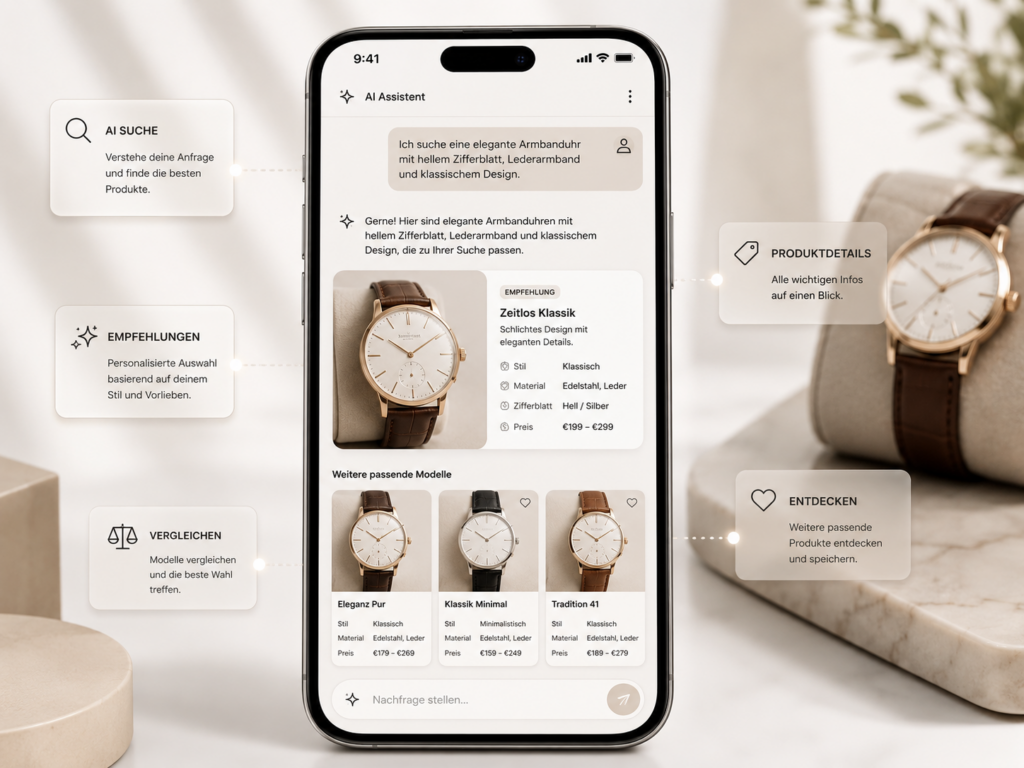
For companies, this creates a new requirement for information. Product data, materials, origin, availability, dealer lists, and service information must be available in a clear, up-to-date, and structured format so that search, comparison, and assistance systems can correctly find and categorize them.
This is particularly relevant for watches and jewelry that require further explanation: If information isn’t provided clearly, there’s a risk that AI systems or third parties will take over the classification process. As a result, content may be incomplete, weighted incorrectly, or not considered at all in search and recommendation contexts.
4. Retail, the public, and the industry are growing closer together
Retail remains a key platform for engagement
Despite the growth of digital channels, specialty retailers remain a crucial point of contact for many segments of the watch and jewelry industry. High-end products, in particular, are not sold based on visibility alone. Expert advice, trust, product selection, local reputation, and personal recommendations continue to carry significant weight.
E-commerce continues to grow, but no longer at the same pace as in previous years. According to the HDE Online Monitor 2026, German online sales rose from 88.8 billion euros in 2024 to 92.3 billion euros in 2025. The share of online sales in total retail increased only slightly, from 13.4 to 13.5 percent. In the jewelry and watches category, it was significantly higher at 24.3 percent, up from 23.8 percent the previous year. Including secondhand sales, the HDE estimates the online volume for 2025 at around 103 billion euros.
The figures show that digital purchasing processes are well established but are evolving in a more mature market phase. For the watch and jewelry industry, it is crucial that digital channels provide comparability and preliminary information, while retailers offer guidance, trust, and confidence in decision-making. These two roles are intertwined.
The customer journey has long been hybrid

Consumers have long been navigating a hybrid customer journey: They gather information online, discover brands through editorial media, social media, or newsletters, compare offers, read reviews, and then often seek personal contact anyway. Print media also continue to play a role in this process.
The Deloitte Swiss Watch Industry Study 2025 confirms this trend: Consumers prepare their purchasing decisions across multiple touchpoints, gather information online, and seek inspiration before making in-person contact. At the same time, in-store shopping remains central: According to Deloitte, more than 60 percent of respondents purchase their watches in stores.
Against this backdrop, individual channels can hardly be viewed in isolation anymore. Digital touchpoints provide visibility, guidance, and comparability. Print formats offer space for context, trust, and in-depth content. Brick-and-mortar retail enables personal consultation, try-ons, and confidence in the final decision. Especially when it comes to high-end watches and jewelry, the full impact is realized through the interplay of these elements.
Desire begins in front of the store window
This trend is evident even at the sales level. Without prior awareness, context, and recognizability, sales work often remains abstract. Retailers rarely stock brands they’ve never heard of, for which there is no discernible demand, or that they cannot contextualize for their customers.
Anyone who wants to establish a brand or an offering in a market therefore needs visibility throughout the relevant customer journey—wherever retailers and customers are looking for guidance. This visibility must be established before or while the sales team approaches retailers.
Technical information alone is no longer enough
The hybrid customer journey also gives rise to a hybrid information logic for the entire industry. Anyone who wants to understand markets, brands, and demand must know which topics, images, and narratives resonate with the audience. This applies equally to specialty retailers, manufacturers, brands, service providers, agencies, and trade associations.
This is changing the role of purely closed B2B communication spaces. Technical information remains important, but it loses its unique position if it is not linked to topics that generate awareness among the audience. Relevant industry communication is increasingly emerging where technical information, brand perception, and audience interest converge.
5. Visibility Requires the Right Moment
As attention becomes more fragmented and target audiences gather information across multiple touchpoints, timing becomes increasingly important. Communication is particularly effective when it aligns with relevant market and industry events: trade shows, new product launches, ordering periods, seasonal occasions, or specific topics that are of simultaneous interest to retailers, brands, and the public.
In the watch and jewelry industry in particular, such moments shape the course of the year. They capture attention, spark conversations, and provide a concrete context for topics. During these periods, receptiveness increases because market participants are actively seeking guidance, assessing developments, and preparing to make decisions.
Visibility is thus particularly effective in places where attention is already focused and where content meets a specific interest.
6. Conclusion: Communication Is Becoming More Strategic
For companies in the watch and jewelry industry, this has a clear implication: Visibility is not achieved through individual measures alone, but through the interplay of target audiences, themes, information channels, and relevant moments.
The key factor is whether communication throughout the customer journey can be integrated—for the audience, retailers, and the industry. Therefore, anyone who wants to gain visibility must not only send out messages but also provide guidance.
Communication becomes strategic when it combines information, presence, and trust. Presence is thus no longer a side effect, but rather a task that must be planned, organized, and built up at the right time. Traditional marketing and media concepts reach their limits when they continue to view channels in isolation. For the watch and jewelry industry, therefore, the combination of digital discoverability, credible context, and trust-building positioning is becoming increasingly important.
Sources and References:
Reuters Institute for the Study of Journalism: Digital News Report 2025
—a reference for changes in media consumption, the fragmentation of information channels, and the growing importance of social media, video platforms, creator formats, and podcasts.
https://reutersinstitute.politics.ox.ac.uk/digital-news-report/2025
Bain & Company / Fondazione Altagamma: Luxury Goods Worldwide Market Study / Current Analyses of the Global Luxury Market
: A reference for market trends in personal luxury goods, the shifting growth outlook, the increasing selectivity of demand, and the importance of value communication, digital search, and AI-powered product discovery.
https://www.bain.com/insights/luxury-is-ready-for-a-new-era-after-stabilizing-in-2025-snap-chart/
https://www.bain.com/about/media-center/press-releases/20252/global-luxury-stays-resilient-despite-economic-headwinds-and-shifting-consumer-trends-that-reshape-marketbain–company-and-altagamma/
Reuters: Reporting based on the latest Bain/Altagamma analyses of the luxury market
, providing a framework for assessing market trends in 2025/2026, the loss of a portion of the active luxury clientele since 2022, and the effects of price increases and a stronger focus on high-spending target groups.
https://www.reuters.com/business/finance/luxury-market-shows-early-signs-recovery-q2-despite-middle-east-war-bain-says-2026-06-25/
Cerulli Associates: Projections on the “Great Wealth Transfer”
—a reference for the expected transfer of approximately 124 trillion U.S. dollars by 2048 and the associated shift of wealth to subsequent generations.
https://www.cerulli.com/press-releases/cerulli-anticipates-124-trillion-in-wealth-will-transfer-through-2048
Merrill Lynch: Analysis of the “Great Wealth Transfer” Based on Cerulli Data
. Additional reference on the significance of generational change in wealth, investment behavior, and decision-making structures.
https://www.ml.com/articles/great-wealth-transfer-impact.html
German Retail Association (HDE): Online Monitor 2026
—a reference for the development of online retail in Germany, the share of online sales in total retail, the jewelry and watches category, and the role of marketplaces, re-commerce, and secondhand goods.
https://einzelhandel.de/online-monitor
Deloitte: Swiss Watch Industry Study 2025
—a reference for the hybrid customer journey in the watch market, the importance of digital information channels, and the continued central role of brick-and-mortar retail in watch purchases.
https://www.deloitte.com/ch/en/Industries/consumer/perspectives/swiss-watch-industry-study.html