
INSIGHT-BUSINESS Market Monitor – Germany
Consumer Sentiment: Stabilizing at a Low Level
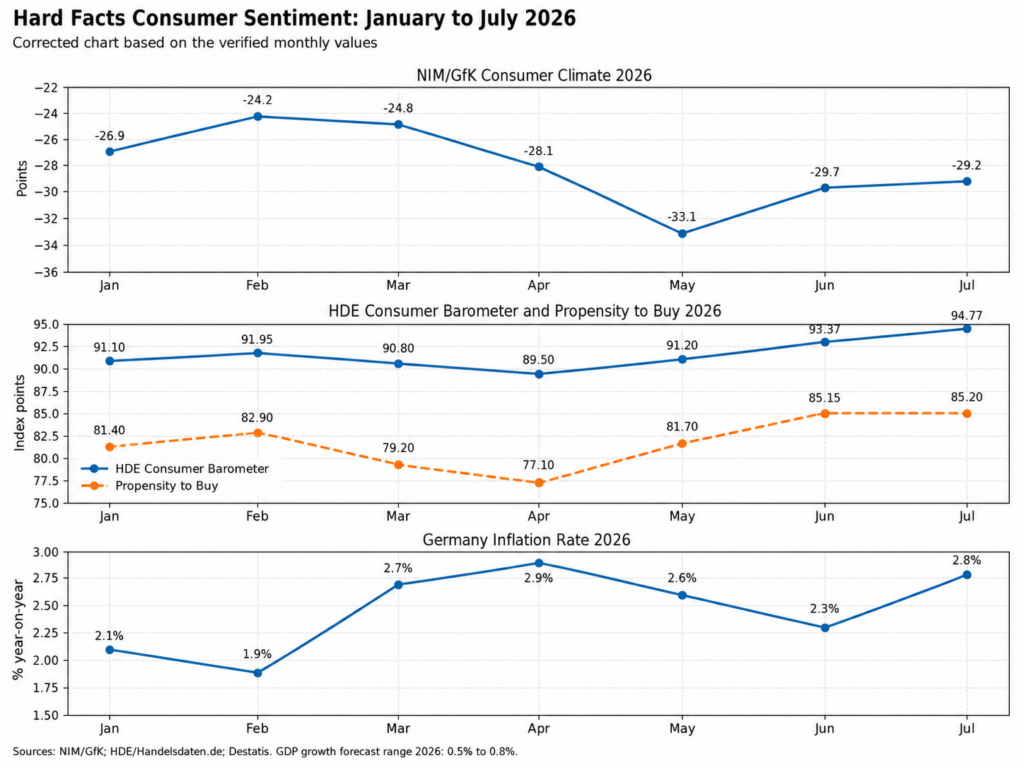
Consumer sentiment in Germany improves slightly in the summer of 2026, but remains significantly subdued. According to consumer expectations, the NIM Consumer Climate Index stands at –29.6 points for August, following a revised –29.3 points in the previous month; the HDE (Handelsverband Deutschland: German Retail Federation) Consumer Barometer also rose from 93.37 to 94.77 points, but remains well below the previous year’s level. Declining inflation initially provided some relief: Destatis reported 2.3 percent for June, down from 2.6 percent in May. In July, the inflation rate rose again to 2.8 percent, according to preliminary data.
However, the key factor for retailers remains: Consumer spending is barely picking up, and the propensity to save remains high. This reluctance is therefore less a matter of a lack of purchasing power and more a reflection of caution, political and geopolitical uncertainty, and a labor market that remains fragile. For the second half of the year, a gradual stabilization is therefore more likely than a noticeable recovery in consumer spending.
Hard Facts: Consumer Sentiment:
–29.6 points
on the NIM Consumer Sentiment Index for August 2026, down 0.3 points from the revised figure for the previous month.
The HDE Consumer Barometer stood at 94.77 points
in July 2026, up from 93.37 points in June.
2.8 percent
: Preliminary inflation rate for July 2026; in June, it was 2.3 percent, and in May, 2.6 percent.
85.20 points
on the HDE sub-indicator for propensity to make purchases; only a minimal improvement compared to June.
Key forecasts for German GDP growth in 2026 range from 0.5 to 0.8 percent
, including 0.5 percent from the Bundesbank and the federal government and 0.8 percent from the ifo Institute.
Precious Metals: Consolidation Following Record Highs
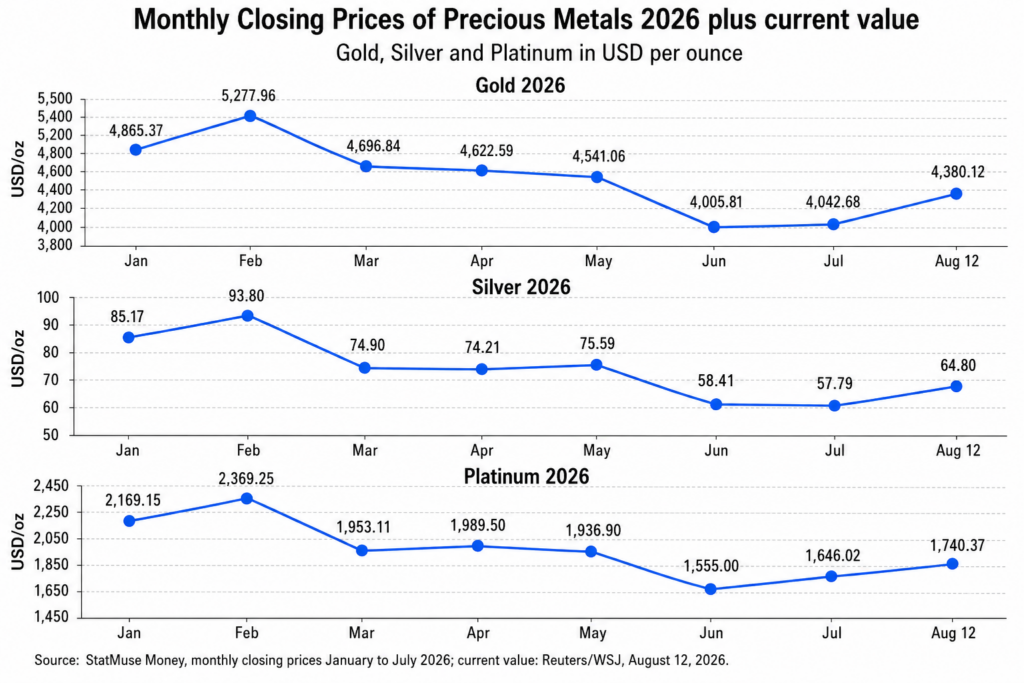
Precious metal prices reached historic highs in early 2026 and have since corrected significantly starting in the second quarter. Gold was a particular focus: In early July, the price stood at around $4,100 to $4,150 per troy ounce, after having temporarily risen above $5,500 in January. In early August, gold rose sharply again; on August 7, the spot price stood at around $4,336 per troy ounce, according to Reuters.
Recently, higher U.S. yields, a strong U.S. dollar, and expectations that U.S. interest rates will remain high for longer have weighed on the market. The most recent rise, on the other hand, was supported by weaker U.S. labor market data, shifting interest rate expectations, sustained demand from Chinese investors, and a weaker U.S. dollar.
Following the correction in the second quarter, gold has formed a key support level around $4,000 per troy ounce. This level is increasingly viewed as a key support level. In the short term, this brings the $4,175 range into focus, which roughly corresponds to the 50-day moving average. A sustained rise above this level would be a positive technical signal and could pave the way toward the June high of just under $4,400.
Nevertheless, many analysts do not expect a rapid return to the all-time highs by the end of 2026, but rather a volatile sideways trend with limited potential for recovery. Heraeus forecasts a range for gold of $3,750 to $5,000 per troy ounce; while some forecasts put gold at around $4,750 to $5,000 by year-end. UBS now expects the gold price to reach $5,000 by the first half of 2027.
Volatility is therefore likely to remain high. Overall, the current environment points more toward a continuation of the recovery than a rapid return below the $4,000 mark.
Silver, too, has corrected significantly following its sharp rise at the beginning of the year. The price remains volatile. In early August, silver rebounded significantly and, according to Reuters, stood at around $63.29 per troy ounce on August 7. This already placed silver above Heraeus’s forecast range of $43 to $62. A supply deficit is again expected for 2026: Demand would thus exceed the available supply from mine production and recycling for the sixth consecutive year. In the short term, the price of silver may continue to fluctuate sharply; however, the tight supply fundamentally supports the price and suggests that a significant easing of the situation is unlikely.
The platinum market is also expected to remain tight. Here, too, forecasts for 2026 predict a continued deficit. Heraeus projects a range of $1,300 to $1,800 per troy ounce for the full year.
Hard Facts: Precious Metals 2026
Gold: Around $4,100 per troy ounce in early July; around $4,380 per troy ounce in early August. In January, the high was just under $5,600. HSBC expects gold to be around $4,750 by the end of the year.
Gold Forecast: Heraeus predicts a range of $3,750 to $5,000 per troy ounce for 2026.
Silver: After reaching a high in January, silver corrected significantly, but by early August it was back at around $63 per troy ounce.
Silver Forecast: Heraeus expects a range of $43 to $62 per troy ounce for 2026. The current market price is thus already slightly above this forecast range.
Silver Market: The sixth consecutive supply deficit is expected in 2026. This would mean that demand would once again exceed available supply.
Platinum: Heraeus forecasts a range of $1,300 to $1,800 per troy ounce for 2026 and expects demand to continue to outpace supply.
Note: Current exchange rates as of early August 26
Outlook: What does this imply?
Consumer sentiment remains weak in late summer 2026. The NIM Consumer Climate Index edged down slightly in August, while the HDE Consumer Barometer rose slightly in July. However, the propensity to spend has hardly improved. Additional political pressures may further exacerbate this reluctance. Tax relief is being partially offset by higher taxes and healthcare costs; the middle class, in particular, remains under pressure. It is precisely this group that accounts for many purchases in the mid-price segment—ranging from gifts and everyday jewelry to their first high-quality purchases.
At the same time, precious metal prices remain a key factor. Gold stabilized again following the correction in the second quarter and rebounded significantly in early August. Silver remains even more volatile, but is also showing signs of recovery and is further supported by the expected supply deficit. For the jewelry industry, this means that a rapid easing of material costs is not to be expected. Cost calculations, pricing strategies, and product line planning remain challenging.
This paints a mixed picture for the second half of 2026. Demand is likely to remain cautious, especially in the mid-range segment. At the same time, high material values underpin the value proposition for gold, platinum, and high-end jewelry. Products with clearly recognizable intrinsic value, a compelling narrative, and tangible material quality can benefit from this. The situation becomes more challenging where price, design, brand, and utility do not align clearly.
Overall, market segmentation is becoming more pronounced: Some customers are saving money, postponing purchases, or switching to less expensive products. More affluent shoppers remain more active in the premium segment—especially where brand, material, availability, and lasting value come together convincingly. For manufacturers and retailers, the second half of the year will therefore be selective: Clear product lines, compelling price arguments, and products that offer more than just novelty in customer conversations will be decisive.
Sources: NIM/GfK Consumer Climate Index; HDE Consumer Barometer/Handelsdaten.de; Destatis; German Federal Government Spring Forecast 2026; ifo Institute/IfW Kiel; IFH Cologne/BBE Retail Consulting Industry Report on Jewelry & Watches 2026; Watchtime/Luxury Watch Survey; Chrono24/YouGov/WatchCharts; Bain & Company Luxury Goods Worldwide Market Study; Heraeus Precious Metals Precious Metals Forecast 2026; Reuters; HSBC; UBS Global Wealth Management; The Silver Institute/World Silver Survey 2026; LBMA; World Gold Council; BVSU; McKinsey/Business of Fashion – The State of Fashion 2026; Metals Focus.