
Breguet honors the history of the tourbillon with extraordinary creations
Breguet is celebrating the invention of the tourbillon—for which Abraham-Louis Breguet received his historic patent on the 7th of Messidor, Year IX (June 26, 1801)—with four extraordinary creations.
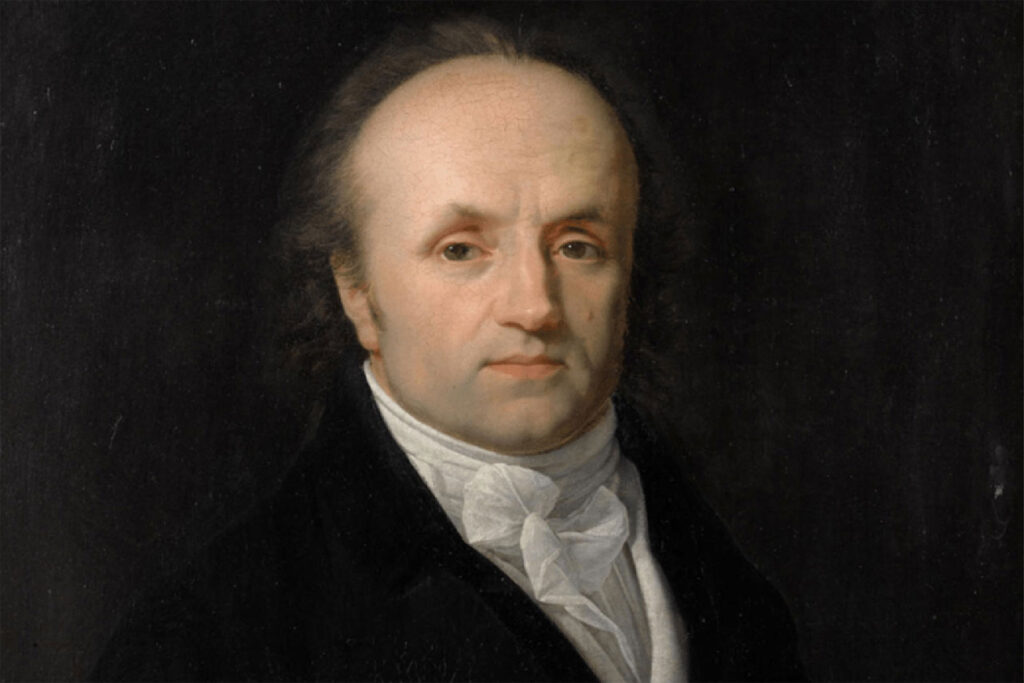
It has been 225 years since Breguet patented the tourbillon, and in that time this complication has lost none of its fascination—even though, or perhaps precisely because, its fundamental principle has remained virtually unchanged to this day.
The tourbillon—French for “whirlwind”—was originally developed to counteract the effects of gravity on the regulating mechanism of pocket watches. By housing the escapement and balance wheel in a rotating cage, the aim was to reduce positional errors.
With a wristwatch, which constantly changes its position on the wrist, this original advantage is admittedly less relevant. However, this has not diminished its appeal to collectors. On the contrary: The watch industry continues to demonstrate tremendous creativity and technical innovation, and has now produced a fascinating variety of tourbillon designs. breguet.com
Learn more here about how the tourbillon works and get an overview of the current models.
225 Years of the Tourbillon and Four New Breguet Models
To mark the 225th anniversary of the tourbillon patent, Breguet is presenting four new creations: the two versions of the “Classique Tourbillon 7357” featuring the newly developed Caliber 187B, the “Classique Tourbillon Sidéral 7255” with a flying and “mysterious” tourbillon, the “Tradition Tourbillon 7047” with a snail and chain, and the “Marine Tourbillon Équation Marchante 5887” featuring a precise depiction of the sky over Paris on June 26, 1801.
Classique Tourbillon 7357
The Classique Tourbillon 7357 succeeds the Reference 3350, the first tourbillon wristwatch produced by the modern Breguet Manufacture in 1989. It is based on an optimized version of the famous Caliber 558, now known as Caliber 187B. To mark the 225th anniversary of the tourbillon patent, the watch is available in platinum and Breguet gold.
The lugs have been redesigned to fit more snugly against the wrist. The dial features the Arabic numerals introduced by Abraham-Louis Breguet as early as the late 18th century, as well as the Maison’s signature guilloché patterns, Clous de Paris and Grain d’Orge.
The tourbillon, positioned at 6 o’clock, sits directly on the mainplate and is supported by a curved double bridge. Four curved inserts along the edge are finished in “Bleu de France.” Two lower appliqués commemorate the invention with the engravings “Brevet du 7 Messidor An 9” and “Tourbillon 225e anniversaire.”
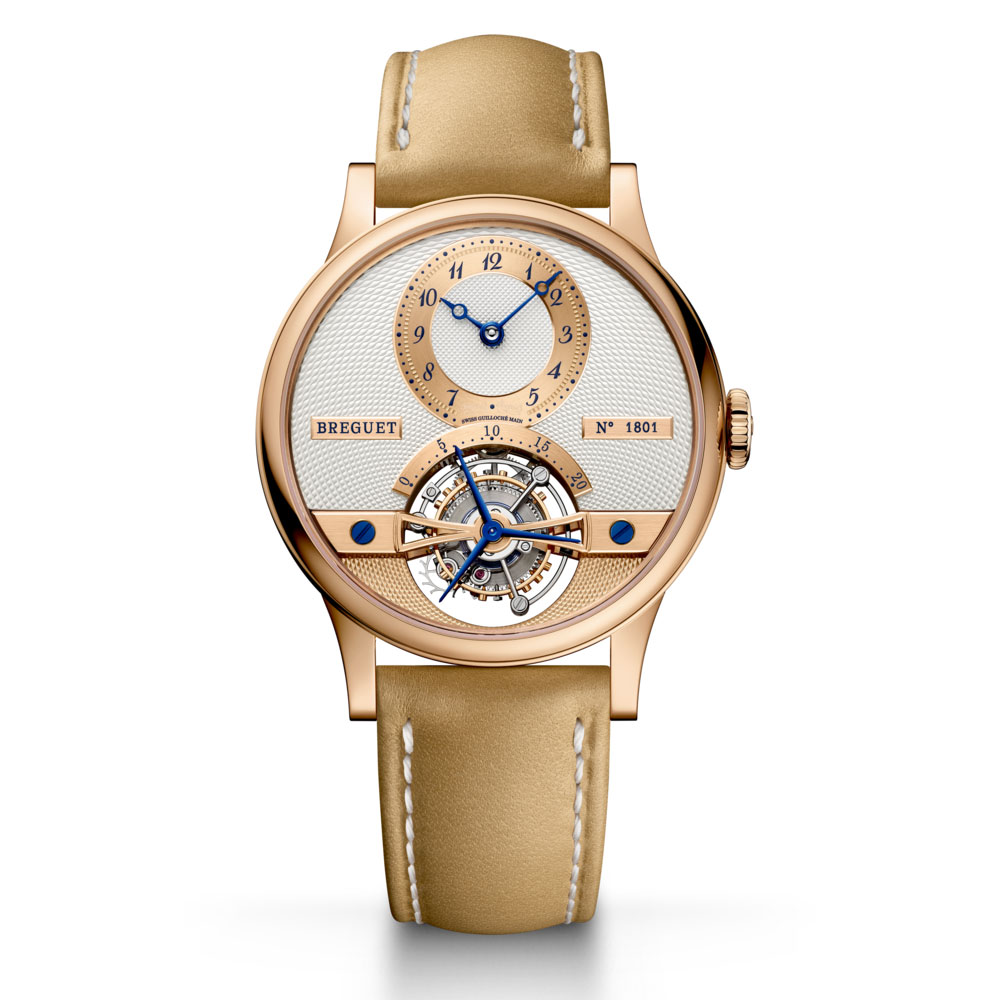
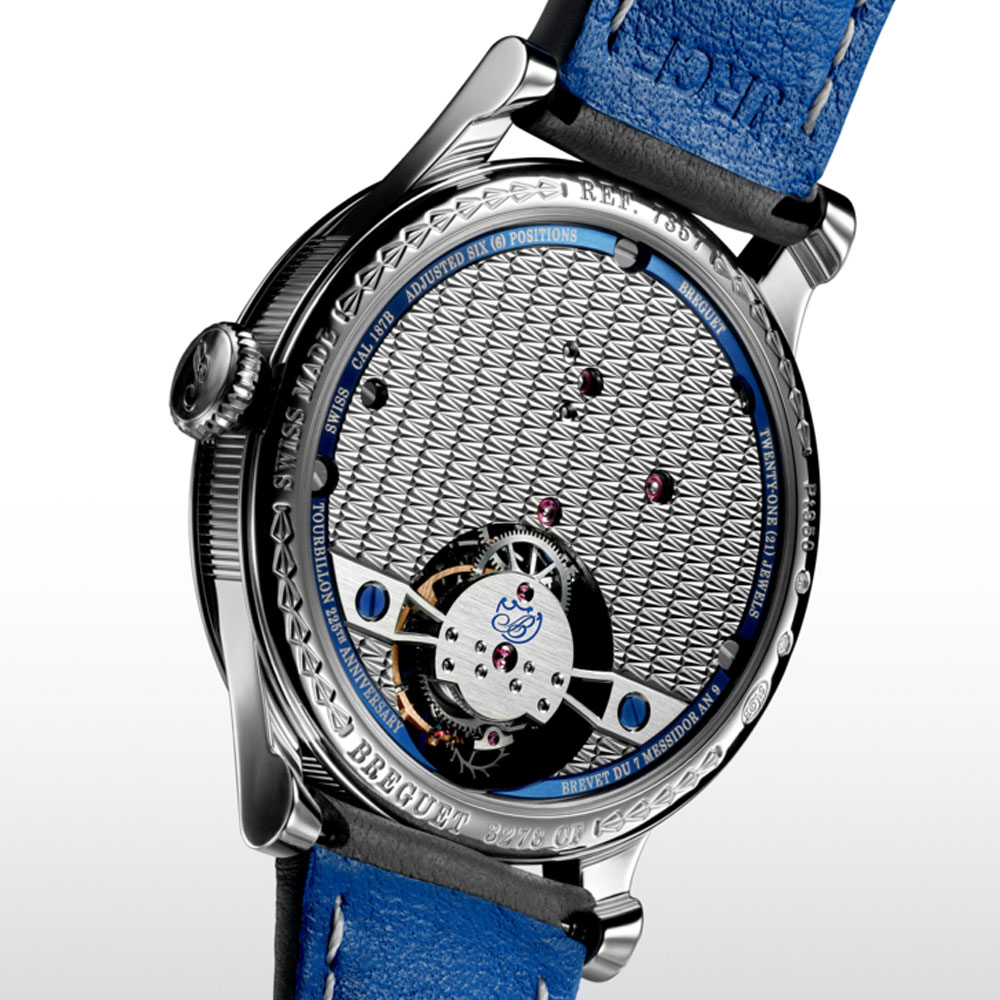
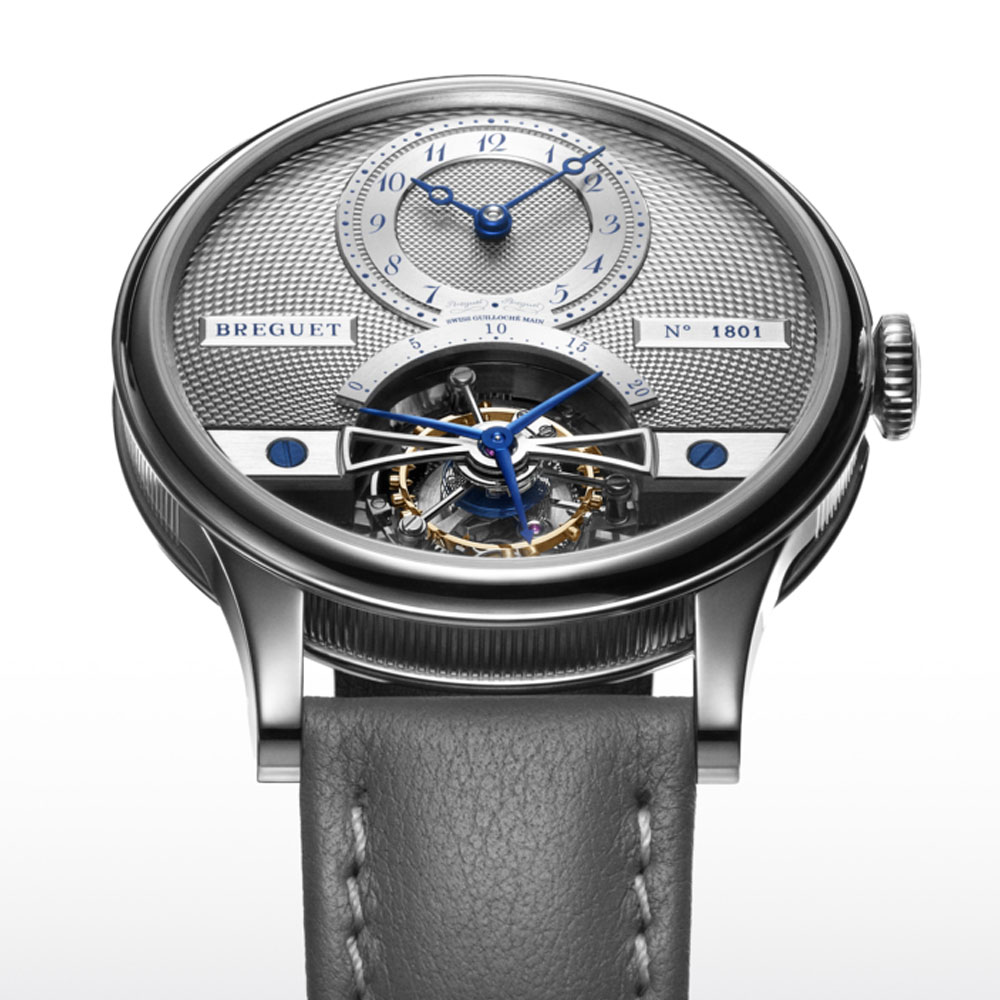
- Model: Classique Tourbillon 7357
- Movement: Caliber 187B, manual winding, 60-hour power reserve, minute tourbillon
- Features: off-center hour and minute hands, small seconds on the tourbillon cage
- Case: Platinum or Breguet gold, 35 x 9.2 mm, water-resistant to 3 bar
- Dial: Breguet gold, anthracite-plated, or silver-plated
- Strap: Leather with a triple-fold clasp
- MSRP: €178,900 or €162,600
“Everything about this creation is inextricably linked to the rich history of the tourbillon.”
Breguet CEO Gregory Kissling

“Nearly 40 years ago, the manufacture decided to bring this complication back into the spotlight—a bold and important decision whose enormous impact is felt throughout the industry today. Our collectors aren’t typically the type to express themselves solely in terms of movement numbers, but the Caliber 558 is an exception. It is a caliber that marks a milestone in the recent history of the tourbillon. It is thanks to this caliber alone that the tourbillon was able to make its spectacular comeback in the art of watchmaking in the 20th and 21st centuries.”
Classique Sidereal Tourbillon 7255
The “Classique Tourbillon Sidéral 7255” is Breguet’s first wristwatch featuring a flying tourbillon. Unlike the classic design, the tourbillon cage has no upper bridge and is supported only from below. Added to this is a so-called “mystery” construction, which Breguet had not used for nearly 20 years.
With this design, a moving component appears to float without any visible connection to the movement. In the “7255,” this effect is achieved through sapphire crystal components that render the gear trains—which connect the tourbillon cage to the rest of the movement—virtually invisible.
The dial, crafted from black aventurine Grand Feu enamel, echoes the model’s astronomical theme. The 7255 is limited to 50 pieces.
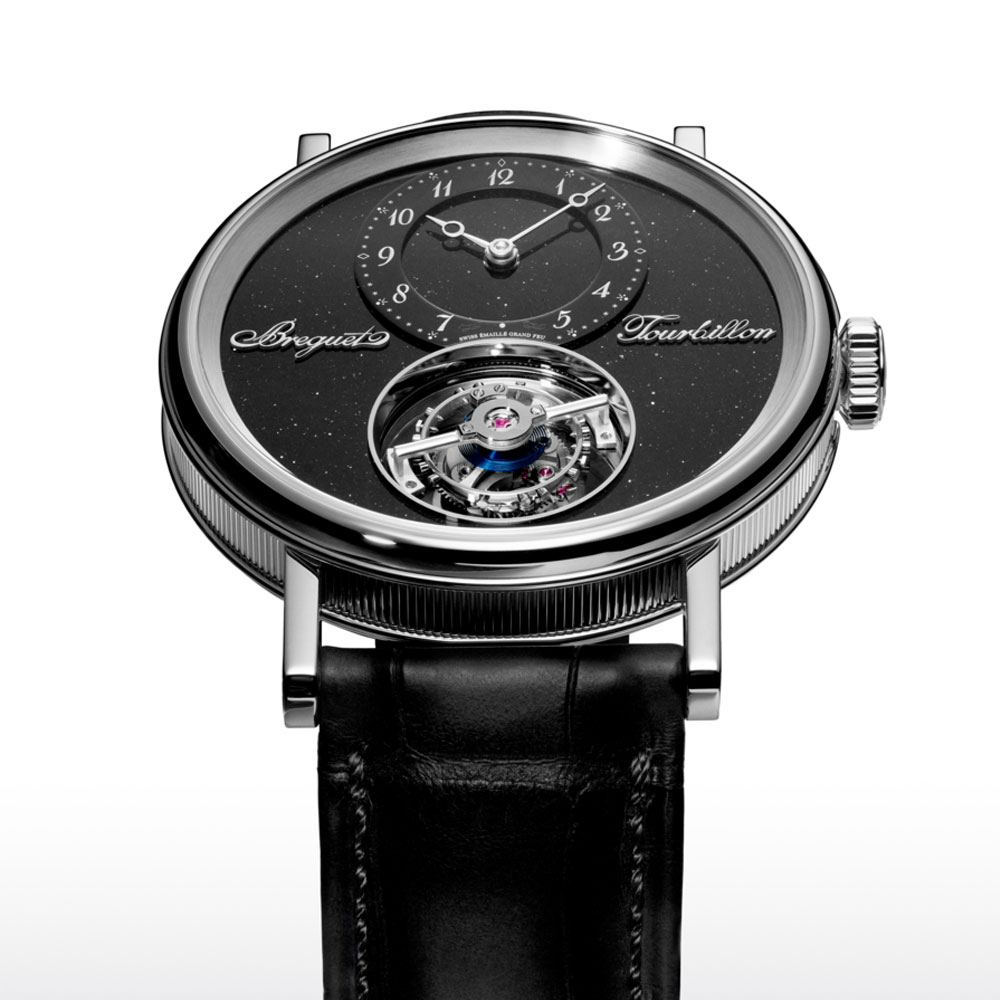

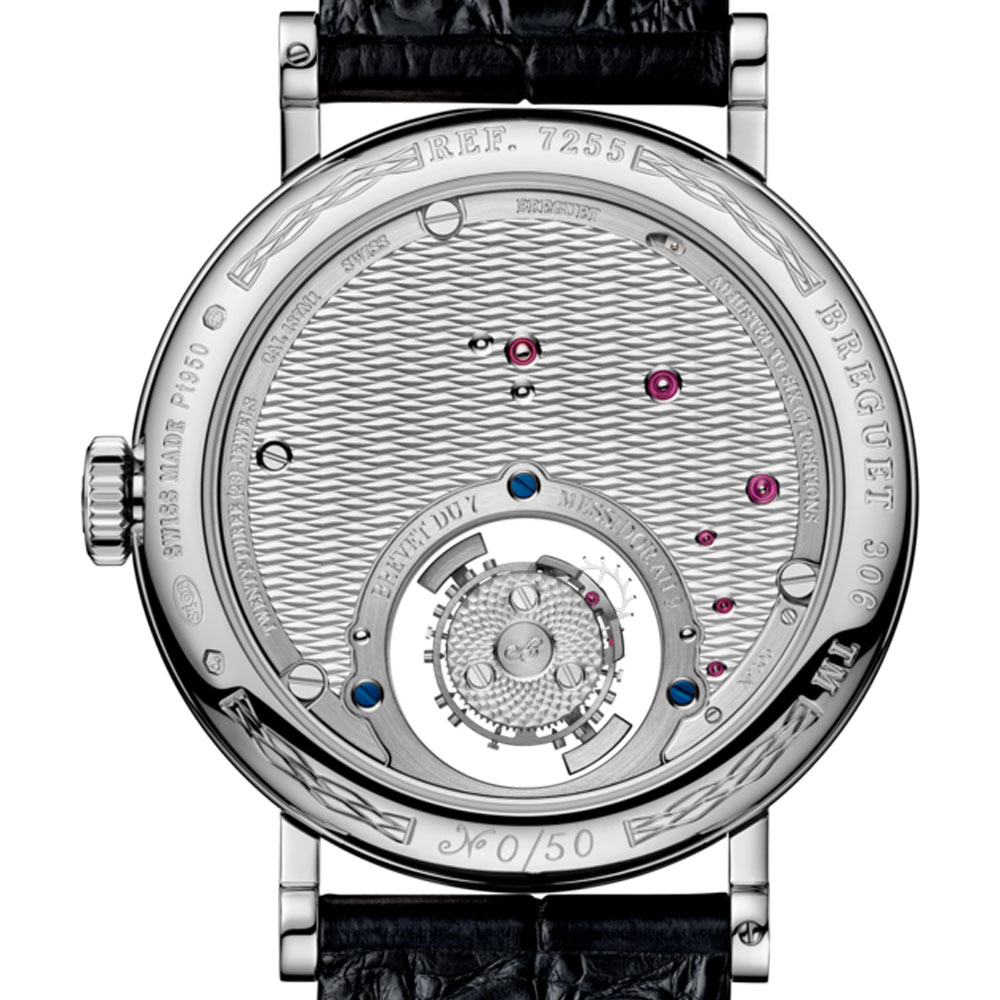
- Model: Classique Tourbillon Sidéral 7255
- Movement: Caliber 187M1, manual winding, 50-hour power reserve, minute tourbillon
- Functions: Hours, minutes, seconds on the tourbillon cage
- Case: Platinum, 38 x 10.2 mm, water-resistant to 3 bar
- Dial: Grand Feu enamel on black aventurine
- Strap: Alligator leather with a triple-fold clasp
- Special feature: limited to 50 copies
- MSRP: €259,000
Tradition Tourbillon 7047
The “Tradition Tourbillon 7047” combines the principles of the tourbillon with a worm gear and chain mechanism. This mechanism serves to regulate power transmission from the mainspring and to provide a more consistent torque over as much of the power reserve as possible. This principle was first described in detail by Leonardo da Vinci and is still used in watchmaking today.
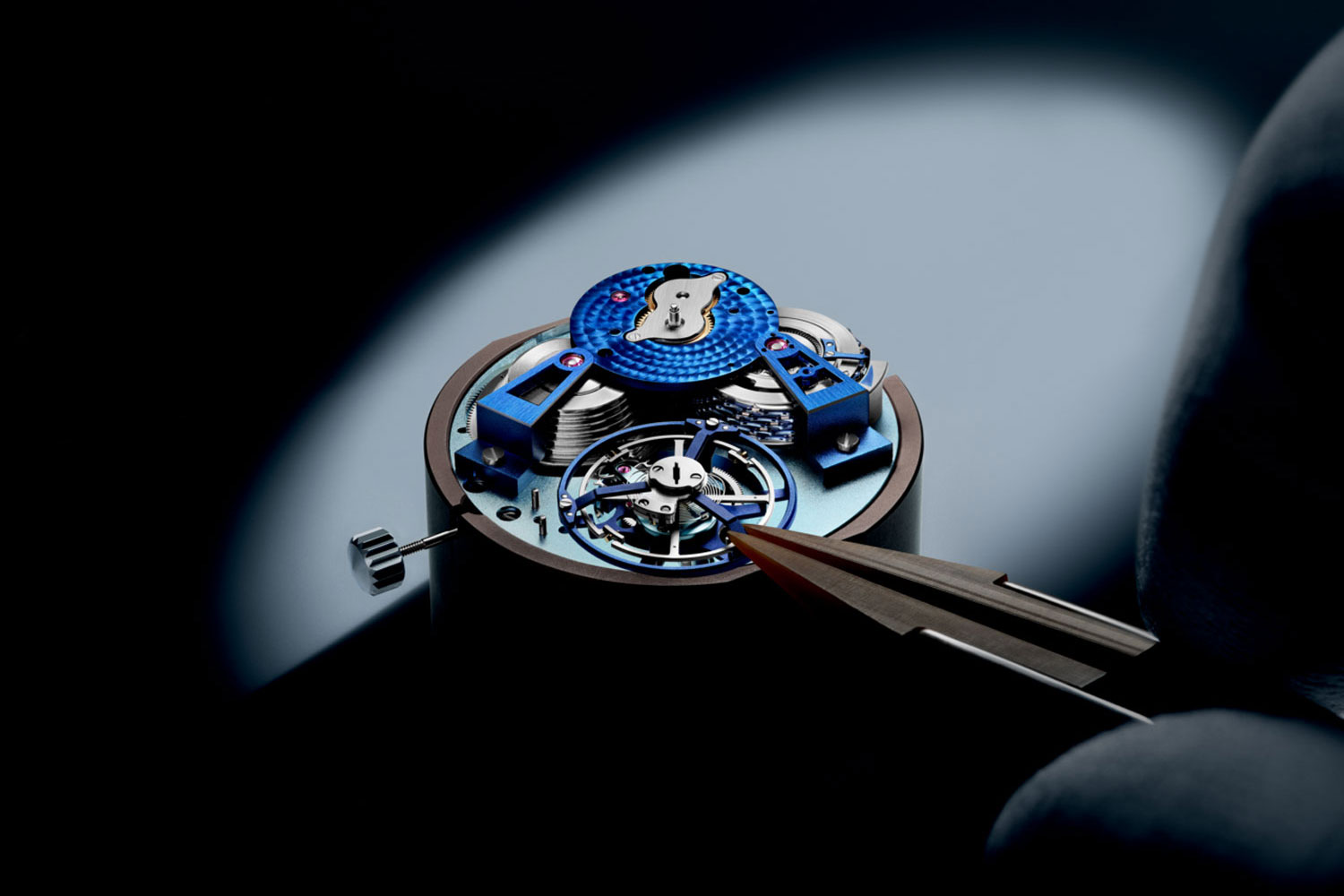
On the “Tradition Tourbillon 7047,” the wide bridges of the chain and snail are visible on both sides of the dial.

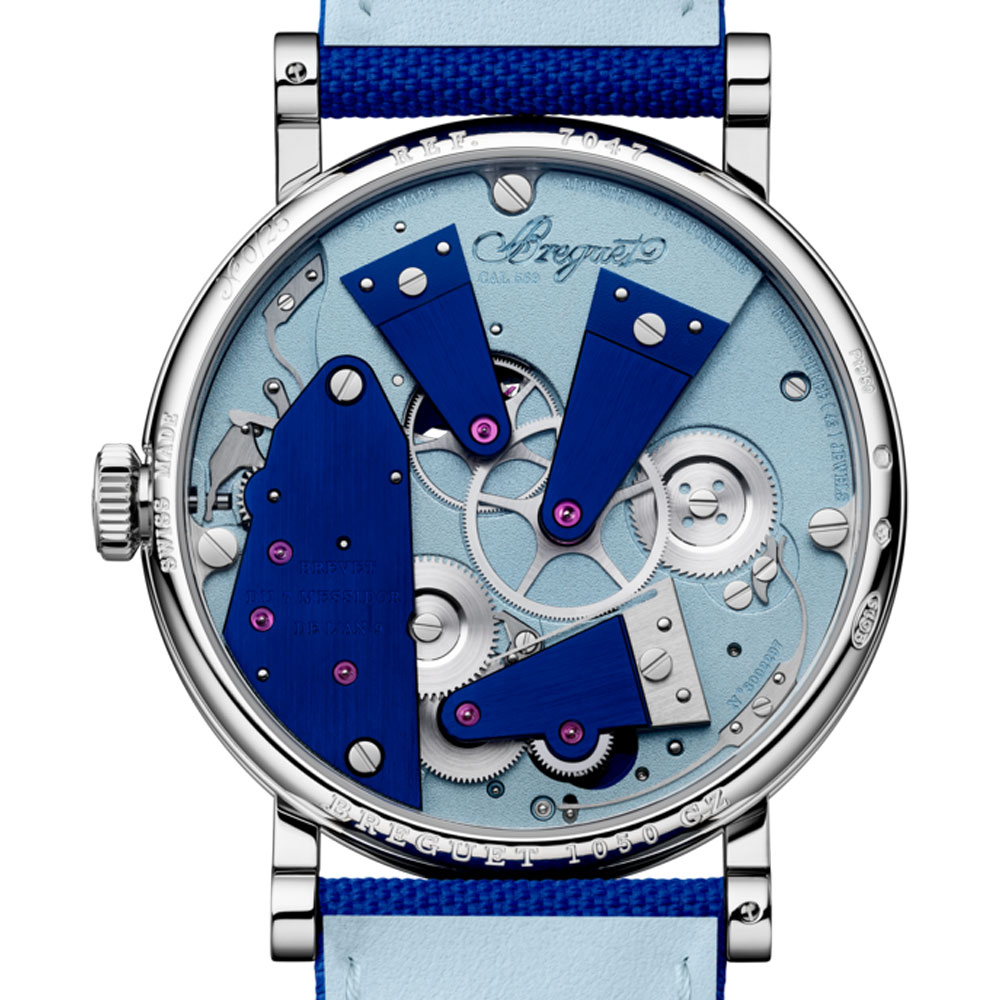
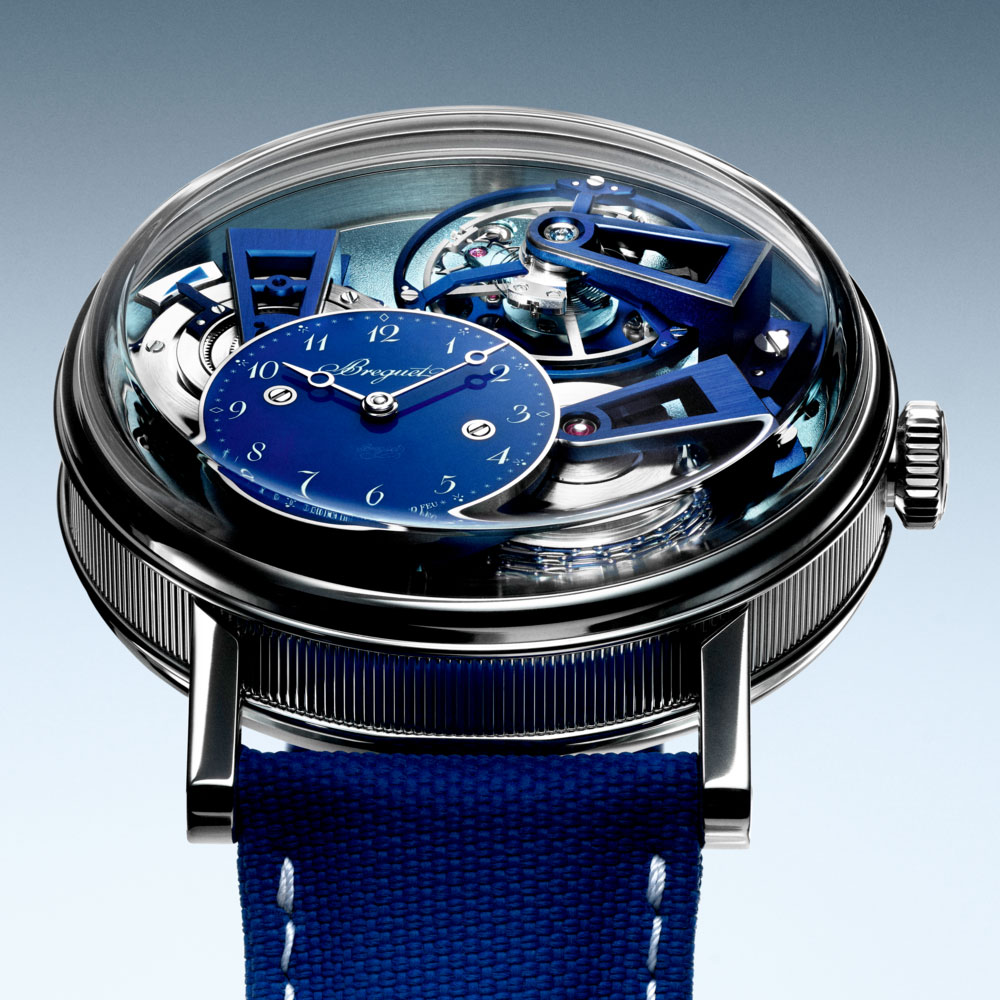
- Model: Tradition Tourbillon 7047
- Movement: Caliber 569, manual winding, 55-hour power reserve, tourbillon
- Functions: Hours, minutes, seconds on the tourbillon cage
- Case: Platinum, 41 x 16 mm, water-resistant to 3 bar
- Dial: Palladium gold with Grand Feu enamel in “Bleu de France”
- Strap: Rubber with a triple-fold clasp
- Special feature: many components in the “Bleu de France” color to mark Breguet’s 250th anniversary; limited to 25 pieces.
- MSRP: €286,000
Marine Tourbillon Équation Marchante 5887
The “Marine Tourbillon Équation Marchante 5887” is currently the most complicated wristwatch in the contemporary Breguet collection. Its dial features a precise, luminescent depiction of the sky over Paris on June 26, 1801—the date on which Abraham-Louis Breguet was granted the patent for his tourbillon.

The “Marine” collection commemorates Breguet’s appointment as “Watchmaker to the Royal Navy” by Louis XVIII in 1815. Its design draws inspiration from historical navigation methods that relied on the sky and the sun.
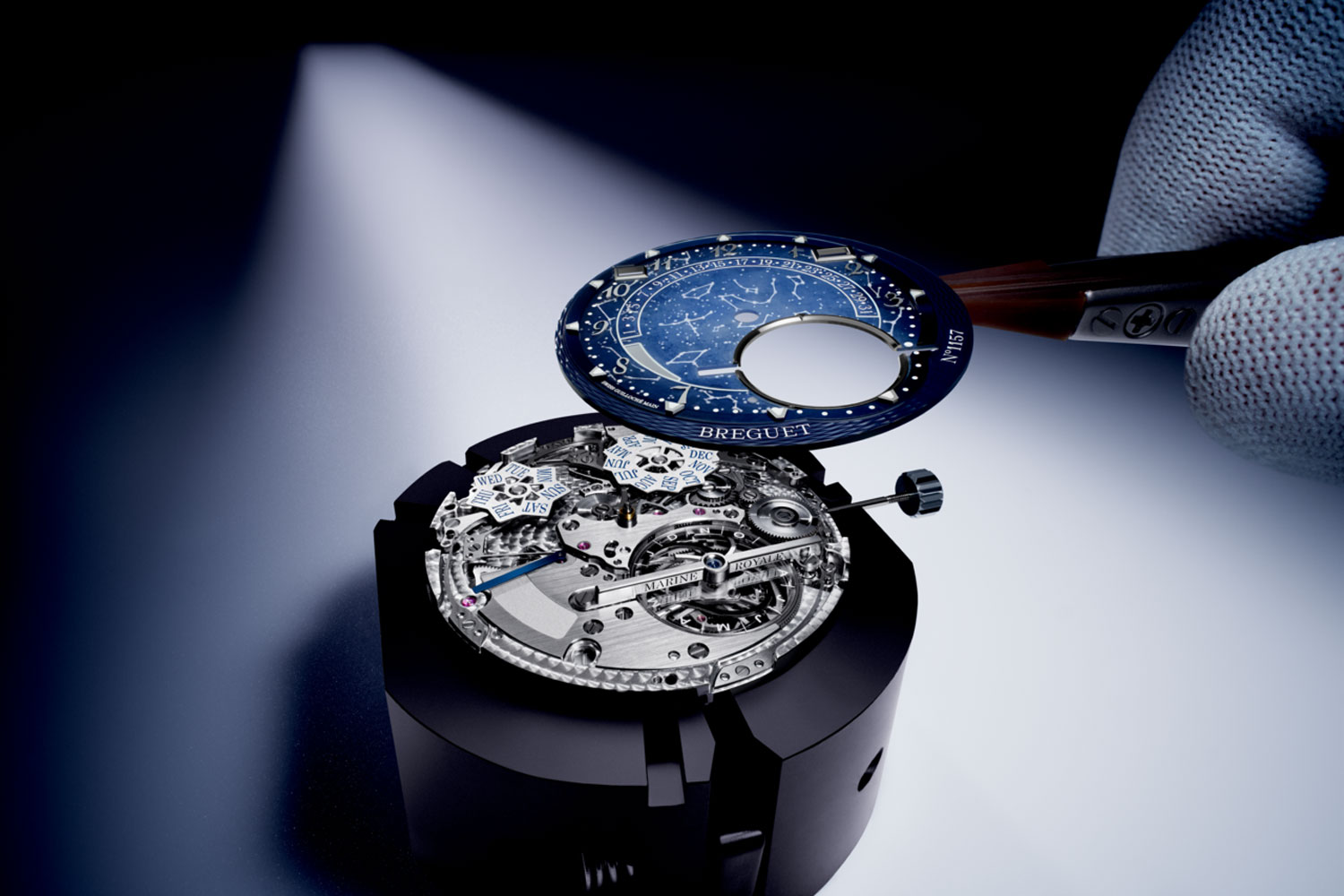
The two-part dial of the “5887” combines a sapphire element featuring hand-painted miniature art in blue Grand Feu enamel with a night sky rendered in luminescent enamel, depicting constellations and the moon in their exact positions over Paris on June 26, 1801.
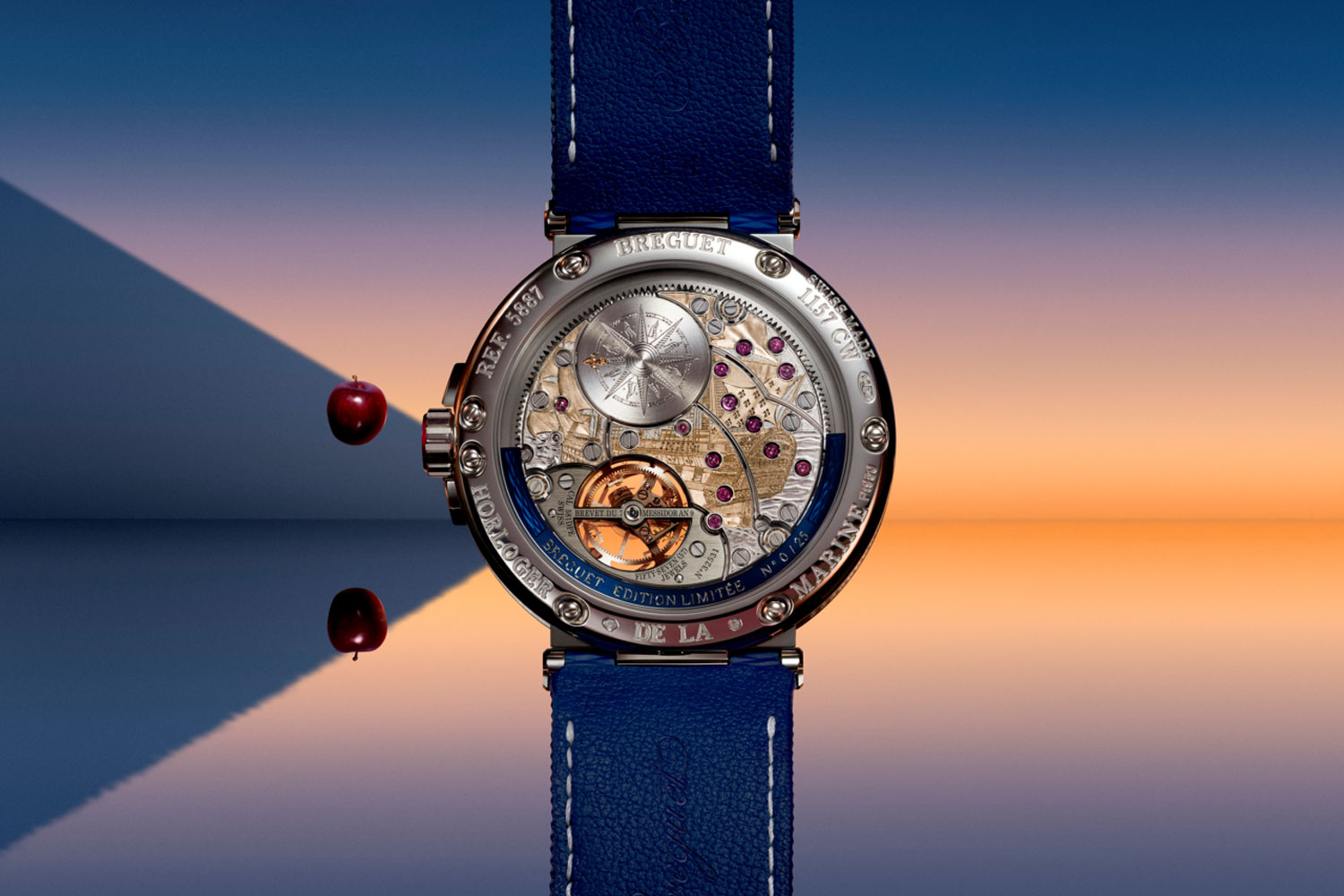
The back is also intricately designed: a hand-engraved image depicts the historic ship “Royal Louis,” complemented by an engraved compass rose featuring a lily made of Breguet gold. The peripheral platinum oscillating weight is guilloché with the “Quai de l’Horloge” motif—the historic address of the Breguet workshop in Paris—and finished in blue.
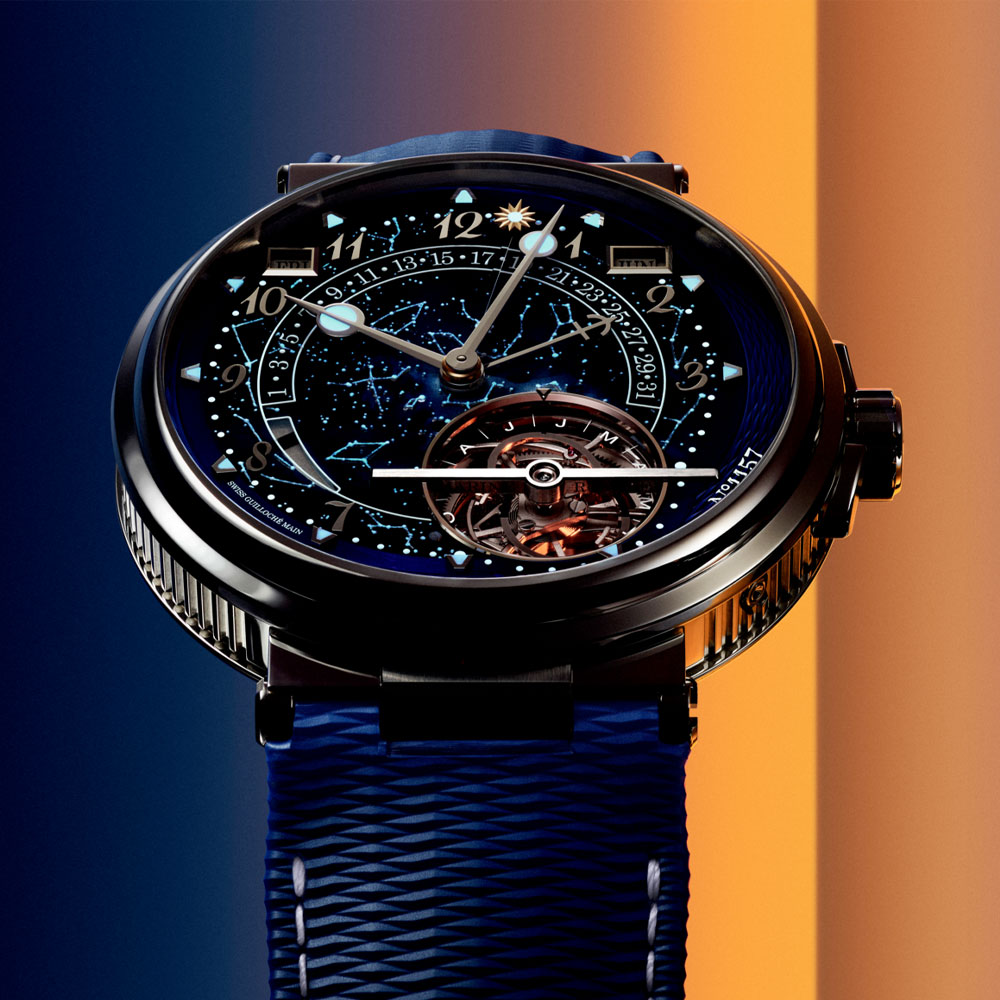

- Model: Tourbillon Équation Marchante 5887
- Movement: Caliber 581DPE, automatic, 80-hour power reserve, minute tourbillon
- Functions: Hours, minutes, seconds on the tourbillon cage, perpetual calendar, running equation of time
- Case: Platinum, 43.9 x 11.8 mm, water-resistant to 10 bar
- Dial: Sapphire crystal with blue Grand Feu enamel
- Strap: Rubber or platinum with a triple-fold clasp
- Special feature: many components in the “Bleu de France” color to mark Breguet’s 250th anniversary; limited to 25 pieces.
- MSRP: €286,000
“The ‘Marine Équation Marchante 5887,’ which we are unveiling today, is arguably the greatest tribute we have ever paid to this extraordinary career,” emphasizes Gregory Kissling.