
Jewelry Piece of the Week: A "Cup-Shaped Stone" with Amethyst Druse
There are pieces of jewelry where your gaze is immediately drawn to the stone. And then there are those where you first want to figure out what you’re actually looking at.
Title: Sabine Müller Ring from the Bercherling Series
The ring from Sabine Müller’s “Becherling” series belongs to the second category.
Blackened silver meets an amethyst druse—not the smooth-polished or faceted amethyst familiar from many jewelry collections, but rather the mineral’s clearly visible crystal structure.
That’s exactly what makes the ring so unusual.
Amethyst druses are certainly used in jewelry. However, they are more commonly found as mineral specimens or in jewelry designs that are much more natural in appearance. It is much rarer to see them combined with an elaborate, sculptural ring design.
On Mold, Wax, and Fingerprints
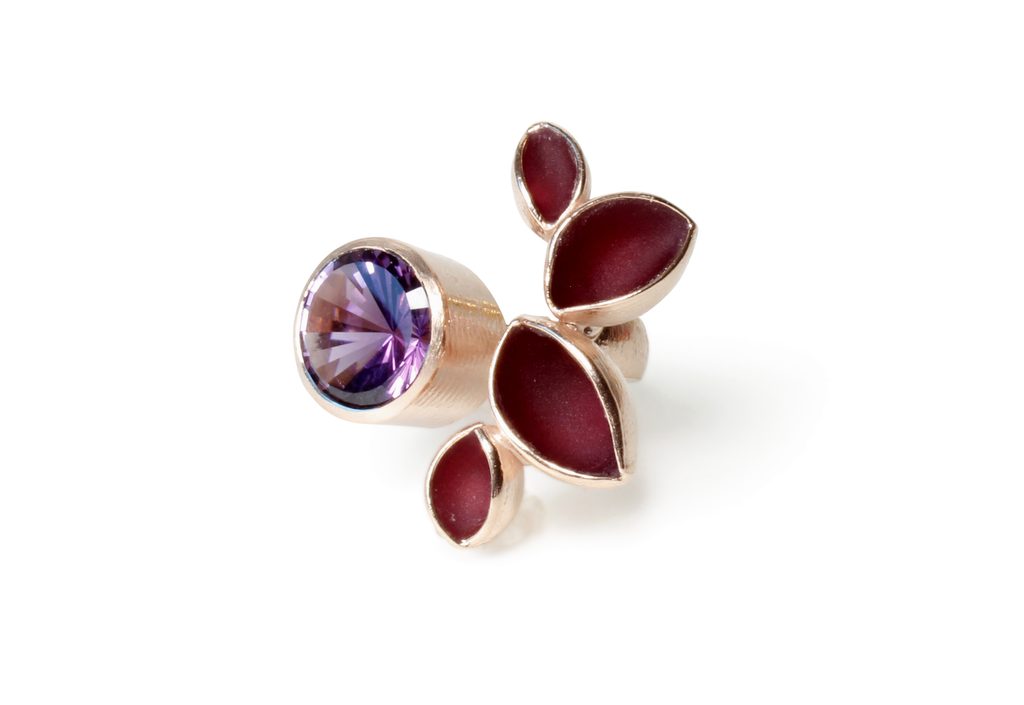
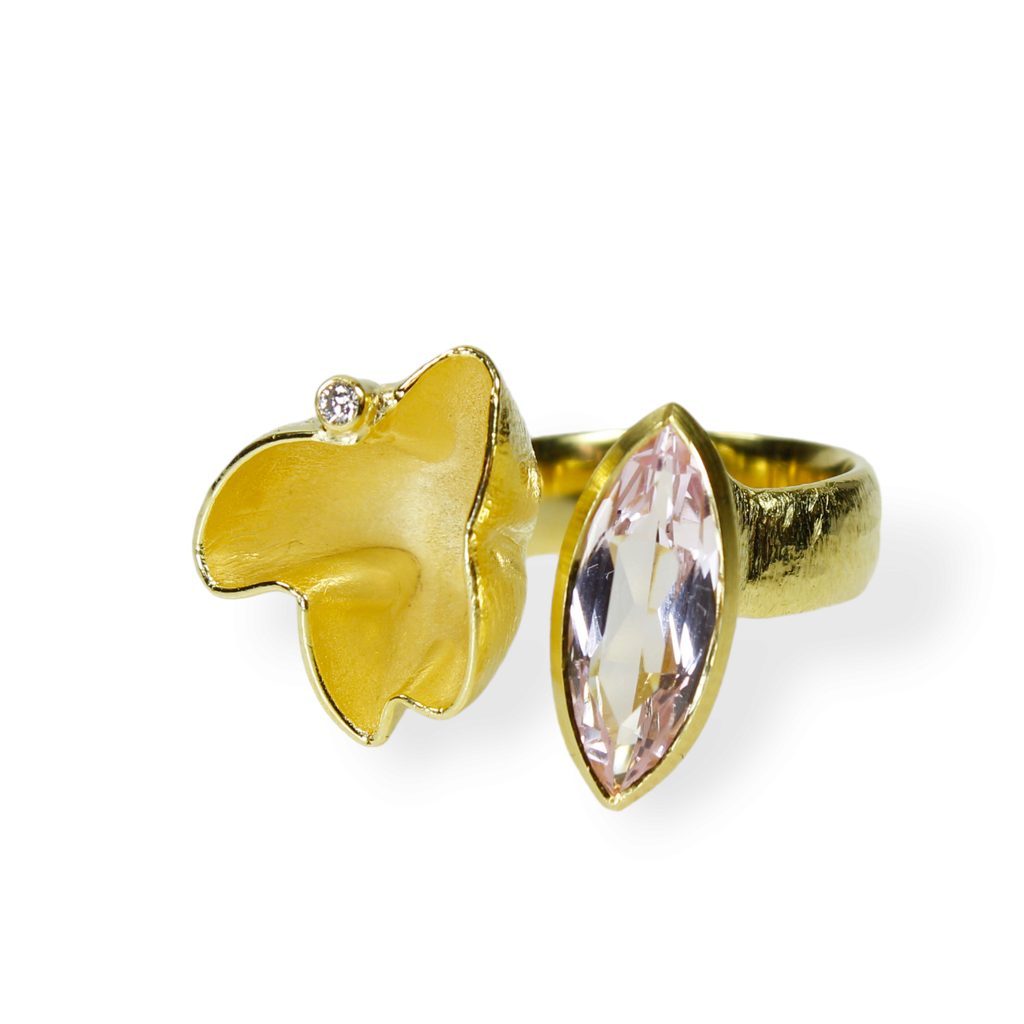
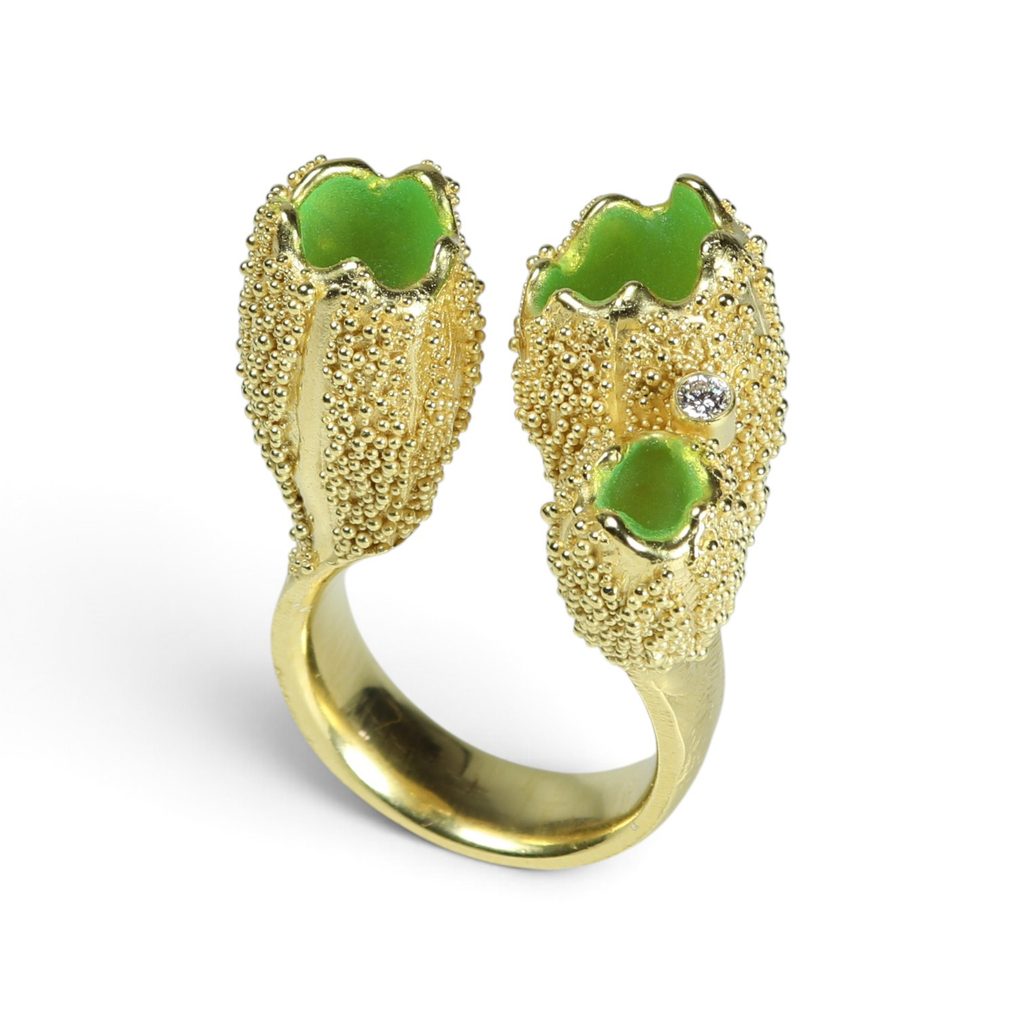
Rings from Sabine Müller’s Becherling series featuring: gold-plated silver with diamonds, morganite, amethyst, and acrylic
The stone fits surprisingly well with a series whose very premise is rooted in nature.
The Harz Mountains as a Source of Inspiration
Sabine Müller lives and works in the Harz region. Forests, mosses, plants, and mushrooms are among the forms that influence her work. It is no coincidence, then, that the best-known of her jewelry collections is called “Becherlinge”: It is named after small mushrooms whose cup-like forms emerge from the forest floor after rain.
Müller does not use this observation to create lifelike miniatures. Rather, her little cups are small decorative sculptures.
It all starts with wax. The individual shapes are modeled by hand, modified, cut open, and reassembled. Even the designer’s fingerprints are imprinted on the surface. During the subsequent casting process, the wax model is lost—leaving behind a one-of-a-kind piece of jewelry.
An amethyst druse has now been added to the eb.ri.mushroom ring.
And suddenly, the design and the stone seem to fit together almost effortlessly. The open cup shapes meet a similarly open, naturally formed crystal surface. The amethyst’s violet hue stands out against the blackened silver, without the stone being polished or tamed by a traditional cut.
As a result, the piece appears a bit rougher and more rustic—and, in keeping with the name “Autumn,” also darker than many of the vibrantly colored mugs in the series.
A stone that doesn’t have to be perfect
Maybe that’s exactly what makes this ring so memorable.
The druse does not display the geometric perfection of a cut gemstone. Its effect stems from small crystal surfaces, irregularities, and the light that refracts differently within it each time.
According to Sabine Müller, she has long been exploring organic and crystalline growth. In this ring, these two themes come together directly.
That’s why our “Jewelry Piece of the Week” this time isn’t a piece of jewelry that draws attention solely through its carat weight or a spectacular cut.
It’s one where nature has simply taken over part of the design itself.