
CIBJO Centenary Congress 2026: What Remains of Vicenza
The Jewelry World in Transition: For a century now CIBJO sets the rules in the jewellery industry. At the 2026 Centenary Congress in Vicenza, the organization faced its greatest challenges: The bitter dispute over lab-grown diamonds, the integration of artificial intelligence into gemology, and the question of what “sustainability” truly means in the world of jewelry. An exclusive look behind the scenes of a historic industry summit.
Cover photo: Gaetano Cavalieri, president of CIBJO (Photo: (C) CIBJO)
Four days, numerous committees, and an anniversary: At the Centenary Congress in Vicenza, CIBJO did more than just look back on 100 years of the association’s history. The focus was primarily on the issues currently facing the jewelry and gemstone industry. But not everything that was discussed led to a resolution. The debate over the labeling of lab-grown diamonds, in particular, illustrates how difficult it is to formulate globally unified rules when different markets and economic interests collide.
Other developments are more concrete. With the new Blue List, CIBJO is expanding its efforts to establish a common language. At the same time, existing Blue Books are being further developed, and new technologies such as artificial intelligence are increasingly becoming part of gemmological standards.
So what will remain of the 2026 anniversary convention?
Key Findings from Vicenza
1. The terminology for lab-grown diamonds remains undecided for the time being.
The stricter labeling requirements discussed in the run-up to the conference were not definitively adopted in Vicenza. Thus, one of the most controversial issues of the conference remains unresolved for now.
2. CIBJO is introducing the Blue List.
This new reference guide is intended to standardize terminology related to responsible supply chains and, among other things, provide clearer definitions of what is meant by “sustainable,” “responsible,” and “ethical.”
3. The Blue Books will continue to be developed.
The standards for diamonds, colored gemstones, pearls, precious metals, and other product groups remain the central tool through which CIBJO defines a common international technical language.
4. Artificial intelligence is becoming a topic of discussion in gemological standards.
AI and machine learning are increasingly being used in testing, grading, and interpretation. CIBJO aims to ensure that the same requirements for quality assurance, control, and verification apply to these methods as to conventional ones.
5. Responsible sourcing is becoming more concrete.
The discussion is increasingly focused on how responsible sourcing and traceability can be implemented in practice and communicated to customers in a way that is easy to understand.
6. Origin and traceability remain key issues in the diamond sector.
Technological capabilities for documenting the supply chain continue to evolve. At the same time, the question of which information can actually be reliably verified remains crucial.
7. Gold and precious metals remain in the spotlight.
Origin, recycling, and responsible sourcing are becoming increasingly important in light of complex international supply chains.
8. Small-scale mining remains part of our international responsibility.
Artisanal and small-scale mining cannot be addressed solely through exclusion criteria. Rather, the focus is on how standards can be improved without excluding millions of people from legal supply chains.
9. Standards are also being further developed for pearls, jade, and opal.
CIBJO is thus working to establish uniform terminology and disclosure practices even in areas that are outside the public spotlight of the diamond market.
10. Knowledge and training are becoming more internationalized.
Through educational initiatives such as the International Fine Jewellery Academy, industry knowledge is to be made more accessible internationally and taught in a more systematic manner.
11. When it comes to synthetic colored gemstones, CIBJO takes a clearer stance.
In Vicenza, the Colored Stone Commission reaffirmed the use of the term “synthetic” for gemstones that are not of natural origin. This situation thus differs significantly from the ongoing debate over terminology regarding lab-grown diamonds.
12. CIBJO has confirmed its leadership for the upcoming term.
The General Assembly re-elected Gaetano Cavalieri as president. The three vice presidents—Jonathan Kendall, Kenneth Scarratt, and Pramod Agrawal—will also remain in office. The Board, commissions, and committees were either reconfirmed or newly appointed for the new term.
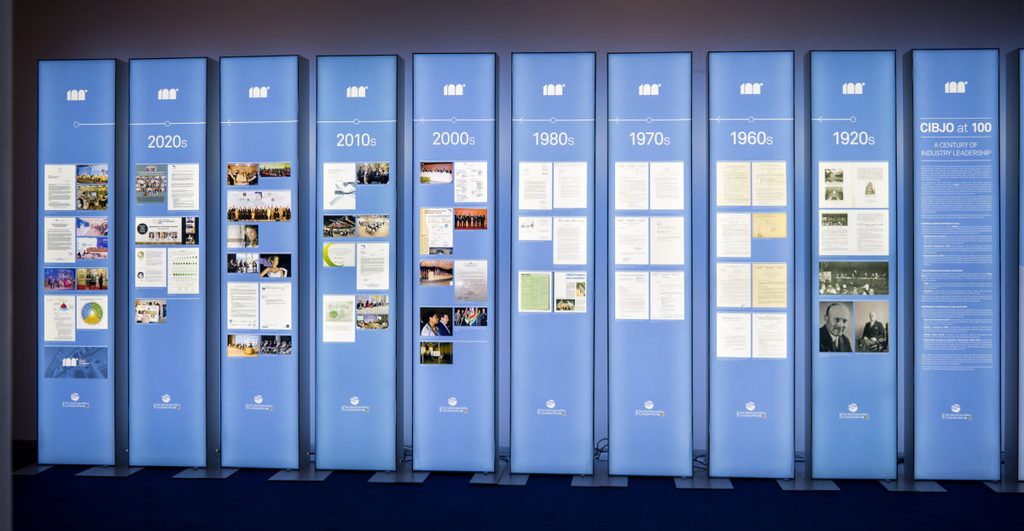
The results in detail:
Lab-Grown Diamonds: The Most Important Decision Has Been Postponed
Hardly any other topic was discussed more controversially in Vicenza than the naming of lab-grown diamonds.
In the run-up to the conference, a significant change had become apparent. There were discussions about imposing stricter restrictions on the terms that had previously been permitted and, in particular, drawing a clearer distinction between industrially produced diamonds and natural diamonds.
This also includes the question of what role terms such as “synthetic,” “laboratory-grown,” “laboratory-created,” or “manufactured” should play in the future.
However, no final decision was reached in Vicenza.
Shortly before the conclusion of the convention, CIBJO received a letter from leading industry representatives requesting a postponement. At the same time, the Laboratory-Grown Diamond Committee advocated for continuing to allow the term “laboratory-grown” in addition to “synthetic.”
This does not end the discussion. Following deliberations by the relevant committees, the final decision rests with CIBJO.
This is noteworthy because language has long since become a competitive factor in this field. When it comes to natural and lab-grown diamonds, it’s not just a matter of describing an object technically and accurately. The terms used also influence how customers perceive a diamond’s origin, rarity, and value.
That is precisely why it is important to use terminology that is as unambiguous as possible at the international level.
The Blue List: What Does “Sustainable” Actually Mean?
One specific innovation introduced at the convention is the CIBJO Blue List.
While the well-known Blue Books primarily establish technical definitions, nomenclatures, and trade rules for individual product groups, the Blue List focuses on terms that have come to appear almost everywhere in communications within the jewelry industry.
These include, for example, “sustainable,” “responsible,” and “ethical.”
At first glance, that sounds obvious. In reality, however, these terms are used in very different ways. What exactly does “responsibly” sourced jewelry mean? When can a product be called “sustainable”? And what requirements must be met for such claims to be verifiable?
With the Blue List, CIBJO is attempting to establish a common linguistic framework for this purpose.
This is certainly relevant to the industry. The more companies emphasize sustainability, origin, and responsibility in their marketing, the more important it becomes to ask what these terms actually mean—and which claims can be substantiated.
Blue Books: The Industry’s Common Language
Work on terminology has been one of CIBJO’s most important tasks for decades.
The so-called Blue Books define, among other things, terminology, descriptions, and disclosure requirements for diamonds, colored gemstones, pearls, precious metals, and other areas of the jewelry industry.
That sounds technical, but it has a very practical significance.
If a ruby has been treated, a diamond has been lab-grown, or a pearl is not of natural origin, it must be clear how these characteristics are described and disclosed.
Especially in an international market, common terminology prevents the same product from being described in completely different ways in different countries.
At the same time, the conference in Vicenza demonstrated that these regulations are not static. New manufacturing processes, treatment methods, technologies, and market practices make regular adjustments necessary.
Artificial Intelligence Makes Its Way into Gemmology
Artificial intelligence is a relatively new topic.
Machine learning and AI are also increasingly being used in gemmological laboratories—for example, in the analysis, grading, or interpretation of test results.
The CIBJO Gemmological Commission is therefore examining how such systems can be integrated into existing standards.
The key point: The use of AI should not alter a laboratory’s responsibilities.
Systems used for testing, calibration, interpretation, or decision support should be subject to the same quality assurance, control, and verification requirements as conventional methods.
This establishes a principle that is likely to grow in importance in the future: What matters is not whether a result is produced by a human being or with the help of an algorithm. What matters is that it is verifiable and reliable.
Responsible Sourcing: From Requirement to Implementation
Responsible sourcing has been one of the major issues in the jewelry industry for years. However, the focus of the discussion is now shifting.
The question is less and less whether origin and supply chains need to be taken into account, and more about how this works in practice.
This applies to diamonds as well as gold, colored gemstones, and other commodities.
This involves a wide range of differing circumstances. An industrial gold mine has different documentation capabilities than a small gemstone operation. An international corporation may implement different systems than a small artisanal operation.
International standards must therefore be robust on the one hand, but also work in practice on the other.
Diamonds: Origin Remains a Key Factor
For natural diamonds, traceability of origin remains a key issue.
New technologies are making it increasingly possible to digitally document information about individual stages of a supply chain. However, this also raises expectations that such information can actually be verified.
The key question, therefore, is not just how much data is available, but how reliable that data is.
For retailers and customers, this can make a significant difference in the long run: the difference between a mere indication of origin and a traceable provenance.
Gold: Recycling alone does not answer all the questions
The discussion surrounding gold and other precious metals is also becoming more nuanced.
Recycling plays an important role. At the same time, using recycled gold does not automatically resolve all issues related to responsibility and origin.
International supply chains for precious metals are complex. Primary production will continue to be part of the market in the future.
This brings greater attention to the conditions under which raw materials are extracted, processed, and traded—and how this information can be documented.
Artisanal Mining: Exclude or Integrate?
This tension is particularly evident in the context of artisanal and small-scale mining.
Small-scale mining provides a livelihood for many people around the world, but it often takes place under conditions that make it difficult to meet international standards.
The simple solution would be to exclude such sources from responsible supply chains.
However, this would cut off from the international market precisely those regions and producers whose economic development we are trying to support.
Discussions within CIBJO are therefore increasingly focused on how small-scale mining can be gradually integrated into more transparent and responsible structures.
Pearls, Jade, and Opal: Alternatives to Diamonds
Diamonds often receive the most public attention. However, CIBJO’s work extends far beyond that.
Terminology and disclosure rules for pearls, jade, opal, and other materials are also continuously reviewed.
This is particularly important in cases where treatments, imitations, or different methods of production are not readily apparent to buyers.
Standardized terms should therefore ensure that a product is described as clearly as possible in this context as well.
Synthetic Colored Gemstones: CIBJO Draws a Clearer Linguistic Line
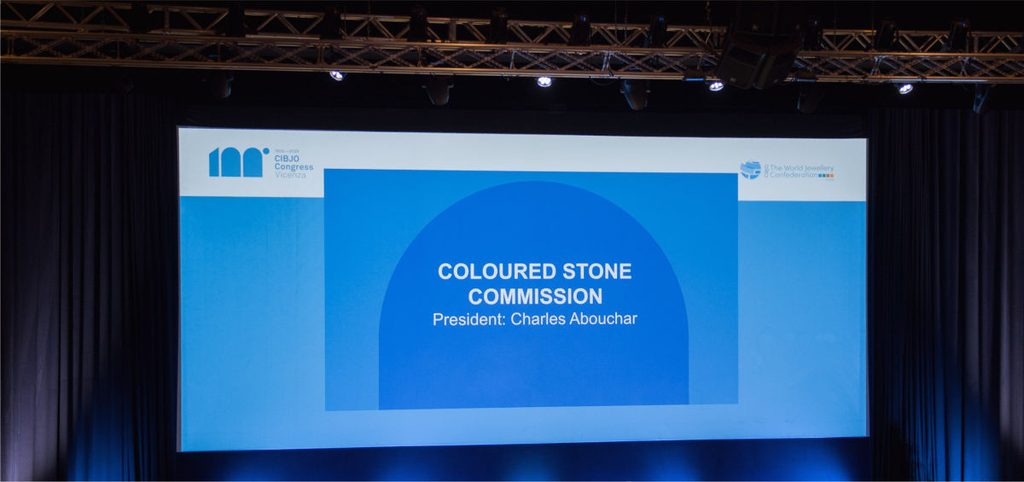
While the terminology for lab-grown diamonds is still being debated within CIBJO, the position regarding colored gemstones is much clearer.
The Colored Stone Commission reaffirmed in Vicenza that the term “synthetic” should be used for gemstones that are not of natural origin.
In this regard, CIBJO is taking a clearer stance on rubies, sapphires, emeralds, and other synthetic colored gemstones than it currently does with diamonds. While there is still debate over whether “laboratory-grown” can be used alongside “synthetic” for diamonds, there is consensus within the relevant commission regarding the term “synthetic” for colored gemstones.
This issue could become increasingly important for the market. Although synthetic colored gemstones have been around for a long time, they are becoming more prominent in jewelry collections. This raises the same question that is already a major concern in the diamond market: To what extent must natural and synthetic stones be clearly distinguished from one another for customers?
Knowledge as Part of the Infrastructure
In addition to rules and standards, training is playing an increasingly important role.
Through international educational initiatives and the International Fine Jewellery Academy, CIBJO continues to expand this area.
This is a logical complement to standardization itself. Rules only work if those who are supposed to apply them know and understand them.
Especially for a globally organized industry with highly diverse educational and market structures, knowledge itself thus becomes part of the infrastructure.
And then there’s politics
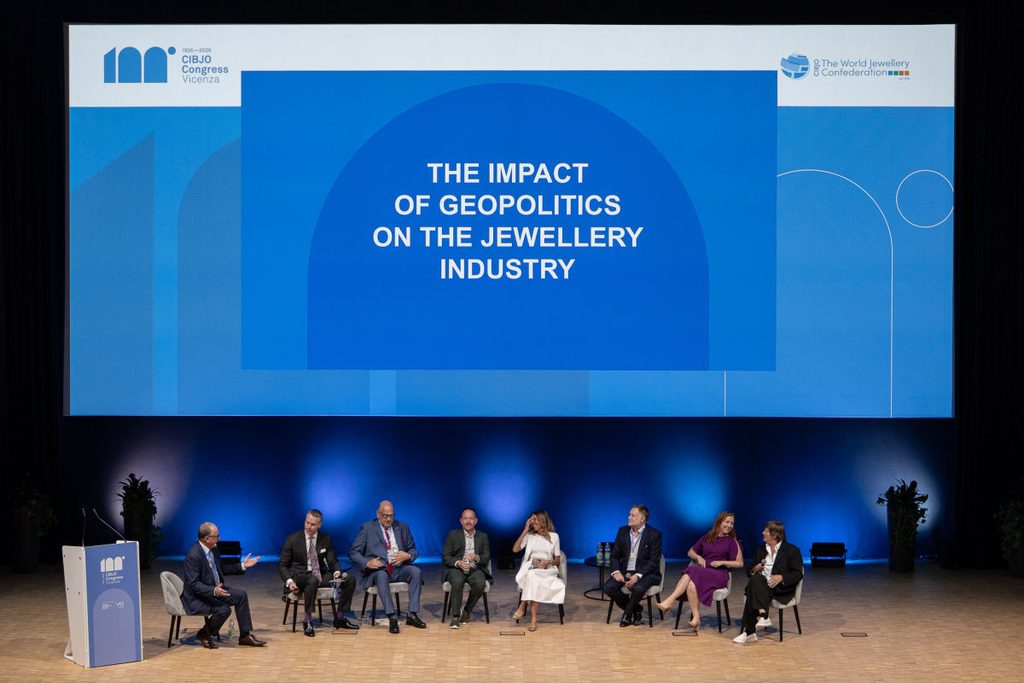
At the same time, the conference made it clear that the jewelry industry cannot be viewed in isolation from geopolitical developments.
Sanctions, trade restrictions, origin requirements, and varying national regulations are increasingly having a direct impact on international supply chains.
CIBJO cannot resolve political conflicts. However, the organization can strive to maintain common professional standards, even as political and economic conditions change.
This is precisely where one of the most challenging tasks of a globally organized industry association lies.
What Remains of the Anniversary Convention
The Centenary Congress in Vicenza did not produce one big new rule. Perhaps that would have been the wrong expectation anyway.
What’s more interesting is just how broad the range of topics has become.
One hundred years ago, collaboration among European jewelry associations focused primarily on establishing common rules for trade and product labeling. Today, these issues range from diamond terminology and gemstone treatments to supply chains, sustainability concepts, and artificial intelligence.
Nevertheless, the basic idea has remained remarkably similar: An international market needs a language and rules that as many participants as possible can rely on.
At the same time, Vicenza has shown just how difficult this goal has become. The unresolved issue regarding the terminology for lab-grown diamonds is perhaps the best example of this.
The fact that this is the subject of intense debate is not necessarily a sign that international standards are losing their importance. Quite the opposite: the greater their economic impact becomes, the more difficult it is to agree on them.
After 100 years, CIBJO remains, above all, one thing: a place where the jewelry industry seeks to negotiate precisely these common rules.