

Market Monitor: Luxury Stocks Under Pressure –
But not everywhere for the same reasons
LVMH, Hermès, and Kering have suffered massive losses on the stock market since the beginning of the year. Operationally, however, the luxury market is increasingly diverging. While the fashion business is struggling, the jewelry and watch segment is showing remarkable resilience.
The initial trigger was LVMH. In early September, shares of the French luxury conglomerate came under pressure again after HSBC downgraded its recommendation from “Buy” to “Hold” and lowered its price target from 600 to 490 euros. Just a few days earlier, several European luxury stocks had already fallen. The STOXX Europe Luxury 10 reached its lowest level in nearly three months in early September and was down about 19 percent from the start of the year at that time.
At first glance, this looks like a general sell-off in luxury stocks. But this is exactly where it gets interesting: On the stock market, some of these companies are sold off together during correction phases—yet their operational performance has long since ceased to move in lockstep.
LVMH: Fashion Remains the Key Factor
At LVMH, the focus is primarily on fashion and leather goods. HSBC attributes its caution to a slower recovery in the so-called “soft luxury” sector—that is, fashion, leather goods, and footwear. At Dior in particular, the expected recovery is proceeding more slowly than hoped.
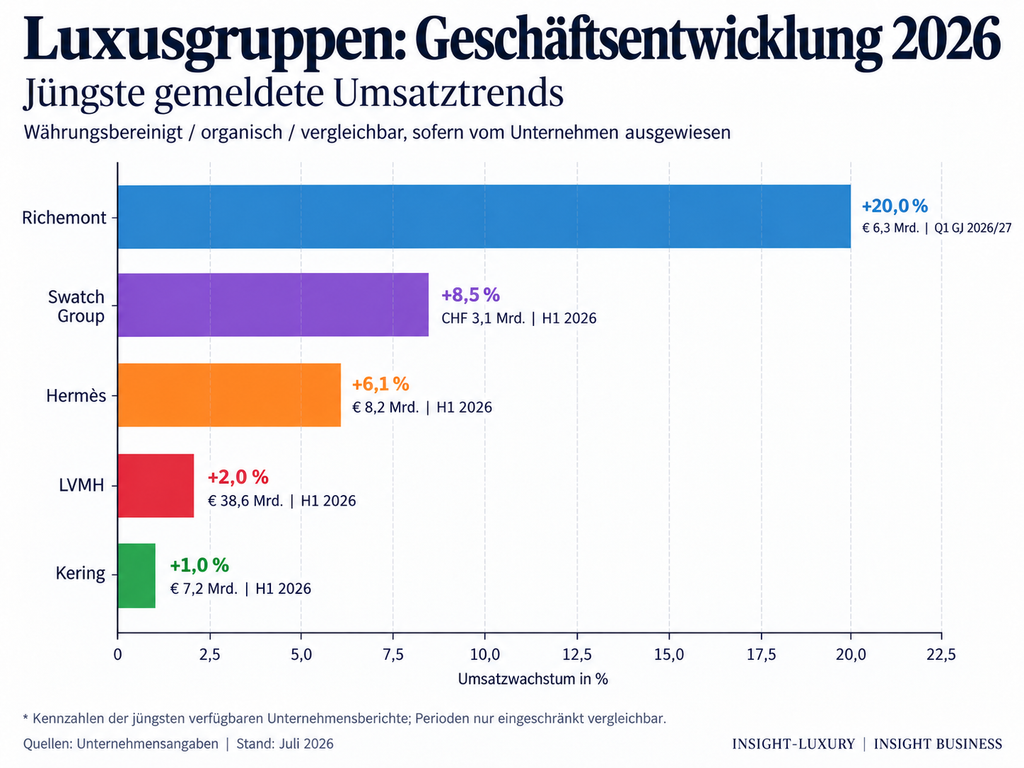
This is particularly relevant for LVMH because this division accounts not only for a large portion of revenue but also for an even larger share of operating profit. The latest figures underscore the problem: With currency-adjusted revenue growth of just +2.0% in the first half of the year (to 38.6 billion euros), business is virtually stagnating.
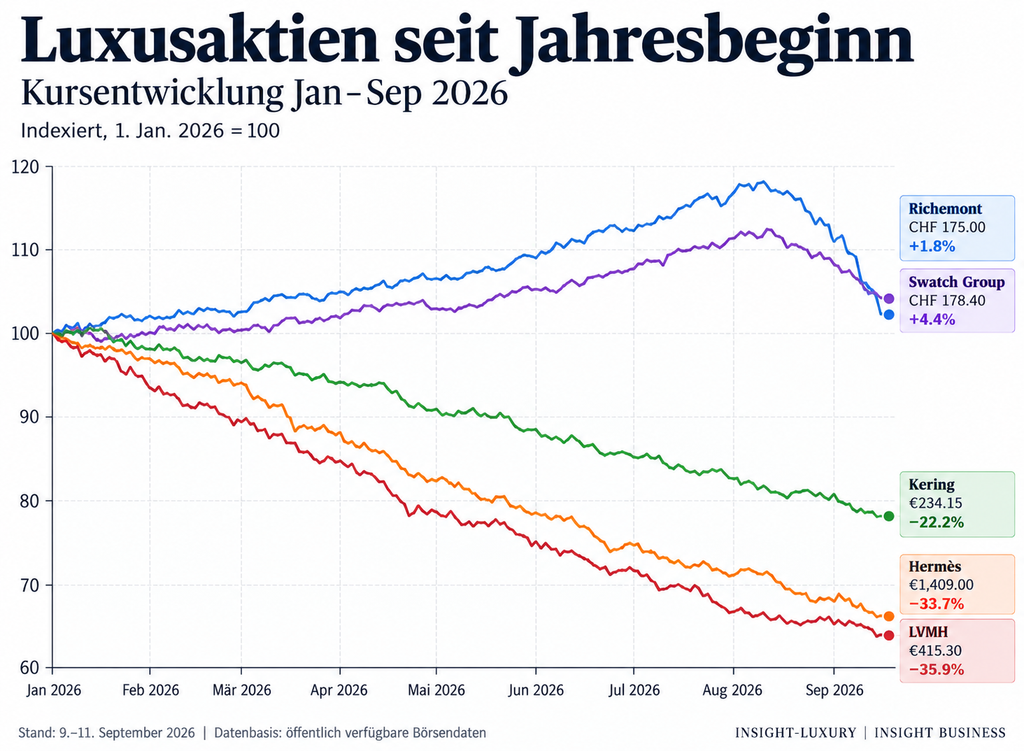
The market has responded accordingly: Since the beginning of the year, LVMH’s stock has plummeted by a dramatic 35.9%. The market is reacting less to a sudden slump than to a question that has been preoccupying the sector for months: How much further growth can still be generated through price increases and expansion when aspirational consumers, in particular, are becoming more cautious?
Richemont: Relative Strength Rather Than a Real Price Drop
At Richemont, the situation is completely different from that of its struggling competitors in the fashion industry.
Although the stock experienced a noticeable correction in early September amid general industry jitters—on September 9, the stock closed at 175.10 francs in Zurich— However, a look at the full year reveals a fundamental decoupling from the rest of the sector: While the fashion giants are down by double digits, Richemont stock has remained in positive territory since the beginning of the year, with a slight gain of 1.8%.
HSBC therefore expressly maintains its “Buy” rating for the group and highlights the momentum of “Hard Luxury.” Jewelry is increasingly perceived in terms of durability and lasting value. Furthermore, Richemont is less dependent on the cautious, aspirational luxury consumer.
This operational resilience is impressively underscored by the latest financial results: With currency-adjusted revenue growth of a whopping 20.0% (to 6.3 billion euros), Richemont is leaving the competition miles behind in the current cycle. The temporary pressure on the stock price in September was therefore not a reflection of the company’s business model, but rather due to the generally weaker stock market environment. On September 9, for example, the entire STOXX 600 index fell by about 1.4 percent after rising oil prices and higher bond yields weighed on the markets.
Hermès Reveals the Downside of High Expectations
Hermès, too, defies a simple winner-loser narrative, but is the exact opposite of Richemont: Here, solid operational growth contrasts with a brutal stock market crash.
Although the company continues to enjoy exceptional pricing power, its stock has plummeted by a staggering 33.7% since the start of the year. As a result, Hermès has lost nearly as much value as LVMH, the struggling laggard. The reason for this discrepancy lies in the shift in growth momentum: While Hermès is growing solidly, with currency-adjusted revenue up 6.1% in the first half of the year, this momentum is simply no longer enough for investors given the stock’s formerly extremely high valuation.
Consequently, in early September, HSBC lowered its price target for Hermès from 1,870 to 1,650 euros. This shows that even the most exclusive business model cannot protect a stock from drastic corrections when growth falls short of lofty expectations and the valuation consequently declines.
Kering: A Turnaround Instead of Business as Usual
In the case of Kering, however, the problem lies more within the company itself than in the macroeconomic environment.
Gucci has been going through a difficult repositioning phase for some time now. HSBC also lowered its price target for the stock—from 340 to 305 euros. With revenue growth of just +1.0% in the first half of the year (to 7.2 billion euros), Kering ranks last among the major groups in terms of operating performance.
On the stock market, this is reflected in a 22.2% decline since the beginning of the year. Kering therefore falls less into the category of a general luxury crisis than into that of a company that must also navigate its own profound turnaround. This makes the difference between Kering and Richemont particularly clear: Both stocks can fall on a weak trading day—but the reasons behind the valuation of their business models are entirely different.
Even with watches, the image is surprisingly robust
Even within the hard luxury segment, one should exercise caution when applying simple crisis categories. A look at the specialists illustrates this point.
The Swatch Group reported a strong, currency-adjusted increase in sales of 8.5% (to CHF 3.1 billion) for the first half of the year, as well as significant gains in market share. According to the Group, business grew across all price segments and continents; momentum accelerated in May and June and continued into July.
The market is also recognizing this operational foundation: Swatch shares are bucking the industry trend and are up 4.4% since the start of the year. This shows that even the watch market cannot simply be lumped into an overall negative picture. Brand strength, new product launches, and a broad distribution network each play their own stabilizing role.
One sector—a shared history that is fading away
Admittedly, recent stock price movements show how quickly luxury companies can find themselves collectively punished in the short term on the stock market. Rising interest rates, geopolitical uncertainty, or analyst reports often affect the entire sector on the same day.
In operational terms, however, the market is inexorably drifting apart. The fashion and leather goods sectors are clearly struggling with slowing momentum and a reluctance to spend among the middle class. The jewelry and leading watch brands have so far proven to be fundamentally more resilient.
This also changes the question we must ask about the luxury market. It is less about whether the luxury market is growing or shrinking overall. What is becoming increasingly crucial is: Which brands can maintain their prices, desirability, and demand even in a more challenging environment—and which were too heavily dependent on the extraordinary boom of recent years? September does not yet provide a definitive answer to this. But the differences are already crystal clear in investors’ portfolios.