Between Heritage and a New Beginning: Jean-Christophe Babin on the Future of the Watch Industry
Geneva Watch Days—born out of necessity, evolved into a phenomenon: What began in 2020 as a pragmatic response to the pandemic has grown into one of the watch industry’s most dynamic gathering places. Precisely because Geneva Watch Days now brings together so many young and independent brands, the changes affecting the industry as a whole are particularly evident there.
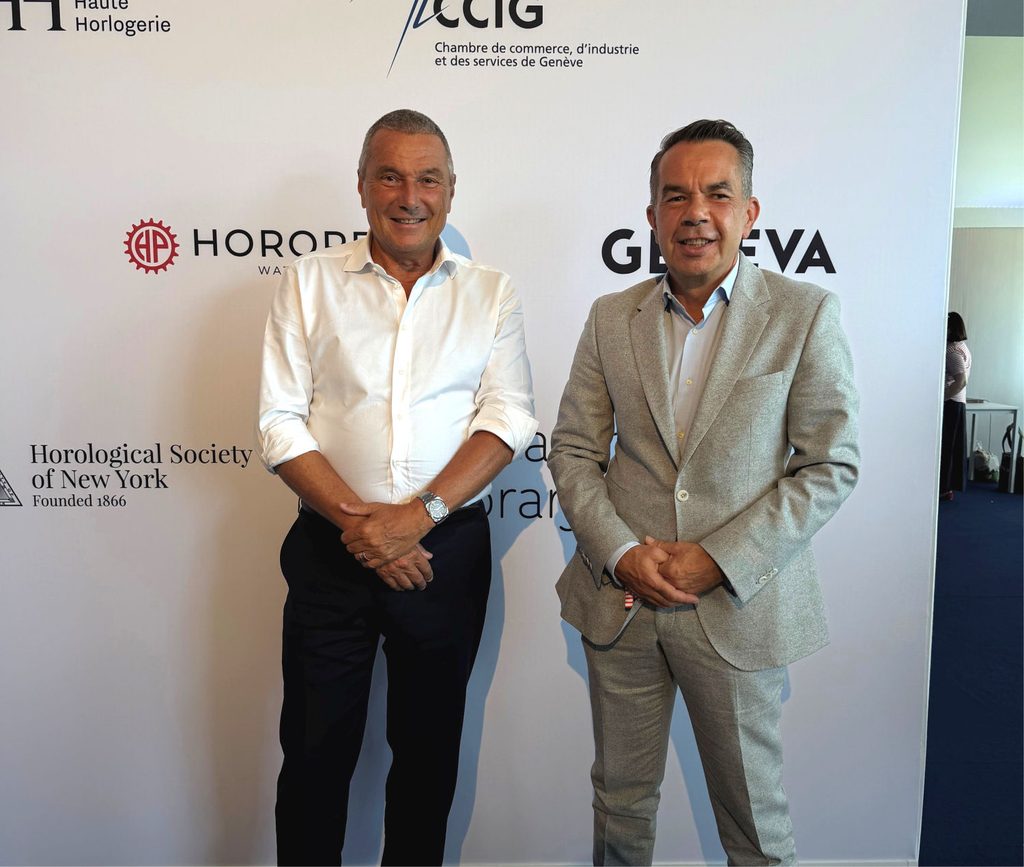
In conversation with INSIGHT-LUXURY, Jean-Christophe Babin, President of Geneva Watch Days and CEO of Bvlgari, speaks openly about the creative limits of relying too heavily on heritage and vintage-inspired watchmaking, why the industry needs a new generation of 21st-century brands, and why established players cannot rely on history alone.
He also looks at a retail landscape under structural pressure – but one that can create new opportunities through greater diversity, differentiation and a stronger focus on emerging brands. And he explains why Geneva in September is not simply another watch event, but a genuine community.
An Interview with Jean-Christophe Babin x INSIGHT-LUXURY
INSIGHT-LUXURY:
When Geneva Watch Days started in 2020, did you imagine that the event would develop into what it is today?
Jean-Christophe Babin:
No. The first edition was really an emergency replacement for the two main events that had been cancelled.
For watchmaking, especially during Covid, it was a difficult situation to be out of the spotlight for such a long time. Watches are not a top-of-mind category. If people don’t see anything about watches for two years, as an industry you risk losing their attention for much longer.
We were a group of friends. We managed to convince the authorities, the brands, around eight retailers and the press – mostly European because of the lockdowns, so we couldn’t really be global – but it was enough to create something.
We also had the full support of the government. The location, for instance, is a miracle. It’s probably the best location in downtown Geneva.
At the end of the first edition, we held a debriefing. Surprisingly, the first reaction from the 17 brands was: “Which dates do we choose for next year?” That was the moment when we understood that it had been a success.
And it was the first time there had been a watchmaking fair that was commercial and transactional, but at the same time very open and approachable as a networking event, going beyond the traditional four or five 25-minute appointments. For me, that is its strength. There are too many events in professional life that you attend simply out of duty. Of course, we want people to come to Geneva Watch Days because it is part of their job, but we also want them to be excited about what they are going to discover.
INSIGHT-LUXURY:
How important is Geneva itself to that success? Could the concept work in the same way anywhere else?
Jean-Christophe Babin:
We have incredible support from Geneva. The location is one example. Then you have the authorities, the institutions and the broader watchmaking environment.
Over time, we have also developed a wide range of educational activities: forums, symposiums, workshops and contests. This makes the event a real concentration of watchmaking.
It is a transactional occasion, but also a place for discovery. You can listen to discussions about Mexico, India, Gen Z and many other markets and topics. So it has really become an ecosystem around watches, and in a way this ecosystem also helps young brands to grow.
INSIGHT-LUXURY:
That seems particularly important for smaller brands. What can Geneva Watch Days offer them that established trade fairs cannot?
Jean-Christophe Babin:
There were already many small and young brands involved from the beginning, and we understood that they didn’t really have a platform of their own.
They would struggle to find a place at Watches and Wonders. And even if they did, it would be expensive. Then there is the cost of building the booth. For a large company, that may be manageable. For a young brand, it can consume a significant part of its communication or marketing budget.
Smaller brands also lack a platform to gain visibility, network and meet retailers and media. They need far more attention than Rolex. Everyone knows Rolex. But if you are a small brand, a retailer may simply ask: “Why should I come and see you? I don’t know you.”
Otherwise, these brands have to travel from city to city with a small suitcase. Even if they interest a retailer, they still need to convey who is behind the brand and what gives it substance. You can bring the watches to Tokyo or New York, but not the workshop, the watchmaking or the environment behind them.
So we understood that Geneva Watch Days is important for big brands such as Breitling or Bvlgari, but even more so for smaller ones. For some, this kind of platform can be essential to their survival.
When you compare our brands with those at Watches and Wonders, only seven of the 71 brands here are doing both events. Take the other 64 and compare them with the roughly 65 brands at Watches and Wonders. Interestingly, the numbers are very similar. Maybe this is some kind of magic number.
At Watches and Wonders, most brands are more than 50 years old, and many are more than 100 years old. Here, most are less than 50 years old, and many are less than ten years old. They are truly brands of the 21st century.
For me, that is the perfect complementarity: there you have around 65 established brands. Here you have almost 65 brands of the future.
INSIGHT-LUXURY:
You mentioned the remarkable success of some very young brands. What I find interesting is that positioning through decades or centuries may be important, and technical complexity is nice to have – but design is back. Would you agree?
Jean-Christophe Babin:
Yes. What many of these young brands have in common is often quite surprising design.
There are beautiful pieces among the established brands, no question, and very respectable ones. But there are also many watches where you have the feeling that you have seen them before. Not only have you seen them before – you may have seen them on your father’s wrist, and perhaps even on your grandfather’s wrist.
“Vintage design revives memories. So, if you are older, it works. But if you are younger, it does not necessarily connect with anything in your own experience.”
INSIGHT-LUXURY:
And is that also the problem with the strong focus on vintage and heritage in recent years?
Jean-Christophe Babin:
So the question is: do you really want to wear the same kind of watch as your father and grandfather?
Of course you may want to keep your father’s watch because of the memories attached to it. But that does not necessarily mean you want to buy the same thing again.
There was a period, perhaps for ten years, when I was tempted to ask brands: “Can you create new watches? Can you stop remaking the heritage watches from the 1960s?” Because sometimes it simply reflected a lack of creativity.
When creativity is lacking, it is relatively easy to take something that worked in the 1960s, redesign it slightly and bring it back. It feels safe. But during that period, we also began to see a decline in Swiss watch exports. Eventually, instead of attracting a new generation, we were mainly attracting an existing one.
Vintage design revives memories. So if you are older, it works. But if you are younger, it does not necessarily connect with anything in your own experience.
We had a similar discussion at Bvlgari. We had images of the founder, Sotirio Bulgari, in our stores, and at some point I said we should reconsider that. Not because we should not respect the founder.
Of course we should. But for many younger people today, an old portrait of somebody they have never heard of does not mean very much.
“Young brands are often closer to the values of younger generations and most importantly, young brands are forced to innovate.“
INSIGHT-LUXURY:
Is it easier for younger brands to find new ways of connecting with younger generations?
Jean-Christophe Babin:
Yes. When you have younger founders and younger watchmakers, there are fewer habits and fewer taboos.
These are brands of the 21st century, created by entrepreneurs of this century. Their approach to watchmaking is therefore not exactly the same. If your brand was founded in the 19th or early 20th century, its DNA is inevitably influenced by that period. Young brands, by contrast, are much more influenced by the speed of the century we are living in and by today’s environment.
They are often closer to the values of younger generations. When you are a young entrepreneur yourself, it is easier to understand the values of younger clients than when you are a baby boomer like myself, because I was shaped by a different period.
And most importantly, young brands are forced to innovate. If you are a new brand, people will normally prefer to buy from an established, reputable brand. So for a young brand, it is almost impossible to compete simply by doing the same thing.
A large, established brand is under less pressure. If Rolex introduces a green bezel, everybody talks about it. If a completely new brand introduces a green bezel, nobody cares. A new brand has to do more.
INSIGHT-LUXURY:
But there cannot be room for an unlimited number of new brands. Has the market already reached a natural limit?
Jean-Christophe Babin:
The limit is ultimately set by the stakeholders: retailers, media and collectors. There is simply a limit to how much people can see and absorb.
Retailers have a life. Collectors have a life. Media have a life. After two or three days, people want to go home again.
So, it is not surprising to me that Watches and Wonders has around 65 brands. If you want to maintain a comfortable discovery experience, you need to give press, retailers and collectors enough time to actually see them.
Beyond a certain number, that becomes impossible within five days. Basically, I think we have reached something like a plateau.
And like in any business, some brands will leave each year and others will come in. We have many brands knocking at the door. Some will probably be here forever. Others will disappear or simply not return next year.
We need enough flexibility to welcome new ones, because we don’t yet know which brands will become the important brands of the future.
“Multi-brand retail remains important because people want choices. That’s precisely why it can make sense to explore new brands and create more variety.”
INSIGHT-LUXURY:
At the same time, the retail landscape is changing. Even in Germany, multi-brand retailers are beginning to look more closely at smaller brands. Is that becoming a necessity rather than just an opportunity?
Jean-Christophe Babin:
You have to look at what has happened to retail over the last years. Many of the major brands have increasingly moved towards direct distribution and their own boutiques. As a result, the multi-brand retailer suddenly finds himself competing with brands he used to distribute.
That means retailers also have to look for new brands. And this can be a real opportunity.
Of course, the big names remain important. But clients are also open to less familiar names – because of novelty, exclusivity and diversity. If you want to survive as a multi-brand retailer, you need to offer something different.
For a new watch brand, getting into retail is still extremely difficult. You can go from store to store with a suitcase full of watches, and very often the answer will simply be: “Nice, thank you.” But these brands can offer retailers something they increasingly cannot get from the large brands: differentiation.
The challenge for the retailer is also that he is not always the one making the decision. In many cases, the brand decides. And if you have invested in the store and a major brand then leaves, you are still left with the lease, the staff and the investment. So the situation for retailers has become much more complex.
Multi-brand retail remains important because people want choice. That is another reason why looking at new brands and creating more diversity can make sense.
Before making their final decision, clients often make a pre-selection online. Then they make the final selection in the store. You may enter a store thinking you want one particular watch and leave with another one. Perhaps the advisor says: “Have you considered this?” And suddenly you change your mind.
People can prepare their choices online very quickly. But when it comes to the final decision, the multi-brand retailer still has a very natural role. Today, having many leading established brands in one multi-brand store is becoming increasingly difficult because very often there is already a mono-brand boutique next door. So the retailer needs diversity. Five brands are not enough. I don’t know whether the right number is 20 or 30, but people come to multi-brand retail because they want choice.
INSIGHT-LUXURY:
In Germany I often hear from retailers: “I already go to Geneva once a year in April. That’s enough.” Why should they come back in September?
Jean-Christophe Babin:
You know the joke about the difference between the two events?
When you are a retailer going to Watches and Wonders, there is a probability that you will be kicked out by the brand you visit. When you come to Geneva Watch Days, there is a probability that you will leave with two more brands.
That’s the reality. And that is really what is different here.
What started as an emergency event has become something much more collective. Traditional fairs are still very individual. Yes, everybody is under one roof, but I don’t believe that the roof necessarily unites people. Brands are competing with each other to get you for dinner or to get you for an interview instead of another brand.
Here, there is much more pooling and goodwill. We encourage brand CEOs to be present in the evening because we don’t only want Geneva Watch Days to be a multi-brand event during the daytime. We want the evenings to be multi-brand as well.
After the formal interviews and the discovery of brands during the day, you continue networking and socialising. You meet people from many different brands instead of spending the whole evening with just one brand.
So yes, it has developed into a community event. The first intention was simply to respond to an emergency. The second was to create something different – something more collective.