German Jewelry and Watch Industry: July Figures Confirm the already Familiar Picture
Jewelry retains its value well, while watches show more stable performance
Foreign trade figures for the German jewelry and watch industry remained at a high level in July 2026—and at the same time, they require further explanation. As early as the first quarter, INSIGHT-LUXURY had pointed out the exceptionally high jewelry figures and explicitly stated that they should not be interpreted as a simple surge in demand. May saw a significant setback, followed by a sharp rise in June. The July figures from the Federal Association of Jewelry, Watches, Silverware, and Related Industries continue this mixed picture.
The same caveat as in previous months remains important here: These figures represent import and export values, not unit quantities, consumer prices, or the revenue of individual companies. In the jewelry sector in particular, high precious metal prices, merchandise values, and international trade flows have a significant impact on the statistics. The BVSU also notes that the figures from the Federal Statistical Office may be revised at a later date.
Jewelry Exports: Below June Levels, but Significantly Above Last Year’s Levels
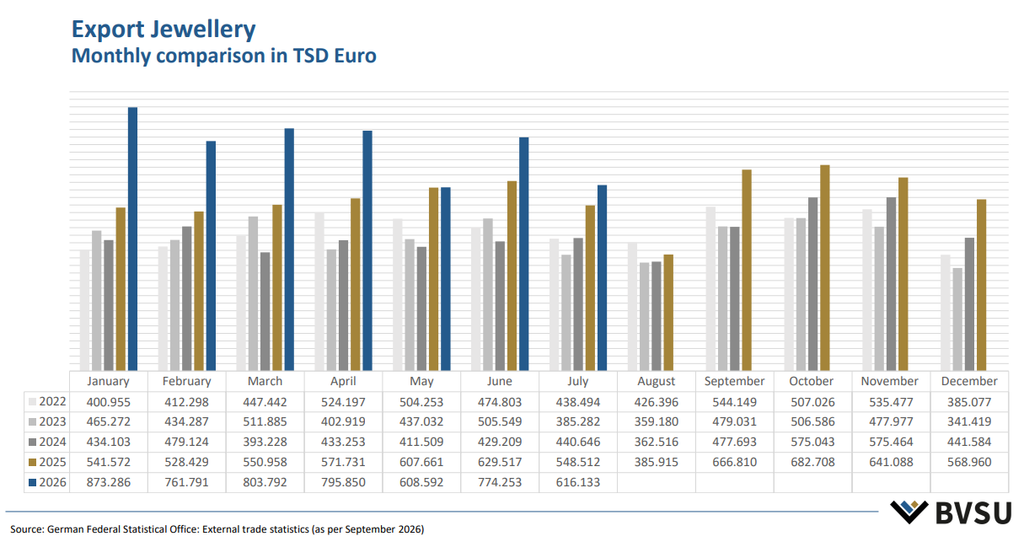
German jewelry exports totaled 616.1 million euros in July. This was 25.7 percent lower than in the exceptionally strong month of June, but still 11.0 percent higher than in July 2025.
The month-over-month comparison once again highlights how volatile the trend is in 2026. After export figures of 873.3 million euros in January, 803.8 million euros in March, and 795.9 million euros in April, the figure fell significantly in May, rose to 774.3 million euros in June, and has now dropped again to 616.1 million euros.
For this very reason, the decline compared to June should not be interpreted as a sudden slump in demand. The previous months have already shown that statistics on value in the jewelry sector fluctuate widely and do not directly reflect actual sales volumes. Compared to the previous year, however, the level remains high: From January through July 2026, jewelry exports totaled approximately 5.23 billion euros, compared to approximately 3.98 billion euros during the same period in 2025. In terms of value, this represents an increase of just under 32 percent.
This confirms the trend observed to date: Export values are exceptionally high, yet this does not translate into a corresponding increase in volume. Rather, there is now growing evidence that this trend is largely driven by higher material values and prices.
Jewelry imports are returning to normal
On the import side, the picture is different. Jewelry imports totaled 505.3 million euros in July, down 2.4 percent from June and 2.3 percent from the same month a year ago.
This is noteworthy because the figures for the first few months of the year had been significantly higher in some cases. In March, the figure was still 809.7 million euros; in April, it was 734.9 million euros; and in May, it was 750.7 million euros. By June, the figure had already fallen to 517.6 million euros.
This suggests that, at least on the import side, the situation is stabilizing following the extreme fluctuations of the spring. Cumulatively, however, jewelry imports remain well above the previous year’s level: From January through July, they totaled approximately 4.60 billion euros, compared with about 3.74 billion euros in the same period of 2025—an increase of just under 23 percent.

Watch Exports: More Resilient Than Jewelry
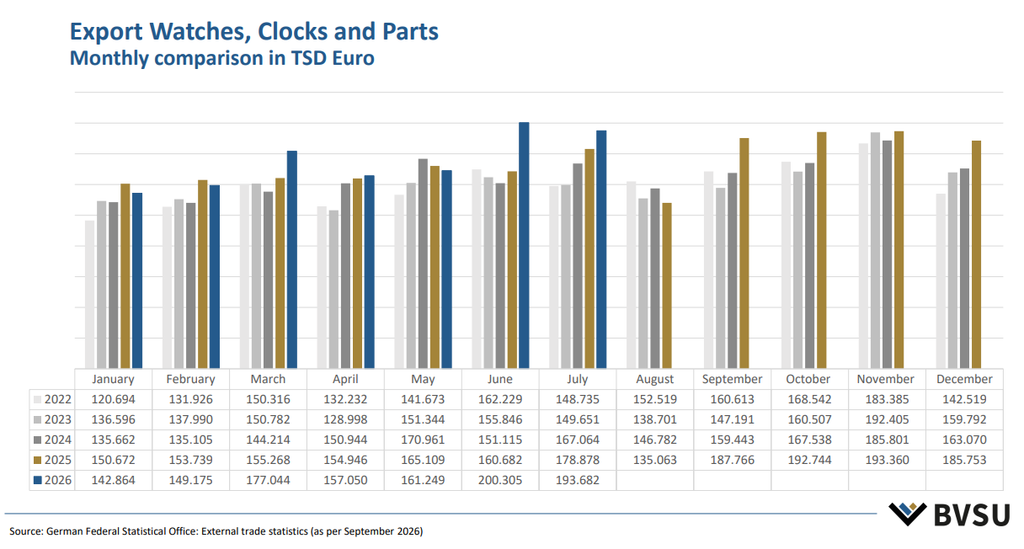
The trend for watches, grandfathers’ clocks, and parts remains significantly more subdued. Exports totaled 193.7 million euros in July. Compared to June, this represents a decline of 3.4 percent; compared to July 2025, however, it represents an increase of 7.6 percent.
Following a strong June, with exports totaling 200.3 million euros, July also remained at a comparatively high level. From January through July, watch exports totaled approximately 1.18 billion euros, compared with approximately 1.12 billion euros during the same period last year. This represents an increase of about 5.5 percent.
This confirms the trend that was already evident in the spring: The watch industry is performing more steadily than the jewelry sector and is significantly less directly affected by fluctuations in precious metal prices. At the same time, growth remains moderate.
Watch Imports Continue to Rise
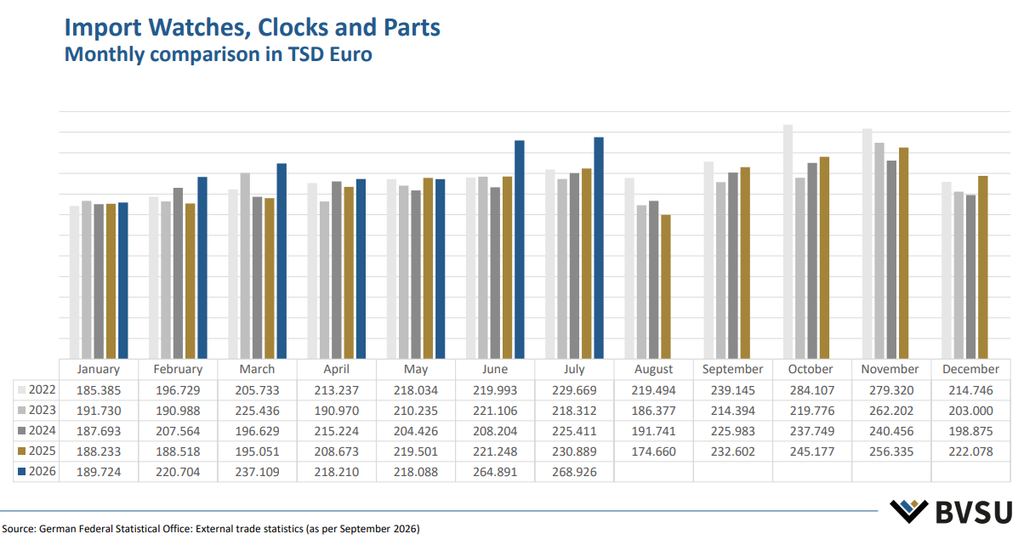
The trend is more pronounced when it comes to imports. In July, watches, clocks, and parts worth 268.9 million euros were imported into Germany. That is 1.5 percent more than in June and 14.1 percent more than in July 2025.
This continues the trend that was already evident in the first half of the year. At 264.9 million euros, June’s import figures were also significantly higher than the previous year. Cumulatively, watch imports from January through July totaled approximately 1.62 billion euros, compared to 1.45 billion euros in the same period of 2025. This represents an increase of about 11.4 percent.
Germany thus remains a net importer rather than an exporter of watches and watch parts. At the same time, it is evident that imports have been growing at a faster rate than exports so far.
What July Reveals
The July figures do not fundamentally change the picture that has emerged so far; rather, they bring it into sharper focus. In the jewelry sector, figures remain high, monthly fluctuations are significant, and the data’s ability to reflect actual demand is limited. After seven months, there is now strong evidence that the extraordinary increase is driven primarily by price and material costs and to a much lesser extent by corresponding volume growth.
In the watch sector, the trend is more stable and easier to interpret. Exports are growing at a moderate pace, while imports are rising more sharply. Jewelry and watches must therefore continue to be viewed separately: in one case, foreign trade is strongly value-driven; in the other, the trend is more stable, though not particularly spectacular.
Source, images, and statistics: BVSU