
INSIGHT Market-Monitor: Germany’s economy is hopeful—but…
INSIGHT BUSINESS | European Consumer Monitor 01
The German economy is sending cautiously positive signals. However, there are few signs of a recovery in the retail sector so far. A comparison with four European markets shows that consumer spending and consumer sentiment are, in some cases, more resilient elsewhere. What does this mean for the watch and jewelry industry?
The economic situation in Germany remains tense. Weak consumer spending, high costs, and cautious investment continue to weigh on many companies. This makes a development in Munich all the more remarkable: The ifo Business Climate Index, published on October 26, 2026, has risen for the sixth consecutive time, albeit only slightly—from 89.9 to 90.2 points.
How does this all fit together? The growing optimism does not mean that the economic problems have already been overcome. Rather, companies expect things to improve in the coming months, even though they actually view their current business situation as slightly worse overall. Their hopes are therefore focused more on the future than on the present.
Sentiment improved particularly in the manufacturing sector, where both assessments of the current situation and expectations showed a marked improvement. An increase in new orders has led companies to anticipate higher production levels once again.
The situation is different in the retail sector. There, the business climate remained stagnant. Retailers assessed their current situation as worse than in September; only their expectations improved slightly. Wholesale performed better than retail.
A potential recovery in the industrial sector does not necessarily mean a pickup in private consumption. A comparison with other European countries shows just how difficult the situation remains for the German retail sector.
A Comparison of Retail in Europe
The latest Eurostat data show significant differences among five European markets.
In August 2026, real—that is, price-adjusted—sales in the German non-food retail sector were 0.8 percent lower than in the same month of the previous year. France, by contrast, recorded an increase of 2.8 percent, Poland reached 3.3 percent, and Spain 2.6 percent. In Italy, growth was virtually flat, with a slight increase of 0.3 percent.
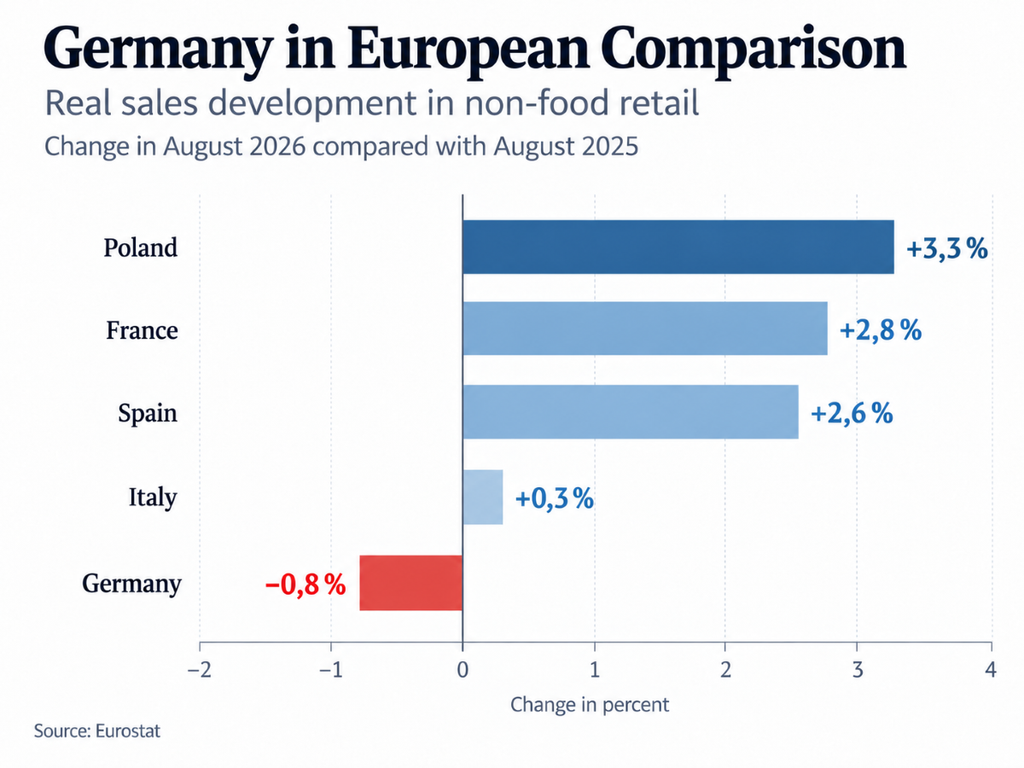
Change from August 2025 to August 2026. Retail trade excluding food, beverages, and tobacco. Source: Eurostat.
In August, Germany ranked last among the five markets surveyed. The coming months will show whether this points to a longer-term trend.
It is noteworthy that, at the same time, nominal sales in Germany rose by 3.5 percent. Real sales indices already take price trends into account and thus provide a rough indication of the change in sales volume. Consequently, higher sales do not necessarily mean that more goods were sold.
Consumer Sentiment: No Reversal in the Trend
Consumer sentiment, too, does not yet point to a sustained recovery in private demand.
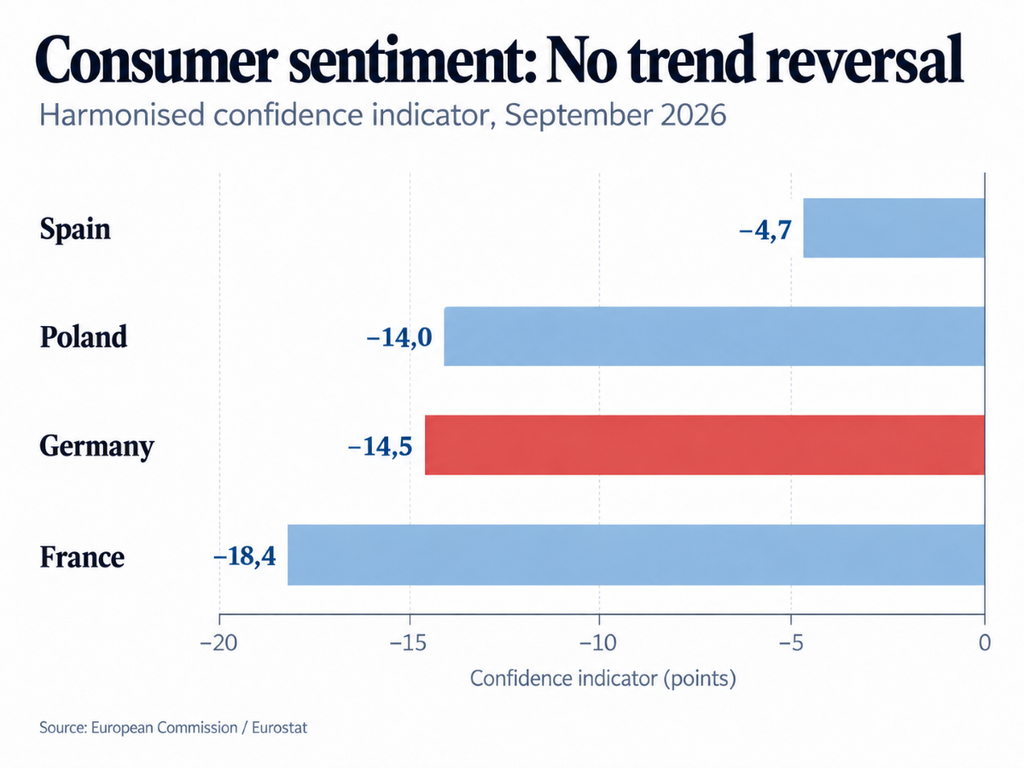
According to the European Commission’s harmonized surveys, the German confidence indicator stood at −14.5 points in September, 5.3 points below the previous year’s figure.
Spain showed a comparatively better sentiment at −4.7 points, although expectations there have also declined. France, at −18.4 points, recorded a lower level of confidence than Germany but showed a slight improvement compared to the previous year. In Poland, the indicator declined to −14.0 points.
Consumer sentiment and actual retail trends do not necessarily move in tandem. These indicators alone do not reveal the extent to which uncertainty affects purchasing behavior or which product categories are particularly affected.
The Precious Metal Effect in Jewelry
This trend is of particular interest to the watch and jewelry industry. However, European retail indices reflect the general non-food retail sector, not exclusively the sale of watches and jewelry.
Added to this is the industry-specific effect we are already familiar with: The extraordinary price increases for gold and silver significantly alter the interpretive value of nominal sales and trading figures. Higher sales can occur even when fewer pieces of jewelry are sold.
The German foreign trade data from the Federal Association of Jewelry and Watches (BVSU) for the first half of 2026 show how differently the various product categories are performing:
- Precious metals and semi-finished products: approximately +53% in export value
- Ready-made jewelry: export value up by only about 5%
For more information: https://insight-luxury.com/2026/09/22/deutsche-schmuck-und-uhrenindustrie-juli-bestaetigt-das-bekannte-bild/
This discrepancy illustrates just how strongly changes in precious metal prices and the composition of traded goods can influence foreign trade statistics. However, it does not yet allow for any direct conclusions about actual end-consumer demand for jewelry.
Although European retail indices are price-adjusted, they do not specifically capture the changes in prices and product assortments in the jewelry trade. Therefore, additional data on sales volumes, unit sales, and average selling prices would be necessary to assess actual industry demand.
Different markets, different requirements
The diverging trends in consumer behavior across Europe are likely to become increasingly important for manufacturers and specialty retailers as well. While some markets are showing relatively robust retail performance, conditions in Germany remain challenging.
As a result, issues related to sales planning, product assortment design, and product availability are taking center stage. At the same time, high precious metal prices increase the value of inventory without necessarily leading to higher sales volumes. In addition to sales revenue, inventory turnover, capital tied up in inventory, and actual sales therefore become increasingly significant indicators of economic performance.
Based on the data available so far, it is not yet clear whether the more favorable overall consumer climate in individual European countries is also benefiting the jewelry retail sector there.
A Sideways Look at the Foreign Trade in Jewelry
European foreign trade data also show varying trends. An analysis of Eurostat data for the first seven months of 2026 reveals that the value of imports of jewelry made of precious metals rose in Germany and Italy, while the weight of imported goods declined. In Spain and Poland, on the other hand, both the value and weight of imports declined. Exports also showed varying trends.
No direct link to domestic demand can be inferred from this. Production, international distribution, further processing, and re-exports influence the flow of goods just as much as companies’ procurement behavior.
Nevertheless, a question arises that goes beyond a mere examination of trade statistics: Are manufacturers, distributors, and specialty retailers already responding to the varying economic conditions in Europe by adjusting their procurement, inventory, or distribution strategies?
The data available so far do not yet provide clear evidence of this. However, as the year progresses, it may become apparent whether the different consumption patterns are also reflected in changes to the organization of goods flows.
A Silver Lining—But Not Yet a Green Light
Against this backdrop, the recent rise in the ifo Business Climate Index is a cautiously positive sign. The federal government has also raised its growth forecast for 2026 from the original 0.5 percent to 1.3 percent.
Both factors point to the expectation of a gradual economic recovery. However, the key question remains: when and to what extent will this trend reach consumers? So far, the improved sentiment has been driven primarily by expectations and more favorable developments in certain sectors of industry, not by a broad-based recovery in the retail sector.
At the same time, a comparison across Europe shows that weak consumer spending is not equally pronounced everywhere. While Germany is lagging behind in terms of real retail sales, other markets are performing more robustly despite similarly subdued consumer sentiment.
This paints a mixed picture for the upcoming holiday shopping season: Economic expectations are improving, but actual willingness to spend remains subdued in many places.
So, a small silver lining on the horizon. Whether this will lead to a noticeable recovery remains to be seen in the coming months.
Sources: ifo Institute, Business Climate Index as of October 26, 2026; Eurostat, Retail Sales Indices (ei_isrt_m) and Harmonized Consumer Confidence (ei_bsco_m); Eurostat Comext, jewelry foreign trade (CN 7113); Federal Association of Jewelry and Watches (BVSU), Foreign Trade and Industry Statistics 2026; German Federal Government’s Fall 2026 Projection.