
A Moment at Parmigiani Fleurier
A first impression is often more than just a snapshot. It’s a feeling, an atmosphere, authenticity. That’s exactly what we’re looking for when we encounter brands: beyond the staged image, where passion, craftsmanship, and history come to life. For our series “A Moment at the Maison,” we traveled to Switzerland to capture these moments at the great watchmaking houses.
Part 2 of our series: “A Moment at the Maison” — A Moment at Parmigiani Fleurier
Parmigiani Fleurier is undoubtedly one of the most extraordinary watchmakers in the world—and not just because they make truly beautiful watches. What makes it special lies, on the one hand, in the brand’s relatively short history—next year, Parmigiani will celebrate its 30th anniversary—and, on the other hand, in the high standards it sets for itself: in terms of design, vertical integration, expertise, and a presence that is never ostentatious.

I don’t really want to give anything away here, but the moments I was able to spend in Fleurier reflected this very vividly:
The Road to Fleurier
winds its way along winding roads through the enchanting landscape of the Swiss Jura. Even now, it’s easy to imagine that two or three hundred years ago, it was nearly impossible to get through here in winter—and why the people there had time to reflect on time itself and began making watches.
Upon arriving in Fleurier, you find yourself in front of Parmigiani Fleurier’s headquarters: a magnificent, yet not overly large, villa that initially served as the residence of the founder, Michel Parmigiani, and is now the brand’s operational headquarters.
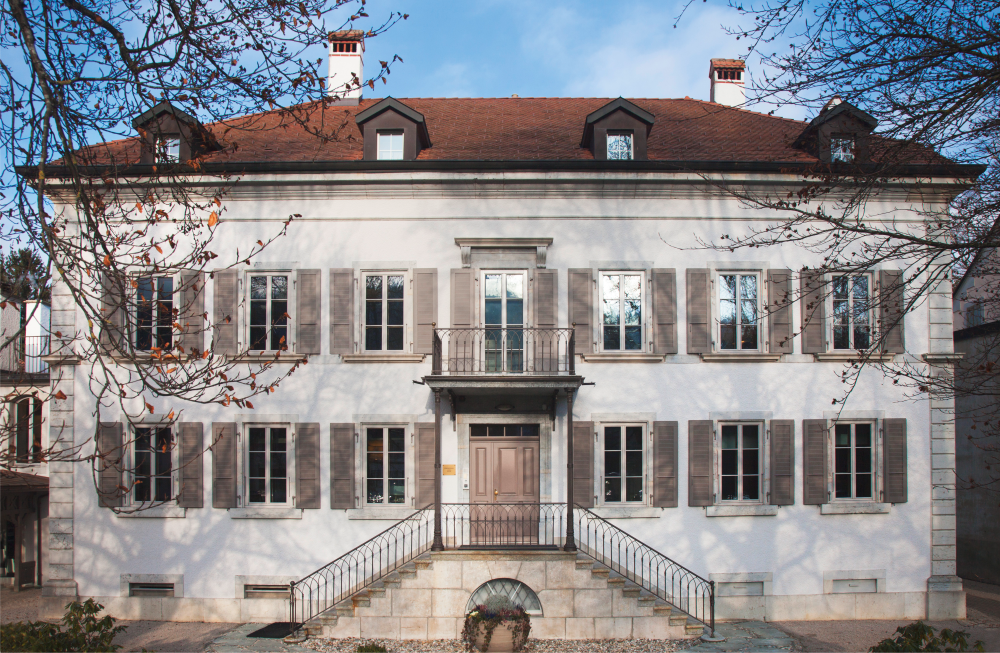
Luxury is evident right from the start—yes—but it’s understated, not ostentatious. Upon entering the house, that impression continues: muted colors, high-quality materials, and thoughtfully designed modern spaces—where old and new come together seamlessly.
After a brief welcome, we headed straight to one of the manufacturing facility’s key areas: the restoration department.
Why “Herzstück”?
This is exactly where the factory has its origins:
In 1976, watchmaker Michel Parmigiani founded his restoration workshop, Mesure et Art du Temps. In the 1980s, the workshop brought him international recognition through its restoration of historic watches and automata for the Sandoz Family Foundation. This workshop was the origin of his later brand, Parmigiani Fleurier, which he founded in 1996 with the foundation’s support.
Watchmaking workshops are always fascinating—and one can never show enough respect for watchmakers and their craft. But what you get to experience in a restoration workshop is in a league of its own.

Imagine,
Someone gives you an old, complicated watch or what’s known as an “automata”—that is, a highly complex mechanical device. There’s no documentation, no manual, no description. All you have is the mechanism itself—and it’s barely functional, if at all.
The task now is not only to restore this work to working order, but also to preserve it in its original condition as much as possible or to restore it to that condition.
Does that sound unsolvable?
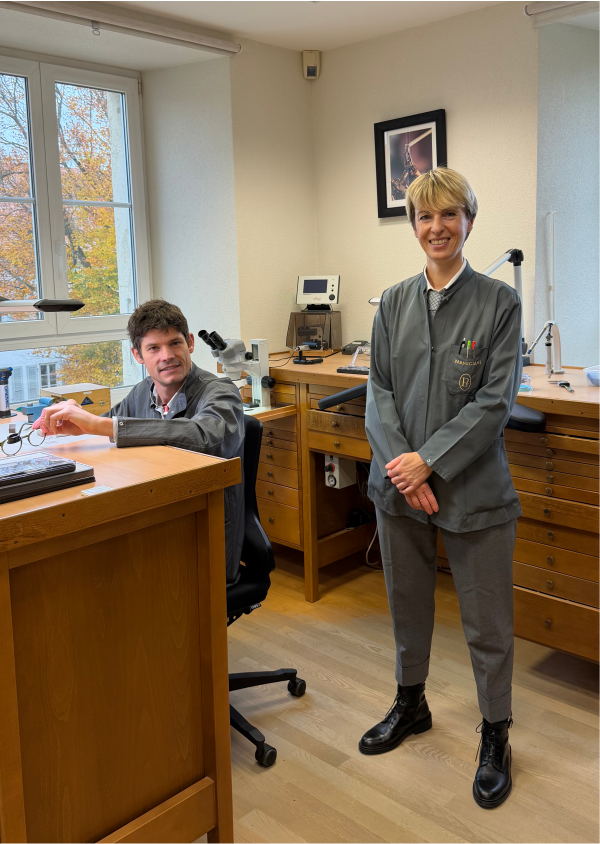
Not so for Michel Parmigiani and his two key figures in the restoration effort today, Christie Girel (left) and Francis Rossignol (right)—watchmakers with an almost unimaginable wealth of knowledge and a deep understanding of mechanics, history, and art history.
Watchmaker, forensic scientist, archaeologist, historian—all in one
It is not enough simply to understand how a mechanism works. To truly grasp it and breathe new life into it, much more must be taken into account:
What technologies did the creators of the work have at their disposal back then? What materials were known and used? How did people work at that time? What measurements, standards, or assumptions were incorporated into the design?
These considerations—along with extensive research into any surviving records—ultimately lead to a clearer picture.

Then the reconstruction can begin:
First, by carefully disassembling and precisely documenting the mechanism; then, by identifying defective parts or those that have already been improperly replaced. The movement is then digitally reconstructed to test its functionality—right down to the precise shape of individual gear teeth, which determine smooth operation and energy consumption.
The piece is the movement of a pocket watch, signed James McCabe No. 06338, made in the mid-18th century.
Functions: Hours, minutes, and small seconds
Features: Grained and gold-plated movement plate and bridges, barrel with chain and worm gear, English lever escapement, gold-ringed balance wheel, flat blued steel balance spring.
Based on these findings, as well as the watchmakers’ knowledge and experience, defective parts are reproduced or repaired—naturally, in the brand’s own workshops. Just as much attention is paid to using original materials and alloys as to faithfully restoring elements such as the chatons, right down to the individual adjustment of the thread pitch of even the smallest screw—it is not uncommon for every screw in an old movement to fit in only one specific place.


As part of the restoration process, the cases are of course also restored, including engravings, enamel work, and finishes.
Here is the XYZ pocket watch
Depending on the complexity and condition of the piece, such a restoration process can take anywhere from several months to a year before the piece or automaton is restored to its former glory and full functionality.
From the Past to the Present
After taking this look at Parmigiani’s current collection, you’ll see the watches in a whole new light: You can really sense the wealth of knowledge, experience, and craftsmanship that went into them—and yet they still look modern.
This is due to the design philosophy: a focus on the absolute essentials. Unnecessary elements are avoided, while subtle details are incorporated—such as the Grain d’Orge (barley grain guilloché) on the dial of the Tonda PF GMT Rattrapante Verzasca
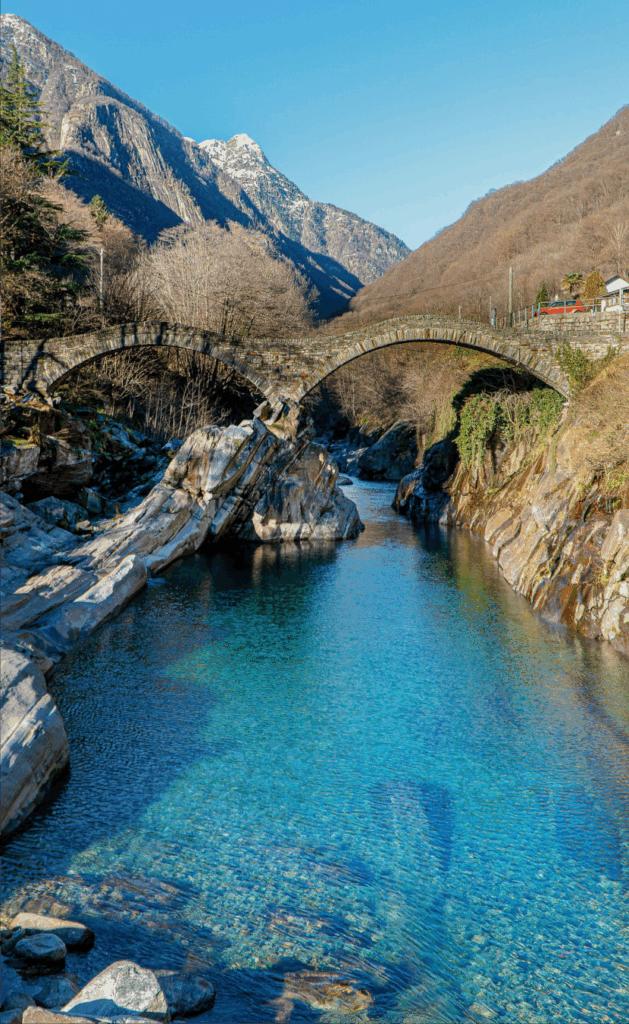
To this day, these roots continue to shape the essence of the brand: respect for the past, perfection in craftsmanship, and understated elegance.
Parmigiani Fleurier is also a fully integrated manufacture—every movement, every case, and every dial is produced within its own network (including Vaucher Manufacture, Atokalpa, and Les Artisans Boîtiers), which adds to its appeal.
Under CEO Guido Terreni, Parmigiani Fleurier has become a symbol of “quiet luxury”—watches for connoisseurs who appreciate subtle elegance, technical purity, and timeless aesthetics. The Tonda PF collection, in particular, stands today as a modern interpretation of Swiss fine watchmaking: discreet, precise, refined—and as mentioned, you can sense this the moment you step into the premises in Fleurier.
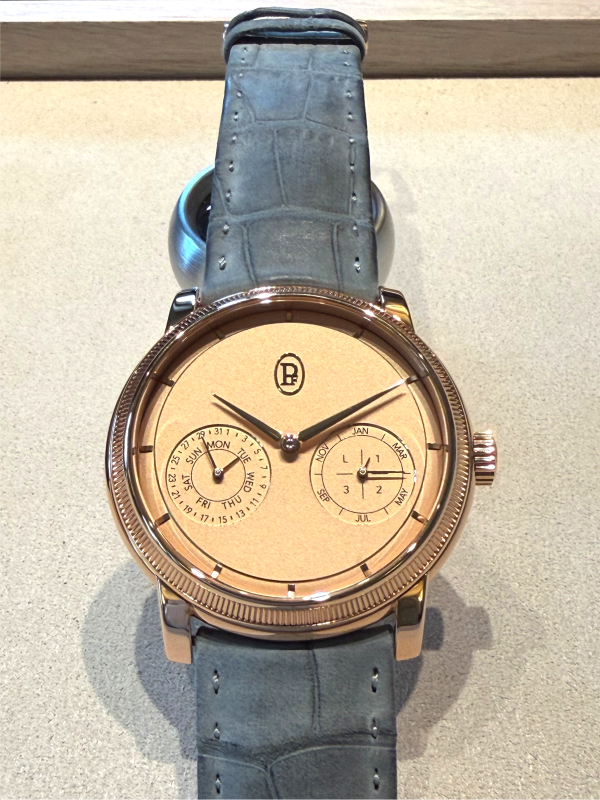
A Contemporary Masterpiece: The PF Toric Quantieme Perpetuel

A Masterpiece of Restoration:
LES ROSES CARRÉES GRAND FEU, LA ROSA ALBA MODEL
PFH991–2010003–300181 – LES ROSES CARRÉES GRAND FEU
Features:
Hours, minutes, minute repeater
Caliber
PF 355 – Hand-wound movement with a minute repeater flywheel
- Power reserve: 72 hours
- Frequency: 21,600 A/h (3 Hz)
- Stones: 35
- Components: 392
- Diameter: 30 mm
- Height: 6.55 mm
- Decoration: Côtes de Genève, openwork bridges, hand-chamfered edges, perlage
Housing
Polished 18-karat white gold PD210 with hand-engraved “La Rose Carrée” motif
- Diameter: 42 mm
- Height: 13.39 mm
- Crown: Ø 6.4 mm
- Bezel: natural citrine lens
- Glass: anti-reflective sapphire crystal (ARunic)
- Transparent back: Sapphire crystal
- Double case back: hand-engraved with “La Rose Carrée” and Grand Feu enamel
- Engravings: Serial number, “PARMIGIANI FLEURIER,” Swiss Made, Pièce unique
- Water resistance: 10 m
Dial
- Color: Yellow, 18-karat white gold
- Finish: hand-engraved and Grand Feu enamel
- Indexes: applied 18-karat gold appliqués, rhodium-plated
Pointer
- Hours/Minutes: skeletonized Delta hands made of rhodium-plated 18-karat gold
Bracelet
Alligator leather strap
- Clasp: 18-karat white gold pin clasp with hand-engraved “La Rose Carrée” motif
PFH992-2010001-200100 – LA ROSE CARRÉE WHITE GOLD POCKET WATCH

Features:
Hours, minutes, small seconds, Grande Sonnerie, minute repeater
Caliber
PF992 – Original movement by Louis-Elisée Piguet, manufactured ca. 1898–1904, individual number 5802, manual winding, hours, minutes, small seconds, Grande Sonnerie, minute repeater
- Power reserve: 32 hours
- Frequency: 18,000 A/h (2.5 Hz)
- Stones: 27
- Barrels: 2
- Number of components: 331, excluding pins
- Diameter: 43 mm / 19’’’
- Decoration: Bridges and main plate featuring hand-chamfered and hand-engraved La Rose Carrée motifs
Case
: Polished 18-karat white gold PD210, double-hunter pocket watch
- Diameter: 64 mm
- Height: 20 mm
- Crown: Ø 10 mm, set with a natural blue sapphire
- Lug: square, with blue Grand Feu enamel and a hand-engraved La Rose Carrée motif
- Glass: anti-reflective sapphire crystal, domed
- Lid: polished 18-karat white gold PD210, domed, hand-engraved, blue Grand Feu enamel
- Water resistance: none
Dial
Solid onyx
- Color: Black
- Finish: polished
- Appliques: square hour markers and PF logo in 18-karat white gold; the bezel of the small seconds sub-dial is also in 18-karat white gold
Pointer
- Hours/Minutes: skeletonized Delta hands in 18 Kt white gold
- Small seconds: Baton-style hand in 18-karat white gold with a square counterweight
Chain
Entirely handcrafted from 18-karat white gold
- 32 beveled and polished square links
- 2 engraved squares
- 1 engraved oval PF logo
- Arranged in progressive order
I would like to extend my special thanks to Christie, Francis, and Loris for their fascinating insights into the restoration process; to Emrecan Balyemez for taking the time to give me a tour of the building; and to Olivier Tomaselli for his insights into the current world of Patek Philippe.
Note:
More articles with additional details about the brand will follow.
Here you’ll find all articles published to date about the Parmigiani Fleurier brand