
Watch News Briefing: Three New Releases from the 2026 Geneva Watch Days
Geneva Watch Days 2026 featured not only major premieres but also a wide variety of answers to the question of what contemporary mechanical watches can look like. Micromilspec reimagines the classic field watch as a modern operational tool; MB&F and M.A.D. Editions, in collaboration with Vincent Calabrese, explore an extraordinary time display; and Louis Erard uses rye straw as the material for its dial.
Micromilspec Fieldmaster: A Field Watch After Three Years of Field Testing

Micromilspec unveiled the Fieldmaster during the Geneva Watch Days. The Norwegian brand does not view the 40-millimeter model as a nostalgic reissue of a historic military watch, but rather as a tool designed to meet today’s demands. The foundation for the watch was laid by a field test program involving 30 active-duty military personnel: From 2019 to 2022, they wore prototypes on duty and provided feedback on their experiences to the developers.
Based on this feedback, the brand developed, among other things, a display designed for quick reading and a titanium case. According to the brand, work environments with strong magnetic fields also played a role in this process. As a result, the development process took significantly longer than a typical product test—the three-year period was intended to reveal precisely those weaknesses that only become apparent during long-term use.
The Fieldmaster is available in two versions. A production run of 75 pieces is planned for each version in 2026. Pre-orders began on September 2, coinciding with the start of Geneva Watch Days. Micromilspec is thus focusing on small production runs without positioning the watch as a one-time limited edition.
MB&F; M.A.D.3 × Vincent Calabrese: The Wandering Hour Returns


The M.A.D.3 Vincent Calabrese from M.A.D.Editions, MB&F’s more accessible sister project, was among the most talked-about new releases at Geneva Watch Days. For this third chapter, Maximilian Büsser’s team is collaborating with one of the most influential independent watchmakers. Vincent Calabrese co-founded the AHCI with Svend Andersen in 1985, developed the architecture of the Golden Bridge for Corum, and has filed more than 40 patents throughout his career.
At the heart of the design is an idea that Calabrese first brought to life in his Baladin back in 1989. Because he disliked the abrupt change that occurs with a classic jumping hour mechanism, he had the hour indicator move across the dial. On the M.A.D.3, the hour numeral moves continuously along the minute track; a triangular hand assigns the minutes to it. This makes the transition from one hour to the next visible, rather than occurring in an instant.
M.A.D.Editions did not simply adopt the historic mechanism as-is. Since Calabrese’s original designs were heavily artisanal and difficult to reproduce in large quantities, the team redesigned the module. The automatic La Joux-Perret Caliber G111 serves as the basis. It operates at 28,800 vibrations per hour and offers a 55-hour power reserve.
The stainless steel case measures 40 millimeters in diameter, 12.7 millimeters in height, and 43.7 millimeters across the lugs. Sapphire crystals cover both sides of the case. Through the case back, a set of Calabrian proverbs can be read, which are revealed bit by bit as the rotor turns: It is easy to please others, but much harder to be proud of oneself.
The M.A.D.3 costs 2,900 Swiss francs plus tax. The pink version is reserved for members of the MB&F Tribe, as well as friends and partners. The blue version was offered through the lottery system typical of M.A.D.Editions; registration ran from September 1 to 7, 2026.
Louis Erard Marqueterie de Paille: Rye Straw as a Dial
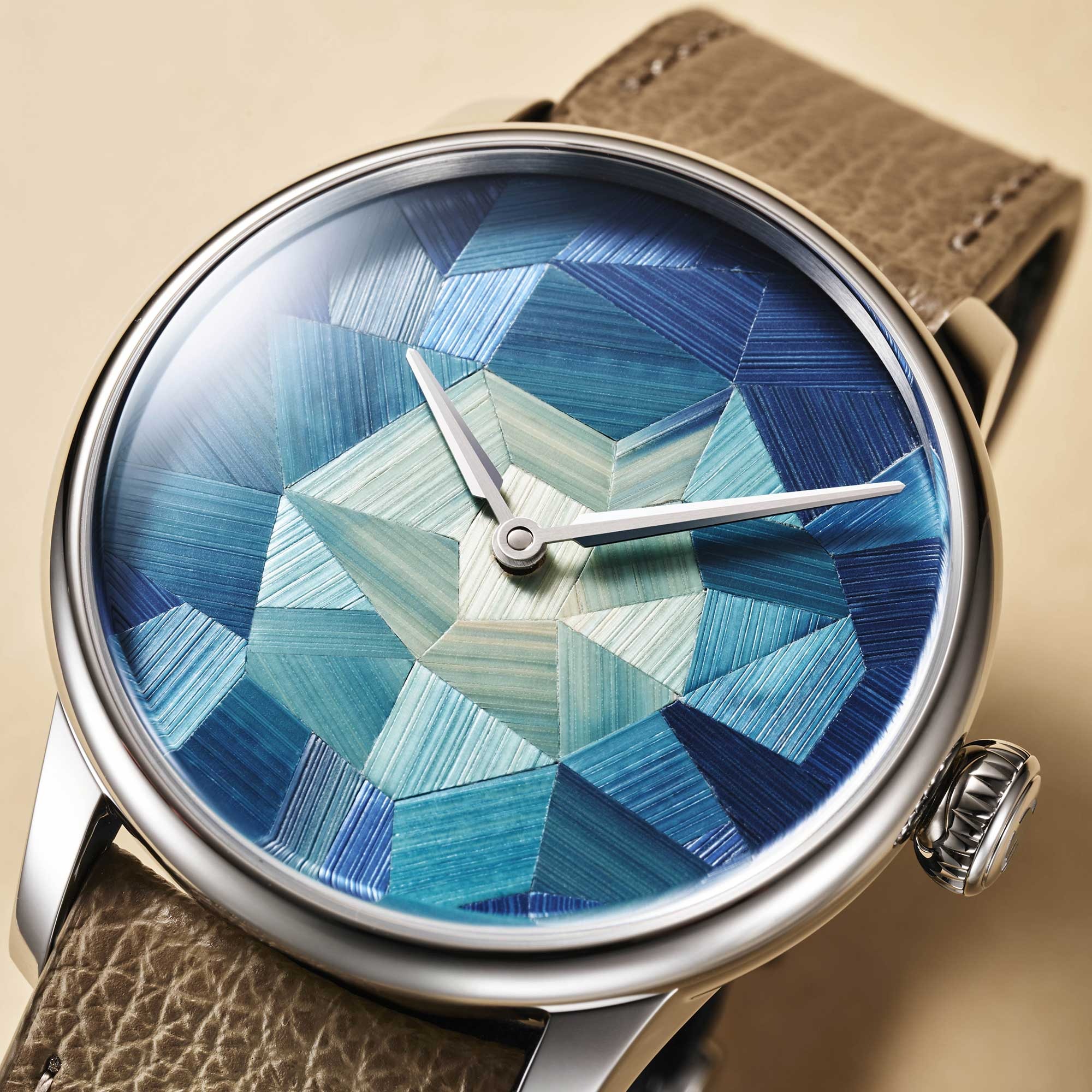

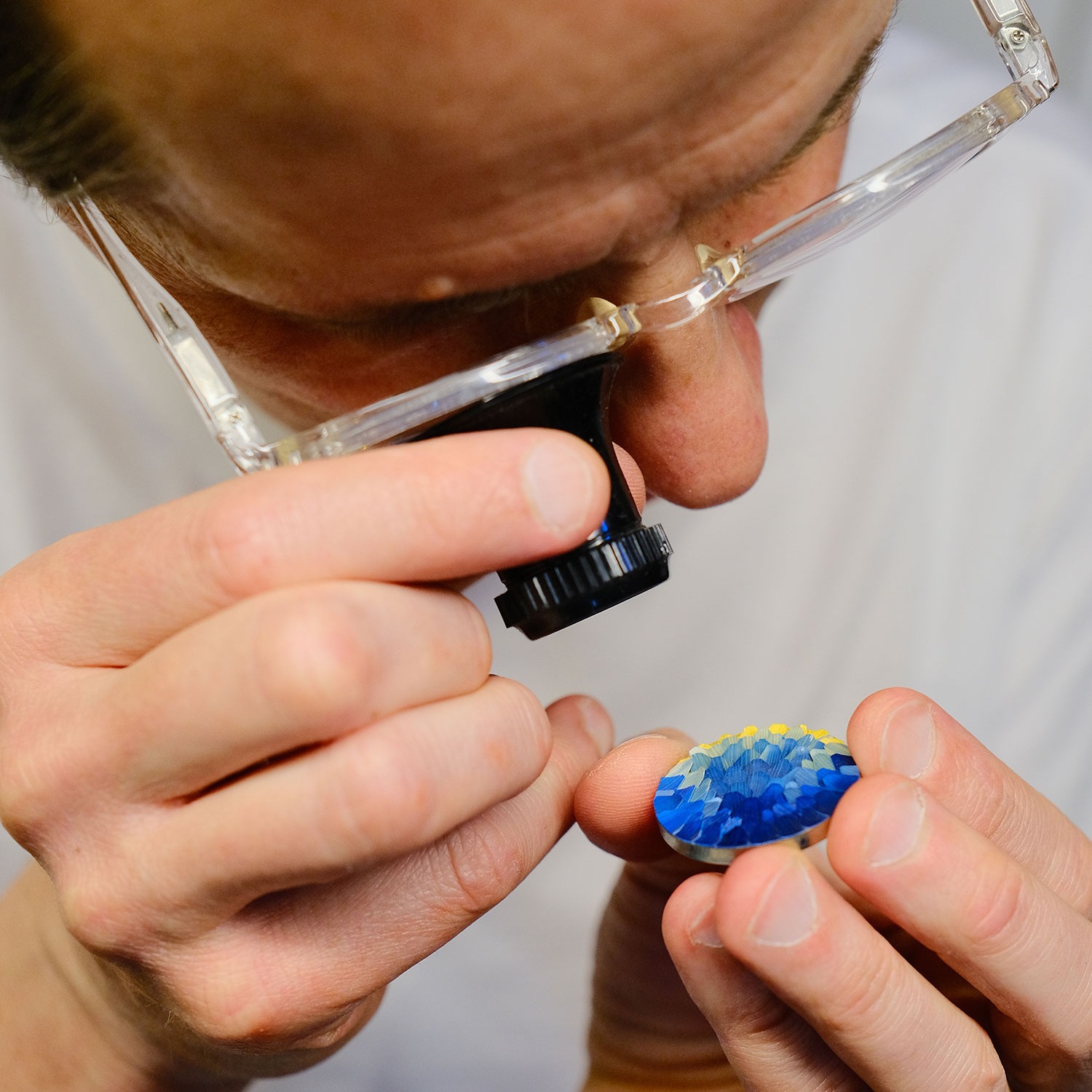
Louis Erard’s “Marqueterie de Paille” was also unveiled during the Geneva Watch Days 2026. At first glance, its blue dial appears to be an abstract, fragmented surface. In fact, it is made of rye straw, which Portuguese artist Bernardo d’Orey selects, splits, smooths, and then assembles by hand.
Each dial is composed of 28 individually crafted segments. Their shape, size, and grain direction determine how light is reflected. It takes about twelve hours of handwork spread over several days, with tolerances of less than one-tenth of a millimeter. Since the color and texture of the natural material vary, no two pieces are exactly alike.
The watch measures 39 millimeters and features a deliberately understated design so that the straw inlay takes center stage. Inside, it is powered by an automatic Sellita caliber SW261-1 in Elaboré quality with a power reserve of approximately 38 hours. The polished stainless steel case is water-resistant to 50 meters and is mounted on a beige calfskin strap.
The Louis Erard Marqueterie de Paille is limited to 25 pieces and costs 4,500 Swiss francs.
Three Ways to Push the Boundaries of Mechanical Watchmaking
As different as these three new models may be, they share more than just their appearance in Geneva. The Fieldmaster’s design is derived from real-world usage experiences. MB&F and M.A.D. Editions, in collaboration with Vincent Calabrese, have transformed a historic, unconventional idea into a reproducible design. Louis Erard, on the other hand, transforms an unassuming natural material through precise craftsmanship.
As such, these three watches exemplify the breadth of Geneva Watch Days 2026: functional instruments, more accessible independent watchmaking, and traditional crafts were not presented as separate categories, but rather came together to form a diverse picture of contemporary watchmaking.