
Watches & Wonders 2026: Precious Metals, Diamonds, and a Panther by Cartier
Cartier was founded in Paris in 1847 by Louis-François Cartier and quickly became the official jeweler to European royal families. From the very beginning, watchmaking played an important role alongside jewelry.
Cartier watches are characterized by clean geometric shapes, Roman numerals, blued hands, and the cabochon crown. The brand combines classic watchmaking craftsmanship with the aesthetics of a jeweler. Today, Cartier is part of the Swiss luxury group Richemont and, in addition to quartz and automatic watches, also manufactures its own in-house movements.
At Watches & Wonders 2026, Cartier will present a wide range of new releases—from jewel-like quartz watches and striking automatic models to exquisite Métiers d’Art creations featuring the iconic Cartier panther.
Clou de Paris and 100 diamonds for Cartier’s Baignoire
The “Baignoire,” which first appeared in 1958 and was officially named in 1973, is one of the brand’s iconic timepieces. Over the decades, it has been reinterpreted time and again, yet has always remained true to its original identity.
Its most distinctive feature is the oval case, which resembles a small bathtub—hence the name “Baignoire” (French for bathtub). The shape dates back to a design from 1912 and was refined in 1958 into the silhouette we know today.
In 2023, Cartier combined the oval case with a gold bangle for the first time. This further emphasized the watch’s jewelry-like character. Cartier itself poetically describes the concept as “an oval within an oval”: the small case rests on an oval-shaped bangle.

This year, the brand reinterprets the model with, among other things, a Clou de Paris motif—featured all over the dial, case, and bracelet. This architectural geometry, which has been part of Cartier’s stylistic repertoire since the 1920s, remains one of the Maison’s signature design elements to this day.
The bangle is crafted from solid gold to create a seamless transition to the dial. The proportions and lines have been carefully adjusted so that the relief pattern harmoniously follows the curved contours. The attention to detail is evident even in small elements such as the yellow gold clasp pushers, which blend seamlessly into the curve of the bracelet.

A second new interpretation of the “Baignoire” also emphasizes sparkling luxury: a total of 100 diamonds are set across the case, bracelet, and dial. The dial features a “snow setting”—a setting technique in which diamonds of varying sizes are arranged closely together to create a particularly vibrant play of light.
Sparkling curves for the Myst de Cartier
The sculptural “Myst de Cartier” epitomizes the fusion of jewelry artistry and watchmaking. “The new ‘Myst de Cartier’ is all about volume and movement. Its design draws inspiration from the jewelry watches created in the early 1930s under the direction of Jeanne Toussaint—pieces that are both sculptural and extravagant,” explains Pierre Rainero, Director of Image, Style, and Heritage at Cartier.

The “mystery” of this watch lies in its surprising design. It does away with a traditional clasp and resembles a trompe-l’œil bracelet. The individual elements are strung together like pearls, wrapping around the wrist like protective talismans.
One version combines black lacquered elements with diamonds and a geometric pavé dial. A second, even more exclusive interpretation features a bracelet entirely concealed beneath a carpet of diamonds.
Elegance and new studs for Cartier’s roadsters
The “Roadster” marks the return of one of Cartier’s most distinctive watches from the early 2000s. First introduced in 2002, the model stood out for its dynamic, automotive-inspired design.
The speedometer-style dial, the headlight-shaped date display, and the rivets and screws were deliberately designed to evoke the world of mechanical car bodies—a tribute to the Cartier brothers’ fascination with technology and progress.

The new “Roadster” has a more elegant look, yet remains true to the original design. Its sculptural lines have been reinterpreted with the help of over a hundred artisans—from designers and watchmakers to dial makers, polishers, and embossers.
The watch is available in gold, stainless steel, and a two-tone version, and comes in two sizes: medium and large. Four new rivets on the bezel emphasize the model’s distinctive character.
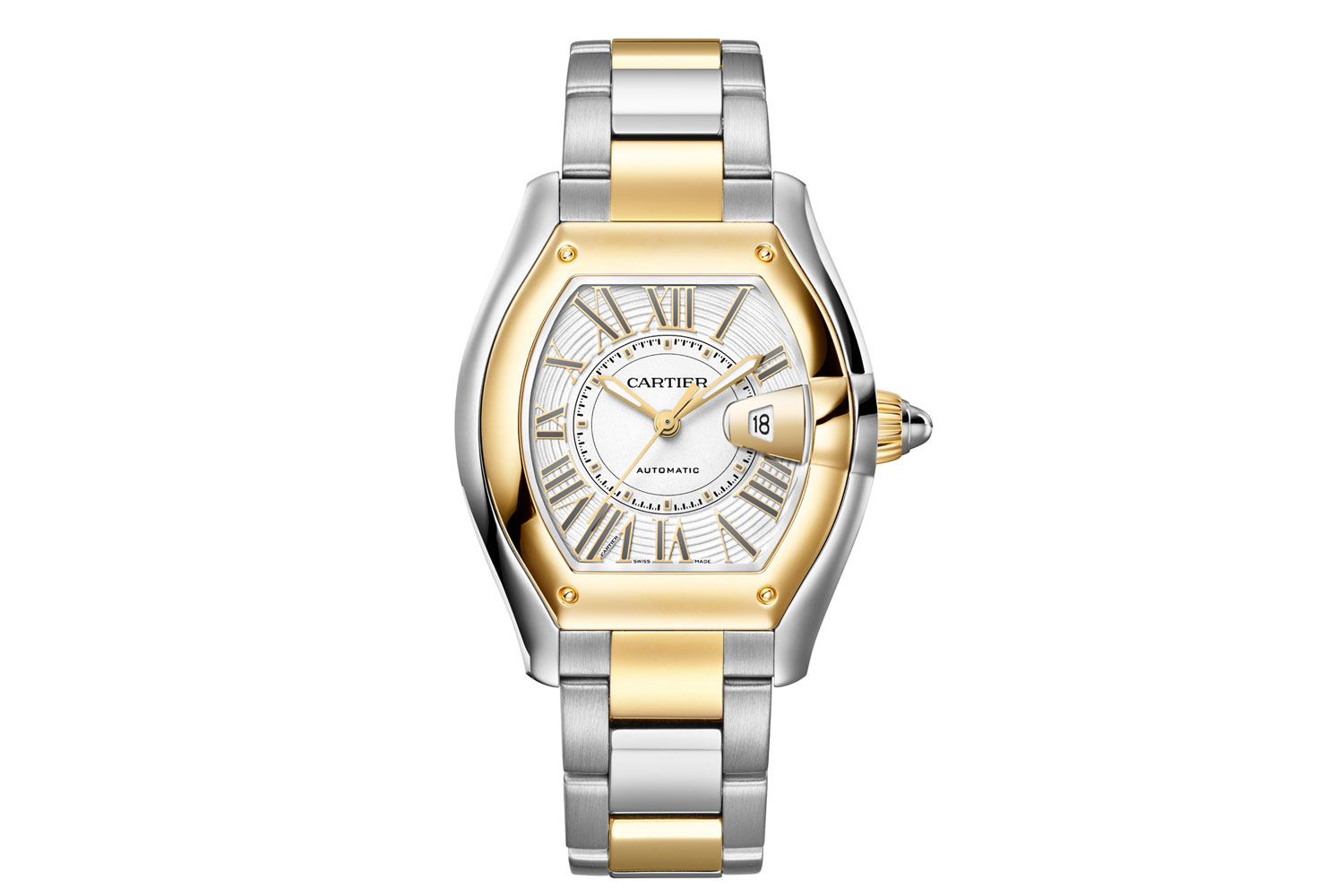
The dial has also been redesigned. The circular striped pattern, the railway-track minute scale, and the Roman numerals remain, but are given greater depth through an embossed appliqué effect and lacquered hour markers.
Inside, the larger models are powered by the 1847 MC automatic movement, while the mid-size models feature the 1899 MC.
Obsidian and 394 links for the Santos-Dumont by Cartier
With its flexible metal bracelet, hardstone dial, and in-house mechanical movement, this new “Santos-Dumont” reinterprets the elegant dandyism of Alberto Santos-Dumont. “The new ‘Santos-Dumont’ emphasizes its resemblance to the original design, and the bracelet, both fluid and precious, is an expression of contemporary elegance,” says Pierre Rainero.
The model incorporates the distinctive features of the pilot’s watch developed in 1904: Roman numerals, visible screws, a faceted crown, and the blue cabochon.
Particularly noteworthy is the dial made of gold-plated obsidian. This volcanic stone from Mexico owes its iridescent sheen to tiny air pockets. At just 0.3 millimeters thick, the material is extremely delicate and demands the utmost precision from the craftsmen.
The yellow gold bracelet consists of 15 rows with a total of 394 links. The links, which are just 1.15 millimeters wide, offer exceptional flexibility and are very comfortable to wear.
Panther and Enamel for Cartier’s Tortue
Since its introduction in 1912, the “Tortue” has been one of Cartier’s signature timepieces. Following its return as part of the “Cartier Privé” collection in 2024, the Maison is now presenting a new interpretation.
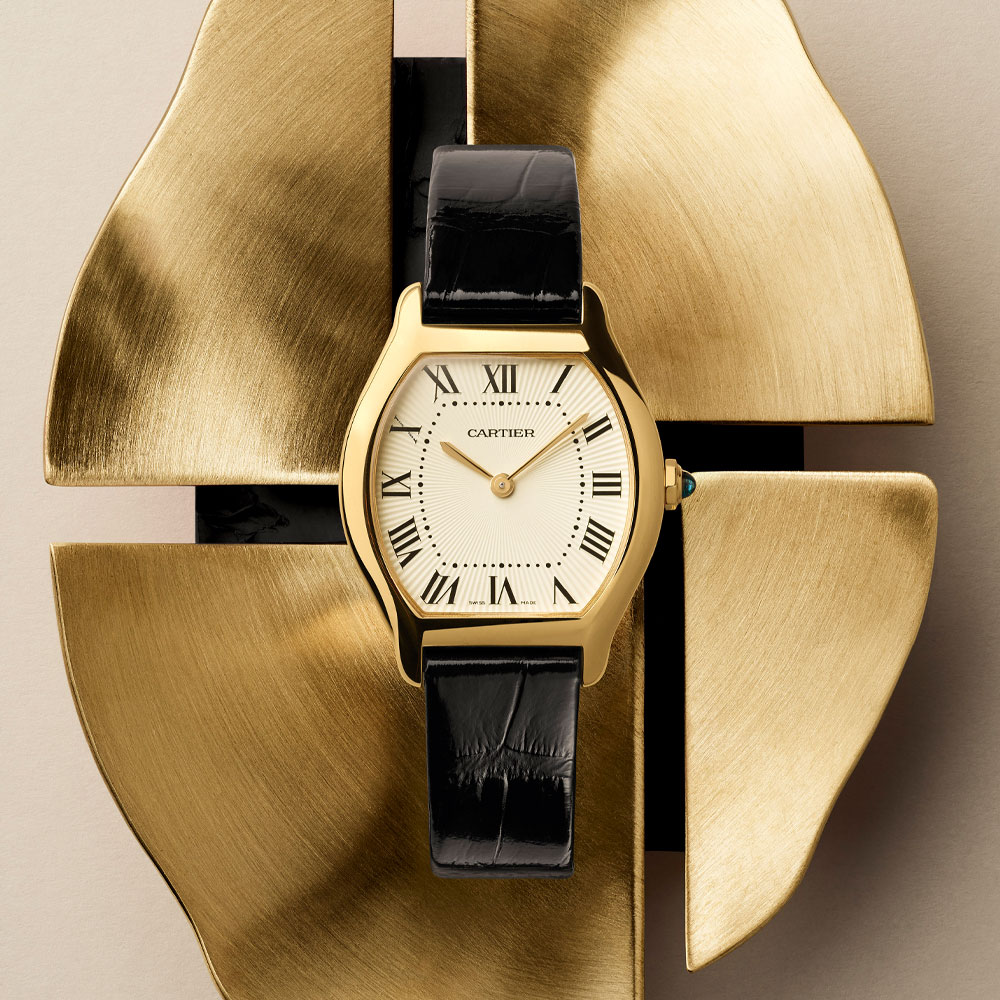
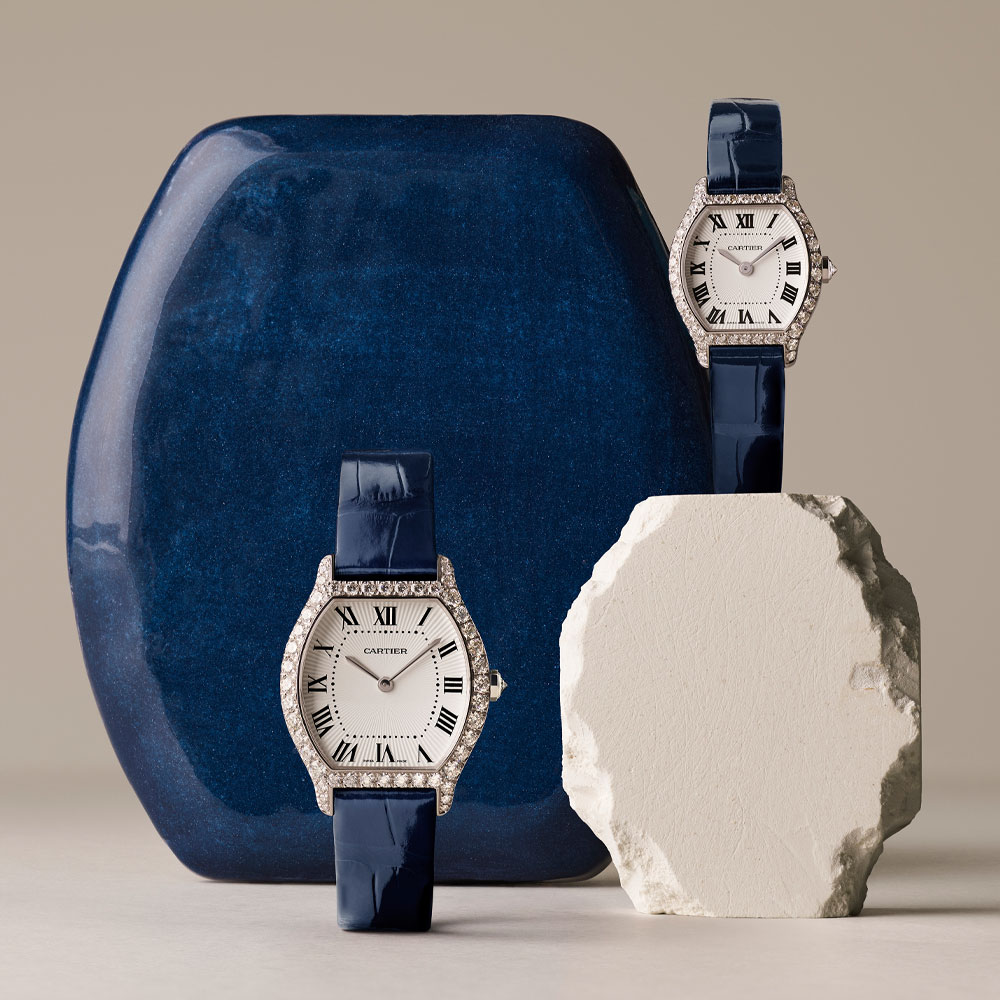
The proportions have been revised, the lines softened, and the edges more strongly rounded. The models are available in yellow gold, rose gold, white gold, and diamond-set versions. A highlight is the platinum version featuring 46 baguette diamonds on the bezel. Additional brilliant-cut diamonds adorn the winding crown and the buckle.
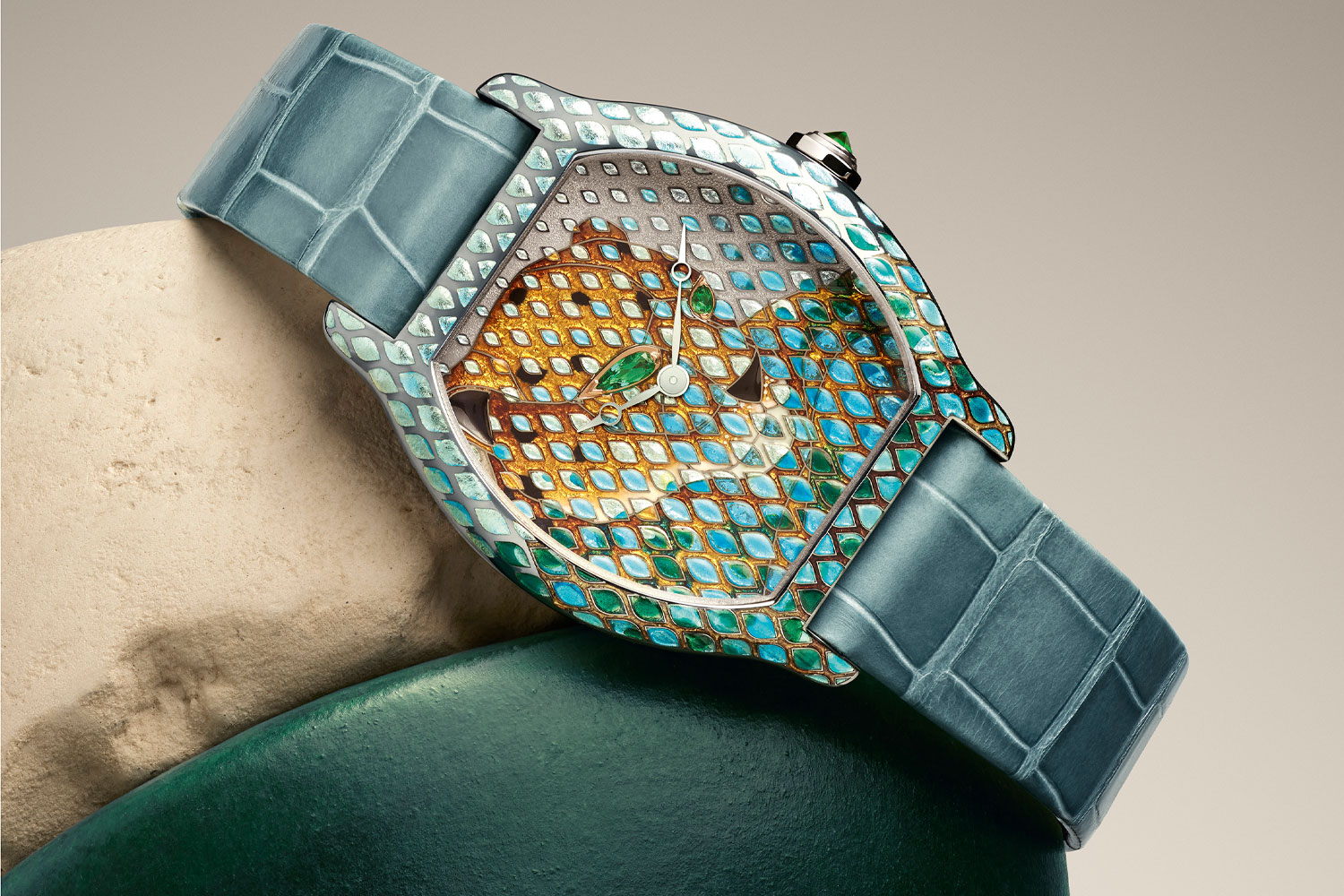
Particularly striking, however, is the “Tortue Panthère Métiers d’Art.” On the dial, the Cartier panther appears behind a curtain of rain. The scene was created using the champlevé enamel technique. To depict the raindrops, the artisans created tiny indentations that were filled with transparent enamel powder and gold or silver flakes. Over 15 shades and more than 36 firing processes were required to complete the motif. The enameling of the dial alone took around 80 hours.
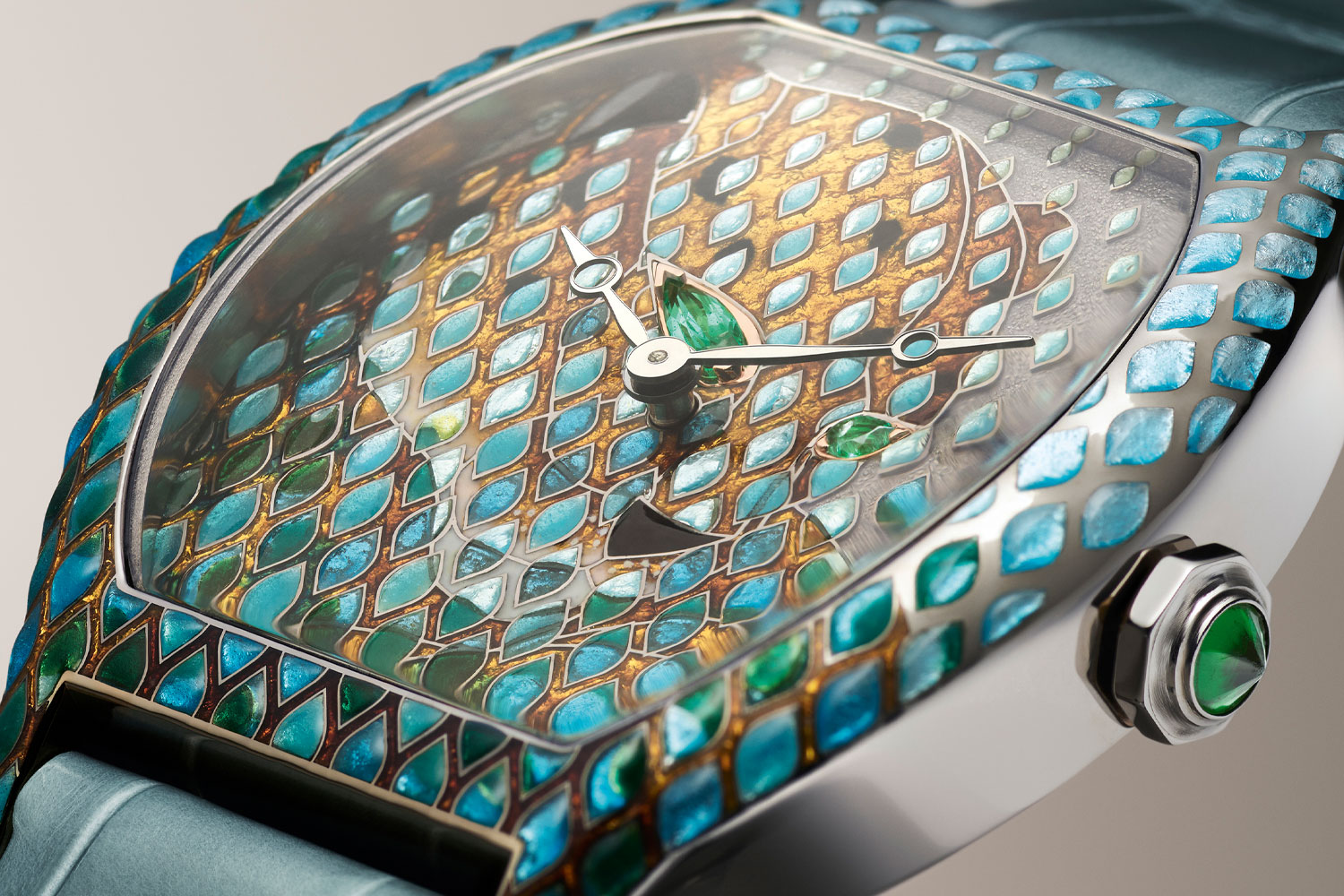
The watch is available in two limited editions, each limited to 100 pieces: one in white gold with emerald-green panther eyes, and one in yellow gold with tsavorite eyes.
“I am particularly proud of the enamel work, which extends from the dial to the middle section of the case and demonstrates exceptional craftsmanship,” says Karim Drici, Senior Vice President and COO at Cartier.